Oculum echo, p.7
Oculum Echo, page 7


“He’s from the gates, remember? Look at his belt,” Cranker whispers. We get a shock. Elias got a gun, the first we seen since we got here!
“That Grannie’s gun?” I say. Cranker nods. “Who else’s?”
That’s where we saw him, this Elias! He took some of our food, a goat, and this gun with five bullets off Grannie, when we first got to the City. At the gates. The same night we first met Bragg.
We sneak around the side of the group and push toward the field. It’s full of folks. Horses and people move around in the dark, lighting fires, setting up tents. Lots more people than before, hundreds now.
Cranker and me stop. Cranker nudges me and points.
In the middle of the field, six plow horses pull a giant truck. The people move back to make room for the horses and the truck.
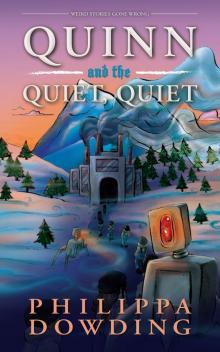
There’s a huge metal machine on the truck standing tall, pointing at the sky. It glows a shiny white with a red nose facing up at the stars. It got wings at the back.
Cranker and I stare.
“What is it?” I say. Cranker shakes his head.
“Jiggered if I know.”
Liam joins us and says, “Now what?”
Elias dances around the truck, people follow behind him. The metal machine on the truck is tall as a building. It looks like one of the bullets from Grannie’s gun. But it’s bigger, a lot bigger, like a house is bigger than a mouse.
Elias raises his hands, and everyone goes quiet.
Then he speaks. “People of the UnRuly! We used all our bombs securing the City, yes, and we went looking for more, yes! But I’ve returned with something much better!”
The people jump and shout for a bit, then he quiets them.
“I have brought you something greater than you can imagine! I have brought you a beautiful, powerful, one-of-a-kind rocket!” Elias raises his hands, and everyone cheers, throwing their arms in the air.
“What’s rocket?” Cranker says, quiet.
“It must be a weapon,” Liam whispers.
Elias climbs up onto the side of the truck.
“Our rocket makes us powerful! Our scouts tell us there is a green valley to the north, where we can grow food! There’s a castle called MedFell Hall! And our new rocket will win it for us! Tomorrow, we go north!”
Everyone cheers.
“Ain’t that where Grannie and the Littluns are headed?” Cranker says. My heart sinks. But it gets worse. Elias points behind the rocket. There’s a cage I didn’t notice. And inside the cage is a sorry-looking man covered in mud.
“And look what else I’ve brought you! A coward! He didn’t want to hunt for bombs with us. Say hello to the coward, everyone!” The crowd jeers and boos at the muddy man.
Cranker and me stare.
The man in the cage looks just like Grannie! He got her hair color, her blue eyes, the shape of her nose and lips.
“Say hello to Georgas-the-coward, everyone!” Elias shouts, and the crowd laughs.
Cranker swears down low. Grannie’s brother looks worse than an animal in that cage! His clothes are just rags, his hair and beard are all over. He don’t look like he’s had much in the way of food or water either.
“We got to help him,” I whisper. Cranker squints at the cage, and Liam shakes his head.
“That’s the worst thing I’ve ever seen,” Liam says.
We watch the truck, the rocket, the cheering crowd, the sad prisoner. What would Grannie do? She’d save him, but I don’t see how.
The sun is down, the fires all lit, but the world is upside down. It feels like a fevered person painted something ugly from a bad dream. The people all dance and reach up to touch the rocket like it’s alive.
The prisoner sits in the cage. A man holds a lantern up to the rocket, and Georgas turns his muddy face away, like the light hurts him. Or maybe he’s shamed.
“He’s alive, at least,” Cranker whispers.
But the lantern light catches something else. There’s two words on the rocket plain as day.
One word is in sloppy red paint with handprints around it: UNRULY.
The other word is just under the red paint. It’s been there a long time, cut into the metal shell in black letters.
It’s old, but I can read it fine.
And the word on the rocket is E.C.H.O.
Echo1
I am made of dust.
I am slow, creaking, covered in grit, endlessly walking.
So Guide leads me to an outpost hidden in a cave. It is like the outpost that I came from on the day I awoke. This outpost opens with the touch of my hand. I step inside, and Guide tells me how to bathe in a spray of oil.
Peregrine lands on the roof of the outpost and gets her own spray of oil.
Guide says, These outposts are hidden everywhere. They do come in handy. You’re not invincible. This one is for cleaning and repairs. There are other outposts that will top up your Sleep Cloud and other supplies.
I have to agree. The oil bath is very pleasant. It is good to feel the dust fall from my titanium shell.
We leave the outpost in the cave after Peregrine and I are oiled and shining.
It is nighttime when Peregrine shows me a video of what is ahead.
Echo1, P1 has sent you video. Do you accept?
Yes, I accept.
A city. A huge city, largely destroyed but with a few people in it. This surprises me; I have not seen any living thing outside the domes but the pigs so far. But Peregrine’s video shows people here and there in the rubble.
I stand at the edge of this city. It is the biggest city I have seen.
I hide in the dark and listen.
There are voices here, heartbeats, the living. Not many but some.
There are animals too. I hear them, shuffling in the dark places where they live. Small, furred creatures with long tails. And larger beasts too. Not pigs.
Guide says, You hear rats and horses.
There are adults here, and children too, Guide. My sensors can feel them, and I hear them.
Guide says, You should keep away from them if you can. No sense sending everyone into a panic. They’ve been through enough.
I stand at the edge of this wasteland, and I call: Echo1! Echo1! Echo1!
Ping! Oculum4!
The fourth dome answers me from deep inside this ruined city. It is close so I set out over the fallen buildings toward it. I tromp over mountains of garbage, and Peregrine flies high above.
The sun rises as I stomp farther into the city, over more and more rubble. Countless millions must have lived here. So clever, so beautiful they must have been.
All gone.
The city has recently taken a beating from weapons.
Guide says, Someone has bombed this place.
That much is clear, Guide. But who would bomb what is already destroyed?
There is no answer to this, so I keep walking. I crush weathered metal and fallen brick under my feet for a full day as I journey farther into the collapsed city. Peregrine sends me video to help me avoid the few people who wander this world with me.
Guide is right. I do not want to terrify anyone. They have never seen anything like me.
Then I hear a mysterious sound.
Guide, what is that? I ask.
Guide answers, It sounds like someone is crying.
I listen. Such a mournful, sad sound.
Echo1, P1 has sent you video. Do you accept?
Yes, I accept.
Then I see video of a tiny person. I watch the video, over and over.
Finally I say, Guide, is that a child?
Guide answers, Welcome to humanity, Echo1.
My first child! At least, my first child outside the domes. My first child in this ruined world.
The child stands on the other side of a house, which has not fallen over yet. There is a person beside her on the ground. I think this person is what makes her cry. It is a bigger person. Lying still and staring at the sky. Sick. Weak. A very fluttery heartbeat.
I watch the video carefully a few more times.
What should I do, Guide? I ask.
Guide says, That’s up to you, Echo1.
You could be more helpful, you know, I say. But Guide does not answer.
I peek over the top of the house and see the little child. She is tiny.
Fragile.
Black hair sticks up from her head. Her dark eyes are full of tears. Her clothes are torn, her feet are bare, and she is very thin. She coughs.
So, she is sick then? I ask Guide.
Possibly, probably, Guide says.
I watch her for a few moments. But a child is so small! Is this what I came so far to find? Humanity sick, tiny, and in tatters?
I look up at Peregrine, who swoops overhead, then heads off deeper into the city.
Guide, can I help this child? This adult? I ask.
Guide answers, You can help with their sickness, if that’s the help you mean. Maybe this is not a bad time to try your Fingertip Darts.
I stay hidden behind the house, but I point at the child. I think “Fingertip Darts.” My fingertip opens, and two tiny darts shoot out.
Pock! Pock!
One dart strikes the child, and she touches her arm with surprise.
The second dart strikes the sick person on the ground. And a few moments later that person — a woman — opens her eyes. Then she opens her mouth. She moans softly, then sits up and gathers the child to her.
Guide says, They’ll be weak for a while, but they’ll recover.
I stay perfectly still, and they do not see me.
Guide, who are they? I ask.
Guide says, A mother and her child, I’d say.
Mother and child. I watch, and soon they move slowly away, across the rubble. The child leads the mother, and there is no more crying.
Guide, they were sick with fever, and now they will be well, I say.
Guide says, Yes, the vaccine and serum combination works very well. It was just too late to do much good at the time. Perhaps these people will be the ones it really helps.
What else do they need? Food? Shelter? Education? I wonder but do not say to Guide. I have asked enough questions, and the answers are all unfulfilling.
Echo1! Echo1! Echo1! I call.
Ping! Oculum4!
The answer comes, strong and close.
I push on through the ruined city toward Oculum4, the last dome on this continent.
With the decay and the recent bombing, I cannot imagine what I will find.
If there is anything left at all.
Miranda1
For the first time in our endless walk, the highway splits.
We must make a choice: which way to turn.
Grannie and the few adults talk, and it is decided we keep left. To the right, far off in the distance, is the largest city we have seen. There are tall buildings, too many to count, lifting high above the ground. “Skyscrapers,” Grannie calls them.
So we walk at the distant edge of this city, on the left hand of the highway, which curves away. The right hand of the highway turns toward the sky.
It is what Grannie calls a “bridge.”
Astonishing. This bridge shoots upward in a great arch above our heads, made of metal and something called concrete. As we walk slowly under the bridge, the children of Oculum stop and look up.
William3 says to me with wonder, “Here is something as mighty as our lost dome.”
“It is mighty, but what was it for?”
We look upward, crane our necks, try to imagine a use for this bridge, but can think of none. The bridge soars above us in a graceful curve, then turns in the sky toward the far-off city. We are all in wonder, and a little fearful. What were the buildings and the bridge for, lifting into the sky? How did the Olden Begones build them? Why did they build them?
I ask Grannie. “What is the bridge for?”
“For travel,” she says, then gets up to talk to a City woman. We are resting under the bridge, since it throws a wide shade. I want to know more, but Grannie doesn’t want to talk about the bridge, the city, the travel. I think about that bridge for hours after we leave it behind, though. Just another wonder from the people who lived here long ago.
We stop at the end of the day near a small town outside the city.
“The outskirts,” Grannie says.
We light fires, and as usual the pigs stand in the distance, watching us. The City folk shoot rocks at them and throw handmade spears, so the pigs never come too close. The children of Oculum have been getting better with our slingshots. Some of our shooters have almost hit the pigs. Not quite, but almost.
During our mealtime, a young City girl runs to beg us for help. “It’s my grandfather,” she says, and we follow her through the camp. When we get to their fire, the sick man stares at the sky. Grannie runs her careful hands over the man, then sits back on her heels.
“Is it the fever?” his wife asks. Grannie shakes her head.
“There’s nothing you can do?” The man’s wife can tell something is very bad by Grannie’s face, as can I.
“I think he’s done, I’m sorry,” Grannie says quietly. “Make him comfortable. Stay with him.” Then she goes to smoke her pipe and wait. She’s right. The man dies a little while later.
This small town has a ritual burying place, with many upright stones in the field. Grannie and a few of the older people dig a hole in the brown, weedy grass, then they place the dead man in the hole and cover him up with dirt. They all say a few kind words over the dirt, then we leave him there for all time.
“Why did the man die, Grannie?” I ask.
She sighs and shakes her head. “People die, girl.”
As the sun lowers and the sad family walks back to camp, Grannie asks me to walk with her toward a tall, thin building in the distance. “The others found something you should see,” she says.
The night is warm, and the sky is orange, pink, calm.
We walk on an overgrown road between tall bushes, away from the burying place. Creatures called “insects” fly around our heads, the first we have seen. We walk together, but I know by Grannie’s silence that something important is ahead.
The road stops in front of the tall, thin building.
There are three heavy, stone steps leading to the closed front door, which is unbroken. This is rare. It’s one of the few doors I’ve seen left standing.
There are windows by the front door, also unbroken. Also rare. This is the first glass I have seen in one piece since we left Grannie’s brother’s farm.
This tall building is untouched.
“It looks very old Grannie, yet it still stands,” I say.
“Some things was built to last, that’s true,” she says.
“Look up,” she says, and I stand back to crane my neck. “What do you see?”
There is a shape on the top of this building, pointing to the stars.
“I see a marker of some kind, perhaps made of metal. Is it the lowercase letter ‘t’?”
Grannie squints at me and says nothing. She goes up the stone steps and pushes the heavy door, which creaks open slowly.
I follow her up the stairs, then stop.
I let out a soft gasp.
“Oh!”
There are people on the wooden benches.
“They … they are dead, Grannie,” I say softly. She nods.
“Long dead, girl.”
I stand at the door; I do not want to go any farther. These dead people are withered, dried skin and bones held together by cloth coats and falling hats, cracked boots on the floor.
“These are your people, Miranda1,” Grannie says. She uses my full name, another rarity. “Look upon them. They’s far past caring, and they cannot hurt you,” she adds gently.
I swallow.
Am I afraid of them? No one died in Oculum. It suddenly hits me: except for the man tonight, I’ve never looked upon the death of someone made as I am.
I take a deep breath and call my bravest self.
I walk to the first few benches and look from side to side. I walk farther toward the front of the building, forcing myself not to hurry, past each bench. I look at every one of the dead, propped against one another, or lying on the bench, or fallen to the stone floor.
When I’m done, I hold my head high. I turn and walk back to Grannie by the door.
My legs shake and I cannot help it. My eyes fill with tears.
“Children, adults, all together, Grannie,” I whisper.
For that is what I have seen.
Large people hold smaller people, all sitting or slumped, leaning, some lying on the ground. All dead, all together.
Grannie moves to stand beside me. “That was gracefully done. You are brave and strong, Miranda. Many would not have looked.”
I head to the door and swing it open, glad to be back outside. The sun is low in the west, and I take a huge gulp of air. My ears suddenly fill with the sound of insects in the bushes, wind in the trees, and the sharp scent of smoke reminds me that friends are in the camp not far away.
Children that we have led to this spot.
Children that I will continue to lead until we find a home.
I fall to one knee, put my hand on the soil, filled with gratitude that I am alive. I look up at the gathering dusk, the color of the sky, the stars that begin to show themselves. Perhaps this was Grannie’s point in bringing me here. To help me understand what we have lost, who we were, what I was or would have been had I lived and grown in the time that I was born.
Grannie puts her hand on my shoulder, and I turn to her.
“What is this place, Grannie?”
“A place where people went when they was afraid or lost. They was mostly afraid and lost at the end of things.”
“Did it help them? To come here?” I ask. Grannie shrugs.
“Only they know that.”