Oculum echo, p.10
Oculum Echo, page 10
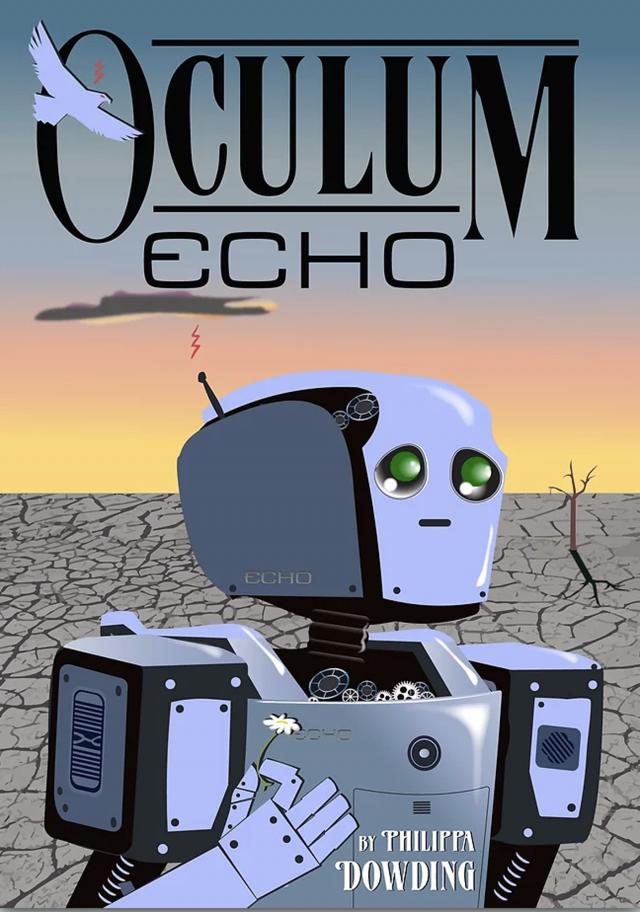


We must stop them, Guide, I say.
Guide says, There are too many of them. Just stay hidden. They could overpower you, even destroy you. You can’t stop these people. Not here, anyway.
But they have stolen a rocket, I say. Then add, I have the Sleep Cloud.
Guide says, Your Sleep Cloud reserves are low after the pigs. We need to find a supply outpost to make more. You do have a laser, though.
I hesitate. No, Guide. No laser.
But I argue with myself. The people have stolen a dangerous weapon. Guide has said the rocket is powerful. It will destroy whatever they point it at.
They do not know how powerful it is, Guide, I say.
Guide says, Yes, Echo1, very likely they have no idea.
The rocket on the truck travels past the rock. It is taller than I am, white with a red nose pointing at the sky. Then I see red paint on the side of the rocket: UNRULY.
Beneath the paint, I see another word: E.C.H.O.
Guide, why is my name on the rocket?
Guide hesitates then says, Do we have to do this now, Echo1?
Yes, Guide, I think my name on a rocket is something we should probably discuss. Right now.
Guide sighs, Very well, but you won’t like it. E.C.H.O. is an acronym. The rocket was made long ago by E.C.H.O. Technology Systems, the same Makers as you, Echo1.
And my titanium-and-diamond heart cries out, No! No! No!
My name cannot be on a weapon of destruction! I will not allow it! I am here to find the First One, to ask The Question. To watch and report. To heal and help!
But not to destroy!
If I could cry tears of despair, I would be crying now. And I feel rage, I think. Rage that my Makers made me and also made this terrible weapon. Rage that the people have stolen this weapon with my name on it.
I must do something. I peek from my hiding spot behind the rock and look at the rocket on the truck.
Guide, could I disarm the rocket? Stop it somehow?
Guide says, Well, you might be able to disarm it if you had time. It’s a tricky business, disarming a delayed action rocket bomb, especially one this old. You can’t do it in a hurry. And …
Guide hesitates.
Yes? What is it, Guide?
Guide says, Even if you disarm the rocket, Echo1, the explosive material in the delayed action detonator will blow up anyway. The detonator must be shielded, or it will cause terrible destruction.
Shielded how? I say. Sometimes I wish Guide would just get to the point.
Guide pauses … Only E.C.H.O. technology is powerful enough to shield the blast. In a special blast barrier or sealed locker. Do you understand?
I consider this. I nod slowly. I do understand, Guide, I think. I say this quietly.
Suddenly, a tall man who drives the rocket shouts, “FASTER!” He uses a cruel whip to lash the horses. The animals are afraid and snort and toss their heads.
And now I am filled with rage!
I want to storm the people, to run among them. I want to break their stolen, terrible rocket. Free their servant horses. Stop their violence, as I stopped the pigs. Perhaps my Finger Laser is the only way …
… and maybe I would have used the laser.
But I will never know, because Peregrine flies overhead.
“Look at that falcon,” one small person shouts.
“It’s huge!” another person shouts.
The tall man gets down from the wagon with the rocket. He points an object in his hand at Peregrine.
A gun, Guide says. If he has bullets for it, it can damage your video drone falcon. Possibly destroy her.
Peregrine hangs in the sky above the people. The man with the gun tracks her. I must act.
I leap out of my hiding spot.
There are many surprised, upturned faces, sudden shouts and screams, much pointing. Many mouths open, and the small people do look very frightened. This pleases me, although it should not.
I run across the muddy field. The ground shakes beneath me.
I shout: Echo1! Echo1! Echo1!
All the people clamp hands over their ears. Some fall to their knees in the mud.
Echo1! Echo1! Echo1! I shriek again. I am quite loud when I want to be.
For a moment, all the people stand still as I run past them. The rain pelts down onto their dirt-stained faces, across their ragged backs, over their poor animals. They watch me, their attention away from Peregrine. The tall man with the gun has forgotten that he holds a weapon and stares at me, his mouth open. I run past him.
“Fly Peregrine!” I shout out loud.
Then I head toward the trees.
Mud splashes up from my huge boots. I run past the rocket, which wobbles dangerously.
Do not fall over! I beg it silently. It would likely explode. I wish I could disarm it now, but I cannot stop.
Not with the gun so close. Not with Peregrine in danger.
The horses scream at the sight of me; they have never seen anything like me. I want to tell them I am sorry I have frightened them. There are more human screams too.
Some people are too terrified to move, or they hide their faces as I run past. A few of the braver ones throw sticks at me and heavy stones. The tall man finally raises his weapon at me but does not fire.
Bullets are scarce, and you’re probably already out of range, Guide says. He might not shoot you, but run faster if you can.
Peregrine has flown out of sight. She is saved.
I thunder past all the people. I try not to hurt anyone, although many of them fall over as I storm past. I do a quick search; there is fever and illness here. Rapid heartbeats.
Some of them are sick, Guide.
You can’t help them, Guide says. They’ll shoot you. Just run.
So I run past the small people, toward the distant trees.
The last person I see is a boy driving a wagon pulled by a not-quite-horse. There is a dark “M” in a circle on the side of the wagon. There are sick people inside.
As I run past, I look at this boy’s face.
He stares at me without fear. There are tears in his eyes, and he waves at me with both arms. He is smiling. Smiling and crying at the same time. I raise my hand in a gesture of hello, but I cannot stop.
Maybe he’s just weird, Guide suggests as we storm by him.
No, Guide. I think he knows me somehow.
Perhaps tears of joy, then, Guide suggests.
You will have to explain. What are tears of joy? I say.
Then Guide explains tears of joy while I run past the crying, happy, strange, and beautiful boy into the forest.
Miranda1
We walk. I have lost count of the days.
Each day, we rise with the sun, eat, and keep moving north on the highway until we stop at dusk. And each night, the pigs come and watch from a distance. But we are getting better with our slingshots. Now and then, a pig gets a stone on the flank, off the snout, between the eyes. This makes me strangely happy, although it shouldn’t.
I don’t like violence.
This morning, we walked through a kind of forest. It’s not a forest of trees but a forest of huge metal poles pointing into the sky. The poles have three long, slender arms like limbs. Some of the long arms have fallen into the grass far below, but many are still attached at the top of the poles.
“What are they?” William3 asks me, toeing one of the fallen arms. It lies in the dirt, long, white, and slender.
“I can’t imagine,” I say, bending my head back to look straight up at one of the trees.
“It’s for catching the wind,” one of the boys from the City tells us.
“How do you know?” William3 asks, doubtful.
“My ma’s ma told stories about Olden Begones machines like this that caught the wind. They called it a ‘wind farm.’”
“What was it for? This catching the wind?” I ask, but the boy doesn’t know.
The sun is high overhead and the day is hot, so we rest at the bottom of the wind farm trees. Children lie in the brown grass, in the slender shade of this strange Olden Begones forest.
We have all joined together well, the children from Oculum and from the City. The City born are capable, helpful, smart, and this is their world. They were not raised in a dome, and they can do many things that we cannot. They teach us to milk the goats, collect the eggs from the hens. They show us how to coat ourselves in mud so we don’t get burned by the sun, how to find clean water in the bubbling stream, how to feed and brush the horses, and so on.
They ask us about Oculum.
“What’s a dome?”
“What’s a peach?”
“Can you teach us to read and write?”
“You each had your own house?”
“What are all them seeds and saplings for?”
“Your mothers were made of metal?”
“Why do some of you wear them colored armbands with numbers?”
And so on. I can’t answer the last question, although I hear it often. Because we are used to them and they name us are the only reasons. Many of us from Oculum still wear our armbands. But some have taken them off and tossed them at the side of the road, where they catch on the dried grass and blow in the breeze. I leave them. A reminder and a small, colorful mystery for whoever walks here after us.
What’s S13? Or W42? Or M17? they might wonder.
And who would tell them?
I will never remove my purple “M1” armband, though. I am the oldest number one left among us, now that William1 is gone. It is my duty to wear my armband, to lead, to be the oldest, the first child of Oculum.
Yesterday, we passed another strange leftover from the Olden Begones.
There was a small town and a towering ball high above it. The ball was on a platform, held up high. Everything about it looked heavy and dangerous. There were words painted on the side of the huge ball: Welcome to Stockton. As we walked around this large, elevated ball, we found a painted word on the other side: Water.
Water in the sky?
Some of the children threw rocks at the metal ball.
Ding!
“It’s hollow!” one boy shouted. Then many rocks hit the metal ball, and the platform started to shake and wobble.
“Stop!” I yelled. “It’s old. The metal could break. It could fall over. Leave it. Time to go.”
Some of the children seemed reluctant to leave this welcoming, airborne water ball of Stockton. We walked away and left them. But they caught up to us after a while. No one wants to be left behind.
Another day, we had a strange visit from a creature in the sky.
“Look at that huge falcon!” a girl from the City cried out.
“Ain’t they almost extinct?” a small boy says.
We all looked up. A falcon? I’d never seen such a thing, but it was beautiful. On wide, straight wings it floated across the sky, and we all stopped to watch. We looked up, pointed or waved at it.
Suddenly, the enormous falcon glided in a great swooping arc and circled close above us. There were cries of wonder from the City children.
“It’s coming to see us!” a boy shouted. And the great bird dropped low overhead and wheeled over us once, twice, three times. Then it arced upward and flew off, until it was a speck in the distance.
We went back to our endless walking.
But I think of the falcon often as I walk. I think of its grace and power.
For a creature of the air, it creaked and groaned like an old wagon wheel. There was something that tugged me as the falcon flew overhead, making such a strange sound. I recognized that creaky sound.
But that was foolish, I decided.
I’ve never seen a falcon before, how could it be somehow familiar? Perhaps this is the way with ancient birds of prey? Loud and whirring in flight?
There is so much about this world I do not know.
I put the falcon out of my mind.
Every day, I carry Lisle in the blue sling. She sleeps. Or if she is awake, I talk to her, like Grannie and Mannfred do. I say things like “Lisle, do you think we will ever get anywhere?” and “Where are we now, Lisle? As lost as before?” She smiles or gums her fingers. At night, I feed her goat milk and small pieces of whatever I am eating.
We somehow just keep going. No one has been lost. No one has been hurt or fallen ill.
Then tonight, we have the greatest fight of our lives. As we knew we would.
I am shaken awake. Jake47 leans over me. He is a sentry and a good one, since he seems to need very little sleep.
“Miranda1! Miranda1, wake up! The pigs are gathering! More pigs than ever!”
Out in the field, there are dozens of pigs, more than we’ve ever seen. Our torches light up their small eyes in the darkness. Our shooters run up, children with their slingshots. They fire rock after rock across the river, but the pigs don’t run off.
“They’re out of range,” Henry23 says. “We can’t reach them.”
“Will they attack?” Samantha4 asks. She’s one of our best shots with the sling.
I think about it. “They attacked a man in the City camp and killed a goat. They must realize the adults have all gone, so we’re vulnerable. That’s likely why they’re gathering. I think they will attack us too.”
Then we all discuss what to do.
“We should make sure the goats and horses are safe,” a boy from the City says.
“We should sleep at the base of that hill, on the other side of the river,” Miranda18 says.
“The youngest should hide in the wagons, with the goats,” someone else says.
“We’ll get thick clubs and rocks,” says another.
We’re good at making a plan, all of us together. Everybody gets to work.
Soon our youngest are safe with the goats in the wagons, against the hill on the other side of the shallow river. I hand Lisle to one of the girls from the City, a girl about my age, tending another baby. Her little sister, she tells me. She seems happy to take care of Lisle too, and goes to hide with both babies in the wagons.
The oldest, the biggest, and the best shots stand together along the riverbank, armed with slingshots, sticks, stones, clubs. We light torches. A few of the City children have knives, small hatchets. One has a bow and arrow.
“It won’t be strong enough to break their hide,” the boy says. “Unless I can hit an eye, but I ain’t that good a shot.” This is what the fighters from the City have told us to do: aim for the pig’s eye with whatever you’ve got, a stick, a rock, an arrow, a thumb. There is something very desperate about these instructions. How much use will my thumb be?
I stand with the others and refuse to shake with fear.
The pigs squeal and grunt in the darkness across the river.
We wait for a long while, the shallow river lit by our torches. The bright eyes of a pig glint here and there in the flickering light. It’s exhausting, waiting for something to happen. My heart hammers, my eyes burn, my skin itches.
“Here they come!” someone yells.
Then we hear splashing, snorts, and heavy bodies in the water.
“Get ready to fight!” I shout.
I hoist my long, sturdy staff and a pointed stick. I stumble into the river. The others join me. The dogs run into the water with us; they bark and snarl.
Then … the pigs charge.
I run right into a huge pig.
It lunges at me, but I crack it across the skull with my staff.
The pig lands hard on a rock, steadies, stands again. It’s dazed, but it comes once more. I whack it again, as hard as I can.
The dogs turn into vicious fighting machines. They bite at the pigs’ ankles. They dance around the huge beasts, snarling and snapping. Caliban is enormous, almost as big as the pigs. Ariel is small but fast and brutal. I’ve never been so happy to have these two dogs with me.
All up and down the river, we fight for our lives. There are screams, shouts, and the sound of rocks whizzing through the air. The dull thud of a rock hitting a pig. The scream and grunt of a pig being hit by a rock.
Behind me, pigs chase our fighters into the trees. But fighters hurl rocks down onto the pigs. The monsters stop at the bottom of the trees and look up, huffing and squealing in rage.
One City boy is chased by a pig toward a tree. The boy is not going to make it! But this clever boy dodges at the last second, and the pig runs headfirst into the tree. It lies dazed and kicking in the mud.
We fight. We run. We come to each other’s rescue. We shout and throw rocks and sticks and do whatever we can. We climb to safety when we are overpowered. The dogs dodge, bite, snap.
The pigs do not like the dogs at all.
But the pigs are bigger, stronger, better fed than we are. Soon we fighters are exhausted, shivering, some of us are hurt. We are slowly losing this battle. The pigs keep coming, only a few are dazed or injured, but many of us bleed, limp, or cradle a wound.
We are desperate.
“Into the river!” I shout and jump into the freezing, shallow river.
We last fighters make a circle, our backs together, heaving and shivering, holding out our pathetic weapons. The dogs dance around our circle, snarling at the pigs. But the pigs are tough, better fighters than we are. The biggest pig separates from the herd and steps into the river toward me. They have somehow realized that I am the leader.
The other pigs watch, tails up.
The pig leader takes another step toward me. And another step. Another.
Splash! Splash! Splash!
This monster wants to hurt us, maybe kill us.
But something in me won’t let this happen. I hold out my staff and the stick, staring at the pig.
I have a sudden image: my Mother killing Regulus, ripping out his mechanical heart. Then parents on benches, cradling their children, all dead together.
This is courage, this is protecting. And this must be love, although I cannot know for sure. We did not talk of love, or death, or freedom in Oculum.