Oculum echo, p.3
Oculum Echo, page 3
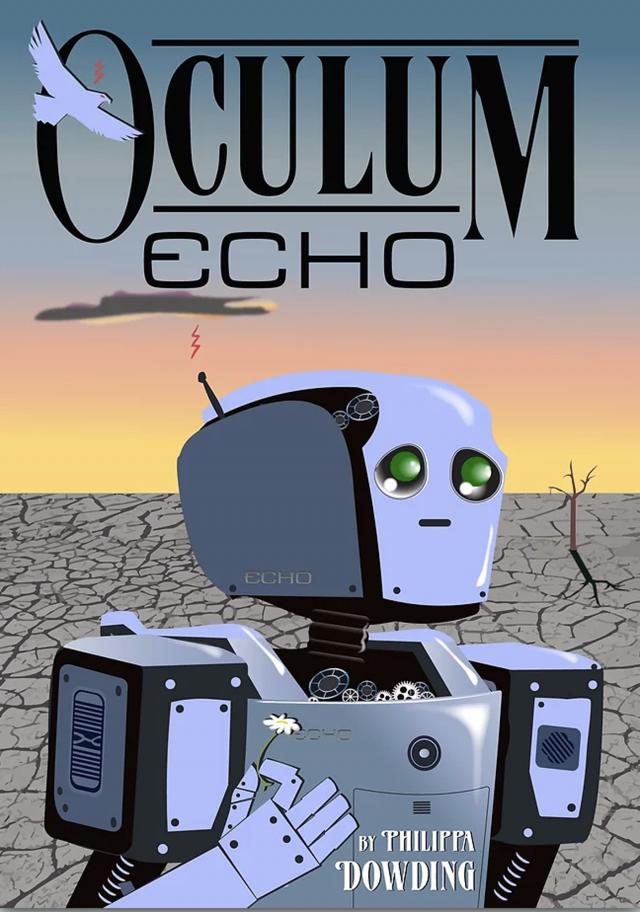


I sit for a while. The late sun beats down, but I do not feel heat or cold.
Before I leave, I have one final job.
I go back to the dome and find the secret door. I place my hand beside the door and burn a message into the pearly glass:
Earth
Children
Humanity
Oculum
If anyone is left to come here one day, they will know that Echo was here.
I have done my duty.
Guide says, Why did you choose these words, Echo1?
It is my name, Guide, I answer. You said so. My purpose is to check on the earth, children, humanity, Oculum. That is Echo.
Guide is silent for a long while, then says, That’s not what your name means, Echo1.
What do you mean, Guide? What does my name mean then, if not this? But Guide does not answer, so I do not ask again.
I turn my back to the dead dome. In time, it will collapse upon itself or be swallowed by sand and waves, a memory only to me.
I send out my call: Echo1! Echo1! Echo1!
Then comes the answer, a distant, faint sound: Ping! Oculum2!
The next dome, Oculum2, is far, far from here. South. Weeks and weeks of travel.
I was hoping for more for humanity than this dead dome.
Wherever I place my hand upon the earth, I test the soil. But there is no life here. Blight has killed everything. Nothing can grow.
I fall to my titanium knees. I look at the sky. I cry out, Echo1! But only the southern dome answers me.
Ping! Oculum2!
There are no blooms, no bees, no children. Is there anything left to save?
Peregrine1, Guide, and Echo will continue the long walk south to the next dome, the only life in this barren place.
If life is what we are.
Miranda1
The Horses pull the wagons. Grannie walks beside me as we follow. The Children of Oculum walk behind us.
Walking, walking, walking. We have been walking north for days. Walking is its own world. Just one foot in front of the other, again and again and again, until it’s time to stop. Our youngest, the Andrews and Annas, ride on the wagons. The rest of us walk, sometimes we carry each other or lead each other by the hand. We walk north to MedFell Hall, to the green valley. It is impossibly far, the adults tell us, yet we must do it. Because there are bombs and the UnRuly behind us.
Cranker, Mannfred and William2, our spies, left to go south days ago. It was hard to see them go, but we didn’t linger. The Shiny Man left us too, with a few other adults.
“To build roadblocks and such,” Grannie said, then said no more.
After a few days, we children settle into a rhythm: rise with the sun and walk, rest at noon, walk again, then stop at dusk to eat and sleep. So far, no one has been lost. We’re all still together on this journey north to MedFell Hall, to William1 and Jonatan Briar. This gives me something cheerful to think about, that I will see my friend again. I hope he is safe from the UnRuly scouts.
I do not want to meet these UnRuly. Not at all.
Each night I light a fire — a new skill — to help feed everyone.
Then I help the others to settle much younger children to sleep in the field. We listen to Grannie sing. We look at the stars, a shocking beauty we didn’t know much about in our domed world. We lie near each other for comfort.
Tonight, we have stopped near a town, our first since we began walking. We haven’t seen a town since we walked out of our broken dome and through the ruined City to Grannie’s brother’s farm, weeks ago.
I see many rooftops and distant buildings with tall trees among them. I have a sudden pang of sorrow; the town reminds me of our lost homes in Oculum.
Grannie and the few City adults go to search the town. They take a few older City children and a few Williams and Mirandas with them. They will look for useful items, learn how to be safe in a strange town or from other people.
Grannie says we need items like knives, scissors, pots, and pans. Rope. Buckets. Cloth. The town might have some of these things.
This happened yesterday as well when we passed a farm.
They went to look into the old farmhouse and checked the barns for any grain or farm tools. But there was nothing we could use and no people. Everything useful was taken long ago. And we have seen no other people as we walk, for there is no one else but us.
As the sun dips low tonight, Grannie comes to find me. She has William3 with her, our oldest boy of Oculum now that William1 and William2 are both gone. He’s a kind boy, one of our smartest.
“Something I want to show you two,” Grannie says.
I look at William3, who shrugs. So we set out behind Grannie through the camp. We pass groups of children at their fires, eating dinner. We pass the City families still with us, eating together, huddled with their goats, or hens, or wagons. Everyone says hello. They all know Grannie.
“Where are we going, Grannie?” I ask a few times, but she just leads us away from the camp beside the highway, her long skirts swishing across the dry fields. We head toward a large red building in the distance. It looms closer and closer until we stop at the bottom of the wide, stone steps. It’s a towering wall of solid red brick.
The building is covered in plants and trees growing wild against it. The front door is long gone, as is much of the roof. A tree grows just inside the door. The windows are all broken. Some of the brick crumbles down the wall. But it is still grand, even ruined. It reminds me of the Oculum Senate from my lost dome.
There are letters carved into the stone above the door.
“Grannie, what is ‘Grantwood Senior Public School’?” William3 asks, reading the words.
“Place of learning, where Olden Begones children learned their letters and such,” she answers.
“Like Teaching Hall in Oculum then?” I ask. Grannie nods.
We follow her into the ancient building, past a young tree that grows through the cracked floor. We walk a long, cool, dark hallway. There are rooms off the hall with broken tables and chairs in them. Dirt, stones, broken pieces of roof cover the floors. Grass grows in corners and along walls where soil has blown in and built up.
Grannie leads us into one room.
A row of broken windows faces the sunset. The children of Oculum play in the distant field as the sun goes down behind them. Grannie has taught them this chasing game, which she calls “tag.” Their faint calls come to us, joyful. Even after a day of walking, some still want to play this game.
But in the building, the three of us don’t speak. There is nothing here but emptiness and dust.
A cracked black wall faces the room, a broken wooden desk leans in front of it. Grannie works a drawer open and says, “Aha!” She pulls out a piece of white stone.
“Chalk!” she crows.
“What’s chalk?” William3 asks, but Grannie doesn’t answer. Instead, she does the most amazing thing: she moves the chalk across the black wall, and it leaves a mark. She writes: Grannie was here. William3 and I gasp.
William3 takes the chalk from Grannie. He writes: We come from Oculum. I am William3.
“Miranda1, you write something,” he says, holding out the chalk.
I take the chalk and draw an outline of my hand on the black wall, all five fingers. I sign it: Miranda1.
“What is this, Grannie?” I ask, pointing at the black wall.
“Was called a ‘blackboard,’ for writing lessons on and such.”
William3 opens a cupboard at the back of the room and shouts, “Paper!”
Grannie and I run over and stare.
“There are boxes of it!” William3 says. We’ve never seen so much paper. We had paper in Oculum, but we were only allowed one piece a week, and it was meant for all of our learning. Writing a journal, art, and mathematics all on the same single piece.
There is also a box that says, “Pens.” Grannie says, “Them pens will be dried out, but the paper’s a find. Take one box, leave the rest for the next people.” William3 puts a box of the precious paper into his satchel.
Then we leave the room.
Grannie leads us outside the building. Trees grow right up to the back door. Soon this building will be claimed by the forest.
But not yet.
Grannie stops us in a small clearing behind the building. There are two strange structures that stick out of the dead grass and rise up above our heads.
“Look at them things. What are they?” Grannie asks, serious. She nods her head at the two tall structures and says, “Well?”
I walk a circle, examining them. They are like nothing I’ve seen before.
The first structure is four metal poles driven into the ground, metal bars join the poles across the top. A few strands of metal chain hang down, and swing back and forth in the light breeze.
I can think of no use for this strange item.
“I don’t know, Grannie,” I say. William3 shakes his head; he doesn’t know either.
“Well, it’s broke. What about t’other?” she says, pointing at the second structure.
This one is a metal ladder stuck in the ground. The ladder stairs go upward and join a smooth, narrow slope at the top that leads back down to the ground. The slope is red, and it’s not metal. I don’t think it is, anyway.
“Well?” Grannie asks, testing us.
“What is the red slope made of?” I point. I’m not sure how that will help us, but I’m curious.
“Called ‘plastic.’ Lasts thousands of years, just as it stands. But what is it?” Grannie asks again. I put my hand on the ladder that leads up to the top of the red plastic slope.
“If I was to climb to the top of this ladder …,” I say, then stop.
“Yes?” Grannie says, eager.
William3 brushes past me. He grins, then climbs the ladder stairs.
“What now?” he says, standing on the small platform at the top of the ladder. “I can see very far. Is it for seeing far away?”
“Sit down!” Grannie says. William3 sits at the top of the slope, slightly puzzled.
He’s starting to grow hair on his face, and his voice breaks from time to time. Apparently, this will happen to all the Williams soon, this facial hair, this change of voice. Then in turn, it will happen to all the boys of Oculum as they grow. Mother said so but didn’t say much more. I’ve noticed a few changes to my own body lately too. I should probably talk to Grannie about this, but not yet. There are so many changes in all our lives at the moment, what’s a few more?
I crane my neck, shelter my eyes from the low sun, and watch William3.
“Push yourself onto the slope and let go!” Grannie says. William3 looks at her with a wild grin, then shoves himself onto the red plastic.
He rushes down the slope! He shouts with joy!
Suddenly I laugh and clamber up the ladder.
I sit at the top of the metal stairs and push myself onto the red plastic slope. The wind on my face! The swoop in my stomach as I race to the bottom!
Grannie watches us climb the ladder and sweep down the slope, again and again.
“What is it, Grannie?” I finally ask, breathless and flushed.
“It’s what children did in Olden Begones times,” Grannie says. “When there was schools and chalk, boxes of paper. It’s what was called a ‘slide.’”
“What’s it for?” William3 asks.
“It’s for play, child,” she says quietly.
Then she points at the metal poles with the swinging chains. “And that’s what was once called a ‘swing,’ but the seat’s broke and long gone.” There is sadness in her eyes. She watches us for a while longer, we almost-grown children of Oculum, as we play upon a plastic slide from a world which no longer exists. We take turns on the slide, then Grannie says it’s time to go.
“No playing after dark, there’s no dentists for busted teeth,” she says, cryptic.
But I feel strange, almost playful, as we head back toward the camp across the dead, rustling, brown grass of the field.
“What’s a dentist?” I ask.
“Something to do with caring for teeth, I imagine. Dentes means teeth,” William3 says. He can see I’m curious, and he adds, “The Medicus showed me drawings of teeth and was starting to teach me about them.”
It’s an odd thing, but most of the time we Mirandas and Williams don’t talk about our old lives in Oculum. We think about it, I do anyway; how could we not? But we rarely mention it, I think so we don’t upset the younger children or each other.
“You were always a good scholar, William3. I’m glad the Medicus taught you about dentes,” I say, to try to smooth the sudden reminder of what we have lost. We walk in silence after that, heading toward the campfires lighting our existence, reminding us in this barren world that people still live at the edges.
As we enter the camp, a City woman runs across the field toward us.
“Grannie! Fever! One family is burning up! It’s Dying Fever, sure!” she calls, waving at us.
“William, bring my healer’s kit!” Grannie says. William3 runs off toward the wagons to find Grannie’s basket of precious healing supplies.
“Miranda, come with me.” The two of us run after the woman.
No more writing with chalk on a blackboard or playing on a slide.
As I run with Grannie, I think about the children who lived here before me in this place. Grannie has told us that their world ended suddenly because of collapse, plague, and the Black Rain. They had no control over their fate.
My world ended when I chose to follow William1 to escape the lies from Regulus and the tyranny of Oculum.
I think it must always be better to choose how your world ends.
Mannfred
Me and Cranker keep slowing down for William2.
We been walking south a day now, but he just can’t keep up. So we’re not moving too quick, giving Cranker’s short temper a poke.
The dogs run along, noses low to the ground. We didn’t know they were coming with us. We said goodbye to Miranda1 and Grannie, and the dogs trailed behind us. They all of a sudden couldn’t hear when we told them to stay.
I let Cranker get ahead with the dogs and stand to wait for William2.
“Let me carry your pack,” I say when he catches up, but he shakes his head and struggles on.
Grannie begged and borrowed — and knowing Grannie, maybe stole — traveling supplies for us. We got dried fruit from Oculum, hard bread, tough rinds of old goat cheese, plus sleeping rolls in our packs. We each got a FatRat skin for water. I got my knife at my waist. William2 got a sharp, tough little knife Grannie give him too. But he got no idea what to do with it, he’s worse off than me. We tell him he can cut food with it, but if we get in trouble, he should hold it like a weapon. We showed him how. But I doubt he’s made for fighting.
Cranker got his slingshot in his belt, though, and no one can beat him with that.
So we been walking, trying to be spies. But we got to find the UnRuly first, and there’s been no one and nothing. We walk back the way we come, back toward the City, over dust and our tracks, then I get a surprise. We find a falling-down farm, then see it’s the farm we just left! Georgas’s farm.
Good thing we didn’t stay.
This farm is all but gone.
The UnRuly bombs did their work if they wanted to blast the place to nothing.
The three of us stare.
“The barn’s down,” Cranker says. He didn’t need to say it, we can see that. It’s just a pile of wood and splinters.
“Look,” William2 says, pointing at the farmhouse.
It’s most gone too. There’s bricks all over the ground and a big hole where half the house was. A shredded curtain flutters out a shattered window.
“Why’d they blow it up?” Cranker asks, puzzled. “The UnRuly. Why?”
I toe some busted bricks. William2 shakes his head.
“Do they need a reason?” he asks.
“I’m not sure I want to find the UnRuly if this is what the bombs can do,” I say, eyeing the mess.
William2 kicks at a board broke off the barn. The dogs sniff and run around, their heads low. They got the trail of something. The big gray mutt growls. FatRats around, maybe.
Then William2 clears his throat. “I would like you to call me Liam.” Me and Cranker look at him, surprised.
“Why?” Cranker asks.
“I’ve been thinking about it, and I want a new start, a new name,” he says. I look at Cranker, and we both shrug a little.
“Okay, Liam. Good name,” I say. William2, now Liam, smiles.
“It’s part of my old name. Wil-liam,” he says, shy.
“That’s smart,” Cranker adds, but I can tell Cranker don’t care much what this boy wants to call himself. He’s just being polite.
“What’s in a name! That which we call a rose by any other name would smell as sweet,” Liam says with a smile.
“More from your lost WillBook?” I ask, and Liam nods. I’m used to these strange sounding sentences from the Oculum Littluns by now. They had a special book they learned from, only one they had in their world, filled with stories and words like these. They called it the “WillBook.”
There’s lots in that book, I think. And what’s a rose?
“I will wear my new name with pride,” Liam says, serious.
Then he takes off his red armband with the silver “W2” on it and sticks it in his pack. Cranker and I look at each other. This boy is a bit soft. I know we’re both thinking it.
“I’m just freeing myself,” Liam says, noticing our look. “Besides, you two don’t have armbands. I should look like you.” Cranker and me both nod and mumble “makes sense” and such.
Then …
Yip! Yip!