The quantity theory of m.., p.1
The Quantity Theory of Morality, page 1
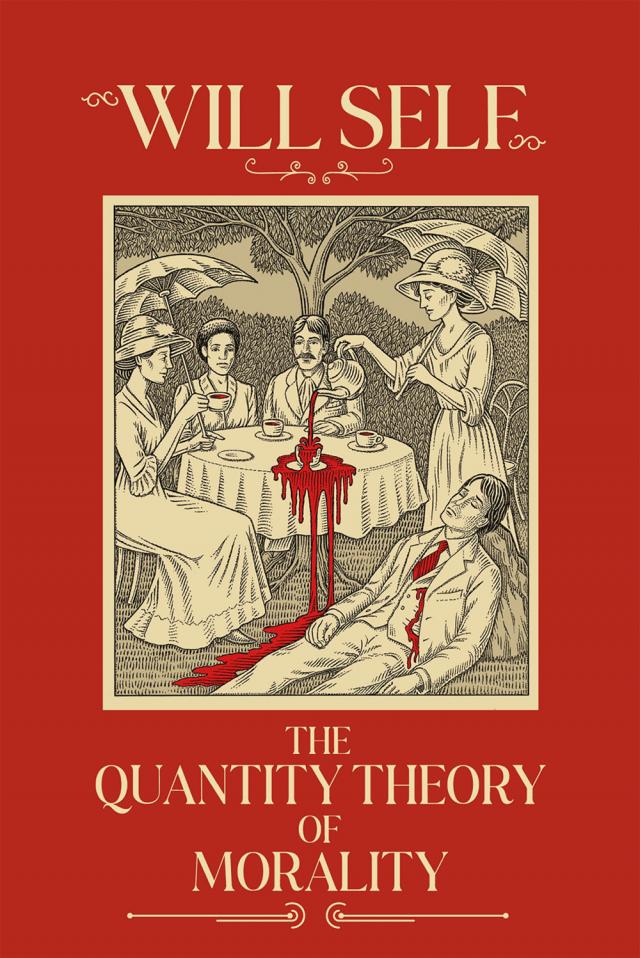


The Quantity Theory of Morality
Also by Will Self
NOVELS
Cock and Bull
My Idea of Fun
The Sweet Smell of Psychosis
Great Apes
How the Dead Live
Dorian, an Imitation
The Book of Dave
The Butt
Walking to Hollywood
Umbrella
Shark
Phone
Elaine
STORY COLLECTIONS
The Quantity Theory of Insanity
Grey Area
Tough, Tough Toys for Tough, Tough Boys
Dr. Mukti and Other Tales of Woe
Liver: A Fictional Organ with a Surface Anatomy of Four Lobes
The Undivided Self: Selected Stories
NONFICTION
Junk Mail
Perfidious Man
Sore Sites
Feeding Frenzy
Psychogeography
Psycho Too
The Unbearable Lightness of Being a Prawn Cracker
Will
Why Read
The Quantity Theory of Morality
together with
Five Supporting Propositions
and an Epilogue
Will Self
First published in the United States of America in 2026 by Grove Press,
an imprint of Grove Atlantic
First published in Great Britain in 2026 by Grove Press UK,
an imprint of Grove Atlantic
Copyright © Will Self, 2026
The moral right of Will Self to be identified as the author of this work has been asserted by him in accordance with the Copyright, Designs and Patents Act of 1988.
All rights reserved. No part of this publication may be reproduced, stored in a retrieval system, or transmitted in any form or by any means, electronic, mechanical, photocopying, recording, or otherwise, without the prior permission of both the copyright owner and the above publisher of the book.
This novel is entirely a work of fiction. The names, characters and incidents portrayed in it are the work of the author’s imagination. Any resemblance to actual persons, living or dead, events or localities, is entirely coincidental.
No part of this book may be used in any manner in the learning, training or development of generative artificial intelligence technologies (including but not limited to machine learning models and large language models (LLMs)), whether by data scraping, data mining or use in any way to create or form a part of data sets or in any other way.
1 3 5 7 9 8 6 4 2
A CIP record for this book is available from the British Library.
Hardback ISBN 978 1 80471 122 4
E-book ISBN 978 1 80471 123 1
Printed in Great Britain
Grove Press UK
Ormond House
26–27 Boswell Street
London
WC1N 3JZ
www.atlantic-books.co.uk
Product safety EU representative: Authorised Rep Compliance Ltd., Ground Floor, 71 Lower Baggot Street, Dublin, D02 P593, Ireland. www.arccompliance.com
‘The Bishop is out for blood, not tea.’
The Unrest Cure, Saki (1906)
.1.
The Minor Character
I went to dinner at the McCluskeys’ and the Brookmans were there, as usual – and the Vignoles as well. Bettina Haussmann had brought a panettone and a new boyfriend – Phil Szabo mixed cosmopolitans. Johnny Freedman was of course in attendance, and when we reached the figs and the cheese, he was still rambling on about his plan to farm vicuña in the Aylesbury Hundreds. He talked and talked, detailing forage requirements, wool yields, shearing techniques – I couldn’t believe how the others hung on his every word, when they’d heard Johnny describe scores of such schemes in the past, none of which ever amounted to more than tipsy social blether.
Tiring of it – and perhaps a little drunk myself – I went on to the back terrace to have a smoke. It was a close, damp night and the crab-apple trees that stood either side of the long narrow garden were shedding their fruit; the loud tapping noises these made as they struck the teak decking sounded like an idiot messing about with a tom-tom drum.
Cathy McCluskey came through the glass door and leant against me – she smelt of Arpège and ripe Camembert, in that order.
‘Giss a snog, Will,’ she slurred, insinuating an oddly chilly hand under and up my shirt.
‘C’mon, Cathy.’ I disengaged myself and holding her by her bare elbows looked down on the crown of her head and the protrusion of her dewy top lip. ‘You’re just drunk – you love Gerry.’
‘Love?’ She snorted. ‘He doesn’t know the meaning of the fucking word.’
Later Rob and Teddy Brookman drove me and Phil Szabo home in their Jaguar. There was the usual I’ll-driveno-I’ll-drive, then we were all sheathed in the cream-leather upholstery and humming past discount furniture warehouses. Teddy took her hands off the wheel at one point – and I remember this quite distinctly – in order to describe the shape of her friends’ sadness, saying, ‘I’m worried about the pair of them, aren’t you, Will?’ And I said, ‘Oh, I expect they’ll muddle through.’
It was the following winter that Teddy was diagnosed, and after she’d had the double mastectomy, she was determined to have a good time. In May she and Rob took a couple of boxes at Glyndebourne and invited the whole crowd down to see Werner Herzog’s production of Die Walküre. I remember standing in the rose garden – more than a little bored at the prospect of all that Wagner – and Teddy coming out of the rhododendrons brandishing a spear. She was wearing a winged helmet and a metallic corset equipped with conical breasts.
Dora Vignoles laughed so hard she had a coughing fit; Bettina Haussmann took photographs while Teddy and Rob – who was similarly attired – struck poses. The McCluskeys were late and looked like they’d been rowing – Phil Szabo went off to find a corkscrew. Johnny Freedman took me to one side and asked whether I had adequate insurance cover, but I didn’t let him get to me – it was a magical evening, and we all felt that with chutzpah like that Teddy must already be in remission.
It must have been a fortnight or so later that Gerry McCluskey called me up in tears.
‘Cathy’s left me, Will,’ he sobbed.
‘Oh, Jesus, Gerry, that’s dreadful.’ I mustered the necessary compassion, although I was preoccupied at the time by the suspicion that the builders who were converting my garage into a studio were ripping me off.
‘That’s not the worst of it,’ Gerry blubbed on.
‘No?’
‘No! It’s Johnny she’s gone off with!’
I was surprised – but pleasantly so – when I discovered how grown-up they were all being about it. Cathy and Johnny moved into a mansion block in town and the kids, who were six and eleven, spent weekends with them.
‘I didn’t want them uprooted,’ Cathy said, when I went round for Sunday lunch three months after the split.
‘I must say, it’s quite a view you guys have here,’ I said, standing looking out over the bronzed and golden crowns of the autumn trees in the park.
‘It was an investment originally,’ Johnny said, coming in with Phil Szabo who had a tray of sherry glasses. ‘But what with the way the market is, I thought we might as well make use of it. Still, there are opportunities to be had—’
‘Oh, shut up, Johnny,’ Cathy said, biting his neck in a way that was at once shockingly carnal and distinctly perverse.
I looked on open-mouthed, but said nothing – then the bell rang and we could hear the McCluskeys’ eleven-year-old shriek, ‘Dad-eee!’
‘You’ll be amused,’ Bettina Haussmann husked in my ear, ‘to see what Gerry’s been up to.’
‘Really, why’s that?’ I turned to face Bettina and saw that she had a bruise on her neck in exactly the place where Cathy had nipped Johnny.
‘He’s come out,’ Bettina husked, ‘a bit.’
It was one of those Sunday lunches that went on and on, then merged with tea. I didn’t leave until it was dark out, carrying with me the image of Gerry McCluskey stroking his new glossy-brown goatee while clicking his way through a carousel he had loaded with old-fashioned slides of their six-year-old, Reggie, whose birthday it was that week. Much hilarity had greeted the shots of the McCluskeys taking mud baths at Bartonon-Sea. Everyone was laughing – especially Teddy and Rob; everyone, that is, except Dora Vignoles, who was coming out of the bathroom as I opened the front door, an expression at once murderous and frightened on her swarthy, angular face.
I walked across the park with Phil Szabo, but we parted at the main gates – he said he was meeting a friend in a pub nearby.
Gerry said I should come down to the cottage at Barton for New Year’s Eve, and so I arranged to pick Bettina up from her flat in the Barbican and give her a lift. Clearly, she’d forgotten, because when I arrived, she didn’t answer the door for a long time; then, when it swung open, she was in her dressing gown, looking both furtive and hungover.
She was reluctant to let me come in while she got ready, but I barged past her, crying, ‘For Christ’s sake, Bettina, I’ve known you for twenty years – how many times have I crashed out on the bloody carpet here –?’
And would’ve continued, were it not for the sight of Cathy McCluskey, naked save for a flesh-coloured bra and sprawled across the double divan bed under the Venetian blinds, her feline body striped dark with shadows and clawed white wit h stretch marks.
‘OK,’ Bettina drawled, leaning against the taupe-papered wall, her arms crossed. ‘Had your fill, have you, Will?’
Cathy groaned and levered herself up by one elbow. ‘Who is it?’ she asked.
‘Only Peeping Will,’ Bettina said, then picking up the duvet from the floor she tossed it over Cathy, so that for a split second it hung in the air above her like a soft and amorphous ravager.
I was much less embarrassed than they thought I was – and much less intrigued as well. Nevertheless, the drive was spent mostly in silence. I’d never been to the McCluskeys’ ‘cottage’ before – and it turned out to be something of an ironic ascription, given that it was in fact a Victorian rectory with nine bedrooms.
I suppose Gerry had long since absorbed the blow, and he seemed genuinely pleased when Cathy pecked him on the cheek and then ambled off through the rather gloomy, damp-carpet-smelling rooms in search of their kids. There was a platoon of champagne bottles standing to attention on the scullery table, and Bettina picked one up and rolled it across her broad, freckled forehead, leaving behind a smear of watered-down foundation.
Upstairs, I found the Brookmans had the bedroom next to mine, and that we would be sharing a bathroom. Teddy already had a glass of champagne, and Rob was recumbent on the bed with the half-empty bottle beside him.
‘Shit, I know all about that,’ Teddy said when I told her about Cathy and Bettina. ‘It’s been going on for an age. Honestly, Will, sometimes I think you must be blind. Speaking of which, d’you wanna see my scars?’
I looked over at Rob, but he only raised his eyebrows with an expression somewhere between resigned, exasperated and amused. ‘I can hardly accuse you of ogling my wife’s tits,’ he said. ‘Not now she hasn’t got any.’
Teddy had shrugged off the top half of her dress and her chest was as smooth as a young boy’s, the tan nipples almost recessed. ‘Look,’ she said, ‘that devilishly clever surgeon hid the scar tissue under my rib bone.’ She took my finger in her hand and ran it along the hard rind of the scar, and somehow, in my mind, this was linked with Cathy’s splayed form on the bed at the Barbican – as if this were the foreplay that should, logically, have preceded it.
Installed in the linoleum drear of the rectory’s kitchen, Gerry’s boyfriend, Miguel, had conjured up enough tapas for twenty – even though we were only half that number. The dishes kept coming: chicken livers wrapped in bacon, squid soused in vinegar, potato croquettes, mini-paellas and boquerones. Everyone ate too much – everyone drank too much. It wasn’t until it was nearing midnight that we noticed Phil Szabo hadn’t arrived – and then he called: he was stranded in Christchurch, but unfortunately no one was sober enough to go and get him, so he had to walk the ten miles to the house and arrived, cold but exhilarated, at about 3 a.m.
‘I passed Dora and Johnny down on the beach,’ he said as he came into the drawing room. ‘I do believe they were stripping off for a swim!’
That summer I went out early each morning with Derek Vignoles, who kept a double scull at a boathouse on the Putney riverside. The first time I tipped up, Derek laughed at my blue canvas deck shoes.
‘You won’t be needing them, sport,’ he chuckled. ‘It’s much better if you row barefoot – that way you get to feel the heft of her.’
I discovered what he meant soon enough. The scull sat as lightly on the river as a water boatman, and our four sweeps pushed it scudding forward with scarcely a ripple. It felt as if the surface tension of the brown water were brushing against the bare soles of my feet.
I’d always been more friendly with Dora than Derek, and hadn’t spent much time alone with him in the past, yet it turned out that his superficially bluff – even prosaic – manner hid a keen intellect and a poetic sensibility. He was one of those men who’d read a great deal, yet wore his erudition extremely lightly. Most mornings we left Putney at 6.30 a.m. and were rounding Eel Pie Island an hour or so later. I wasn’t fit enough to row and talk; Derek, however, kept up a steady stream of observations, anecdotes and even lengthy quotations from the great poets, his words coming from behind me, as if fed through invisible earphones.
It sounds oppressive, put like that, but it was actually something of a revelation, and I realized towards the end of July that, in his funny gruff way, Derek had targeted me as someone in need of a little late re-parenting – and for that I was grateful. He was going to Spezia with Dora for a fortnight in August, to stay with Bettina Haussmann. And although I knew the Brookmans, the McCluskeys and Phil Szabo were going as well, for some reason Bettina hadn’t invited me.
I tried not to feel put out, and made arrangements to go on a watercolour-painting trip with Miguel. Then, on our last morning sculling together, Derek angled the prow towards Eel Pie Island and said: ‘I’ve got a little surprise for you. I didn’t say anything before, but I’ve a share in a business Johnny Freedman runs out of an old boathouse here, and I thought you might like to take a look-see.’
‘Really?’ I was nonplussed. ‘I wouldn’t’ve thought you and Johnny would get on… in a business sense.’
‘There’s more to Johnny than meets the eye – or ear,’ Derek said – and then I heard the tinkle of laughter from the veranda of the boathouse, and Cathy McCluskey cried, ‘Surprise!’ while Phil Szabo popped the cork of a Prosecco bottle.
‘It’s a little early in the day, isn’t it?’ I said to Derek, and he laughed.
‘It’s always too early, sport – and then it’s too late.’
They were all there – even Bettina, who apologized for her behaviour in a heartfelt way. ‘It’s stupid,’ she said, when, hours later, we were draped over the balustrade watching snags being carried downstream by the ebb tide. ‘But that day when you surprised me and Cathy at the Barbican, I sort of… well, it sounds crazy, but I blamed you for a lot of things that’ve gone wrong in my life.’
‘It doesn’t sound crazy to me,’ I replied – although of course it did.
I was hanging one of Miguel’s watercolours of Helvellyn in the studio when the phone rang – it was Dora Vignoles wanting to gossip about the Spezia trip. While she talked, I stared out the window: the dustmen were coming along my street chucking splitting black plastic bags into the filthy anus of their grunting truck. Perhaps sensing my disinterest, Dora said: ‘Are you coming to Rob’s fiftieth in October? Phil Szabo’s putting on an eighties disco.’ And when I admitted that I was, she took this as a cue to say her goodbyes.
*
It must have been in the early spring of the following year that Cathy McCluskey sent me a text message: ‘Phil Szabo has been found dead in his flat.’ And when I called her back she was in tears. ‘It’s dreadful,’ she cried, ‘apparently he’d had a stroke and been lying there for more than a fortnight – he’d started to r-r-r—’
‘Putrefy?’
‘No, rot. Honestly, Will, you seem quite disengaged about this – it turns out that Phil didn’t have any family.’
‘Well, I certainly never heard him talk about one – besides his old man. Had you been friends for long?’
‘Us? Friends?’ She sounded confused. ‘I mean, I s’pose he was a friend, but I rather thought you were closer to him – I mean, didn’t you introduce him to us?’
After I’d noted down the information about Phil’s funeral and hung up, I sat there thinking. It had seemed as if Phil Szabo had been around forever, yet when I cast my mind back, I couldn’t recall him being one of our crowd before the dinner party at the McCluskeys’ a couple of years before – the one when I first realized Cathy was being unfaithful to Gerry. Anyway, I’d always thought of Phil as a sort of minor character, not of any real significance, merely there to make up the numbers.
It would’ve been better not to pursue this uncomfortable thought, yet I couldn’t prevent myself, for when I considered Cathy and Gerry McCluskey, Dora and Derek Vignoles, Johnny Freedman, Teddy and Rob Brookman, Bettina Haussmann – and even Miguel, who I’d developed a fast and firm friendship with – they were all minor characters as well. As for me, although ostensibly the narrator, and so omniscient within this tale masquerading as a life – I was undoubtedly the most minor of all. After all, what did anyone know about me, besides the fact that I painted in watercolours, had a studio conversion and consorted with these ciphers?