The quantity theory of m.., p.21
The Quantity Theory of Morality, page 21
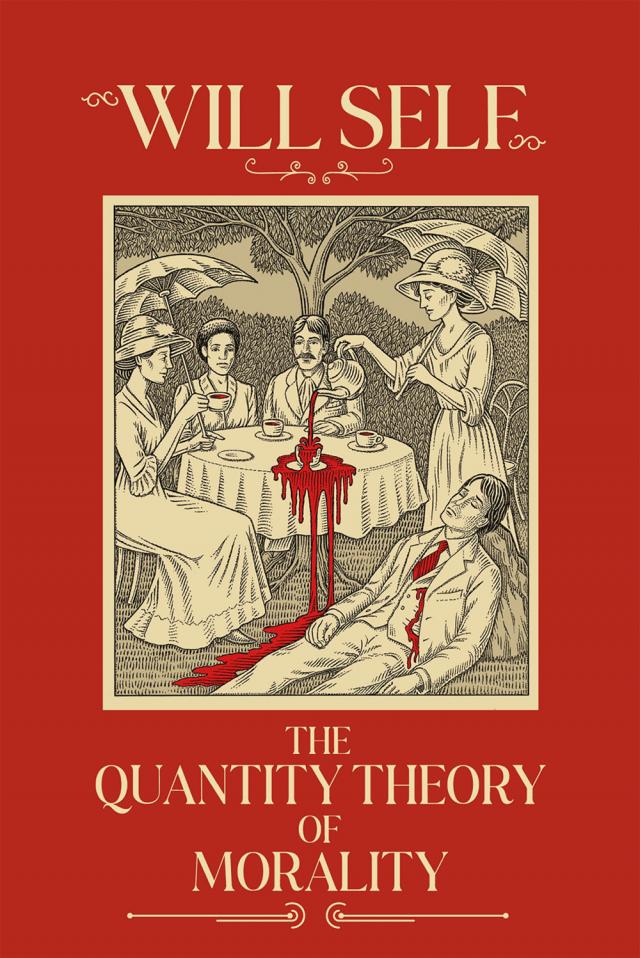


Then Dora Vignoles called a couple of times – just to be polite, I thought, by offering herself up to gossip about the aftermath of the holiday. She did say one or two things about prejudice and restrictions, but to be honest, you get so bored hearing privileged people complain about their picayune problems, I rather switched off at that point. I had enough difficulty at the time, dealing with Trude Schinkel, my rather tricky M -1, and the rest of my team.
Work can become so absorbing, can’t it…
Dora did also tell me Phil Szabo was organizing an eighties disco party for Rob Brookman’s sixtieth – and that did make me sit up: I mean, it only seemed like yesterday that Phil had organized a seventies disco party for Rob’s fiftieth. Dora said something about it being difficult to find a venue for it – but again: I confess, I didn’t pay much attention, having no intention of flying back for what was bound to be a desultory affair.
I did think of them all from time to time – and especially of Will’s old uncle, Dr Busner. I couldn’t help it, since in October I began working fairly closely with the technical department… and Margaret.
Who I never got used to. I mean, her overall appearance was weird enough – yet weirder by far was the method Herr Weininger, JetzBank’s R&D Direktor, had devised of communicating with her.
‘It’s called an ephod,’ he explained, when he showed me the prototype input–output module he and his colleagues had built. ‘Due to Margaret’s semi-organic nature, it’s necessary that our keyboard and display also have this fleshy aspect.’
The ephod turned out to be a sort of corset or tunic that had been grown in the laboratory, from stem cells harvested from the wombs of female baby minke whales: ‘They are highly intelligent creatures,’ Weininger explained, as he helped me into this wearable tech’ – which had to be directly next to the skin for effective data entry and output. Weininger even made me take off my bra, saying, ‘Go into the next office to change – this is no time for modesty, Frau Haussmann – not in the midst of a revolution in cybernetics!’
It felt warm to the touch – and blubbery; while on the front of the ephod were three rows of faintly iridescent, roughly rectangular nodules, which when Margaret began to ‘speak’ would glow, either singly, or in rapidly mutating patterns. Above these nodules were two further growths that Weininger said he had named the Urim and Thummim.
Standard financial modelling outputs – market fluctuations, commodity prices, futures, bond yields etc. – were displayed by the nodules, whereas predictions regarding political developments were in the form of high-frequency emissions from the small sphincters at the tip of the Urim and Thummim.
In the case of standard outputs, the nodulous patterns went through further semantic analysis before assuming a utile form – whilst as for the Urim and Thummim, passing the high-frequency emissions through piezoelectric transducers created two ultrasonic waves of differing frequencies. ‘It’s a complete illusion,’ Weininger explained, the first time I heard these waves resulting in what Weininger said was an interference pattern, but which sounded to me like a woman’s voice.
To be a bit clearer: a strange sort of sonic blending of Margaret Thatcher and Margaret Atwood’s voices; one still further modulated by an echo which made whatever was said – if it could be said that someone was speaking – sound vatic, mantic and overwhelmingly auratic: clearly, whoever or whatever this was, it… or she… knew.
Not that I’d ever heard Margaret Atwood speak – but the voice had the usual Canadian inflection: pronouncing the English ‘ow’ sound as ‘ooh’, so that boat becomes boot, and out… oat.
Thatcher’s curiously strangulated tones, on the other hand, are as familiar to me as my own mother’s: they’d both had the weird tonal oscillation produced in the English establishmentarians of that era by the elocution lessons paid for by their aspirational parents – ones which made them, forever after, slide up and down the greasy pole from lower- to upper-middle class, as if this itself were a sort of nasaled, trombone variation on a theme of social insecurity.
Thatcher’s predecessor as Tory leader, Heath – another upwardly mobile child – used to pronounce ‘our’ ‘eower’, so desperate was he to ventriloquize those he imagined to be his betters.
Margaret could have data continually inputted when the ephod was inserted into a specially devised compartment in the JetzBank mainframe. And Weininger told me that as soon as they’d created an interface for her with the internet, she had gone to work with a vengeance, absorbing petabytes of information the way beer drinkers do… salted peanuts.
It was a simple matter for Weininger to program Margaret to look for any information on the web concerning the McCluskeys and their gang; and from time to time, I’d ask her about their future – if she’d managed to find anything out which suggested one or other of these dear friends of mine might be about to die? It didn’t seem altogether crazy, given when it came to financial data, Margaret had proved herself capable in a few short weeks of better inductive-predictive modelling than any of our existing methods.
Wearing the ephod was a pretty freaky experience: it clung to your skin as if you were… well, as if you were being entirely embraced by another quasi-sentient entity, which you were: every square centimetre of your upper body received the pressure of a square centimetre of… hers.
When she gave her outputs, the ephod undulated, palping and squeezing your own flesh – once, when issuing a particularly perspicacious forecast concerning the KRX, I could swear she tweaked both my nipples regularly for over thirty seconds, while sliding some sort of pseudopod or feeler down the back of my panties and into my anus.
I held off orgasming for a while – then did.
As for her vocalizations – these I could never get used to: her pronouncements and predictions issuing, Oz-like, from behind the tank which housed her – as if coming from the inner-chamber of her tabernacle.
Obviously, I asked Weininger about all this Kabbalistic computing – I mean: why employ the same methods allegedly used by the ancient Hebrews’ priesthood to speak to their deity in order to obtain economic forecasts? But he replied that things had just turned out that way: you start down a certain research path, and it leads you where it will. ‘We are mostly Theseuses, Frau Haussmann,’ he said, rather sententiously, ‘very few of us are Ariadnes.’
But when it came to assessing morality quotients, and making estimates of ethical behaviour by social groups and individuals, Margaret was as vague as any politician: she’d flute and toot to such little effect, it was as if an AI had absorbed all their most banally ambiguous and transparently self-seeking speeches of the past half-century, and was now regurgitating them in the facile form of:
‘Hope and consistency… Integrity and concerted effort… Managed expansion… Comprehensive resets… Outstanding contributions… Mutual understanding… Overarching imperatives… Sustainable traditions… Innovation and consolidation… Emerging intersections… Consistent hopefulness… Effortful and integrated cooperation… Expansive management… Reset comprehension… Contributory standpoints… Understanding mutuality… Imperative arching over… Traditional sustainability… Consolidating innovation… Consistent integrity… Cooperative hope… Reset comprehension… Expansive arching…’
No wonder I gave up after a while – especially since the purely quantitative outputs were so beautifully precise when it came to telling me how to make money. I concede: with the bank’s permission I was allowed to increase my own preferential shareholding, while thanks to Margaret, JetzBank’s stock rose, if not precipitately – which would’ve been worrying – certainly steeply enough to make us all very pleased with ourselves, indeed.
So, when I received Cathy McCluskey’s text message in the early spring of the following year, it came pretty much out of the blue: ‘Phil Szabo has been found dead in his flat.’
I was sitting in the Opernhaus at the time, waiting for the curtain to go up – Weininger had had a spare ticket for Rihanna’s new production of Salome, and asked me if I’d like to come along.
I looked at my phone’s screen for several, long minutes, while I thought about Phil, and our relationship. As the singletons in our little group – I don’t count Will, for obvious reasons – and him being gay, and me bi, we were always rather thrust together; yet I never really warmed to the guy: there was always something pretentious about Phil.
Nevertheless, I had felt rather bad about how things had turned out on the Spezia holiday – although there’d been no open breach between us. Phil called to chat a couple of times – and also sent some pictures of Rob Brookman’s party, together with others he’d taken at a twilight bat-watching event in Highgate he’d been to with Gerry and Will, although these hadn’t turned out well; you certainly couldn’t see any bats.
Funny the stuff people get up to – passing the time, they call it. Then they die.
When I called Cathy back later that evening she was in tears. ‘It’s dreadful,’ she cried, ‘they think it may have been suicide… and he’d been lying there for more than a fortnight – he’d started to g-g-g—’
‘Go off?’
‘No, fester. Honestly, Bettina, you seem quite disengaged about this – it turns out that Phil didn’t have any family.’
‘Well, I certainly never heard him talk about one – had you been friends for long?’
‘Us? Friends?’ She sounded confused. ‘I mean, I s’pose he was a friend, but I rather thought you were closer to him, being of the same, y’know… persuasion. I mean, didn’t you introduce him to us?’
After I’d noted down the information about Phil’s funeral and hung up, I sat there thinking. ‘Persuasion’? What the hell had Cathy been talking about – and suicide? That old weirdo Busner had talked about someone in the group being at risk, but in the light of Phil’s suicide, it occurred to me he may have been suggesting that one of these sudden collapses in morality quotients was about to happen – not only to our small circle, which I’d always thought fairly benign, but in other bigger and much more vicious ones as well.
I would’ve done well to consider this matter more – and even dig a little deeper than the headlines and the financial pages – before I got on my Helvetic Airways flight from Zurich to London City Airport on the morning of the cremation. I have no excuse – only this explanation: I was depressed by the prospect of the funeral, yet oddly exhilarated by the anticipation of the flight.
It doesn’t matter how many times I did this particular journey – it still remained a thrill. I mean, I know it’s not what my father would’ve wished for me: scholar that he was, and no sexist, he always assumed his only child would follow in his pedagogic footsteps – but while I had the necessary aptitude for academia, the first time I walked through an airport departures lounge pulling a wheeled carry-on suitcase, and wearing an elegantly severe business suit, I felt like… I’d arrived, like I’d been selected for a special destiny.
Ha-fucking-ha.
It was a brilliantly sunny February morning, and, as usual, the jet circled over the City before landing on the runway beside the old abandoned docks. I know plenty of people think the new megastructures forming the London skyline are not only an eyesore, but also diminish the historic centre of the two-thousand-year-old metropolis, but as the plane tilted, and then banked to make its landing approach, and us passengers’ eyes were raked across then around that great, mirrored massif, I had a strange experience – it felt, unaccustomedly, like a homecoming.
Which was why it was even more of a shock when the man on the immigration desk at arrivals told me to wait, then fetched a colleague who, in turn, asked me to accompany him to an interview room.
I’d never had this happen to me before – although I’d seen plenty of others undergo this: the official holding the passenger’s identity document away from their body, as if it might contaminate them, while the passenger looks furtively around, making a mute appeal to those who were so recently his or her fellow travellers, but who now wouldn’t give him or her the time of day, as they’re frogmarched away.
There was something funny about these officials’ uniforms as well – I’d never seen ones like them: they were brown as against the dark-blue and black ones of Border Force, while instead of ordinary epaulettes, they had US-style shoulder boards, which were shaped like slices of bread. A strange dissonance yet further enhanced by the recording of the largo from Dvořák’s New World Symphony, which wheedled its way out of the public address system, and infiltrated the workaday transportation zone, thereby inducing feelings at once elegiac and… expeditious.
‘What are you?’ I asked, a little incredulously, once he’d shut the door.
He didn’t answer – or ask me if I’d like to sit down. He just stood there under the overhead light, leafing through my passport, then looking from the photo page to my face and sort of squinting.
I’d seen that squint before, though: it’s entirely distinctive – it’s the one many gentiles give you when you let drop you’re half-Jewish. What it signifies is that up until then they hadn’t identified you as Jewish at all, so now, in order to make good their deficiency in prejudice, they undertake a delicate, sensitive assessment of… the size of your nose.
What comes next is entirely predictable: ‘Was your Jewish parent your mother or your father?’ And when you answer ‘my father’ (and in my case, omit to mention that your mother was a convert), they happily let you off the hooked nose: ‘Oh, in that case you aren’t really Jewish…’
But on this occasion things transpired quite differently: still without answering me, the official simply took my passport over to a desk on which sat a number of what looked like old-fashioned hole-punchers for ring-binders, selected one, took the cover of my passport between thumb and forefinger, punched it and handed it back to me.
I looked, and saw the word ‘ASH’ formed by a pattern of small perforations.
Granted, this seemed a little bizarre, but glancing at my watch I saw I was already running late if I wanted to make the crematorium on time, so said to the official: ‘Will this take long? I’m attending a funeral in a couple of hours.’
He glanced at me in a desultory fashion, and replied: ‘You’re free to go, Haussmann – your report day is Thursday, and your HOVIS reporting point is…’ he consulted a tablet computer, ‘239 Balls Pond Road.’
I looked at him bemusedly: ‘Balls Pond Road? and what’s HOVIS?’
‘Home Office Visitor Inspection Service,’ he snapped. ‘We’ve replaced the old Border Force, as well as constituting police and army auxiliary battalions.’
‘It wasn’t that old.’ I tried making light of the bizarre situation. ‘I mean it was only introduced as a sort of Little England version of the US’s Homeland Security and, latterly, ICE – and for the same reason: to intimidate both would-be illegals, and those from the same minorities already in the country…’
But this attempt to get the man talking was dismissed out of hand: ‘That’s as may be,’ he replied, slapping the tablet down on the desk. ‘Our remit runs considerably further – which is why you’ve been assigned a reporting day.’
‘But I’m not a visitor – I’m a British citizen!’
This time the man regarded me with open contempt, and said: ‘Report on Thursday to Balls Pond Road – everything will be explained.’
The cab ride was uneventful. True, the driver did slightly cavil when I said I wanted to go to Golders Green, and for a moment, I was reminded of how a black friend once told me that whenever she asked the white driver of a licensed London hackney carriage to take her home to Brixton, they would say to her what this one said to me: ‘I’m going to knock off in an hour, and that’s in the opposite direction from my gaff.’
I began to remonstrate, saying since he was on the rank, he was obliged to take me – but he gave way at this point, and although I thought I’d heard him mutter something under his breath about a ‘lairy Yid’, I didn’t imagine for a second he was referring to me.
I then spent most of the journey checking my phone to see what was going on with the big Huawei deal – Mergers & Acquisitions had called me in to look at some issues around leverage, and it was going to be very tricky getting everyone involved on the right page, at the right time.
Metaphorically speaking, that is.
I scarcely looked up until I was attempting to give the driver a cash tip – one he hadn’t wanted to accept for obvious reasons: preferring, I now realize, not to touch money that had been handled by a Jew, although he was perfectly prepared to accept the hygienically electronic transfer of funds I’d already effected with my credit card.
‘Just drop it there,’ he said, gesturing to the passenger seat – and when I had, he pulled away without another word, let alone a cheery Cockney ‘ta, love’, as his colleagues would’ve in the past. I looked up. There was a bitter wind blowing over the Jewish cemetery, and a group of cemetery workers appeared to be digging a fresh grave in the mid-distance.
At least, one man was digging – two others stood there, watching and vaping, their cloudy breath emerging like… ectoplasm.
And inevitably I travelled back in my memory to all the burials I’d attended there – including my father’s.
Next, I briefly recalled all the immolations I’d witnessed on the side of Hoop Lane where I was standing. Fair enough, it is the biggest and the oldest crematorium in the country, but even so, over the years it had already begun to seem a little disturbing quite how many of the secular Jewish people I knew were burnt there, and religious ones as well, who were buried over here.
Consulting the signboard in the courtyard, I saw ‘Szabo ASH’ listed for the East Chapel – and yes, schmendrik that I am, while I registered this repetition, I didn’t analyse it the way I had the Huawei stock prices.
Yet, as a child, you’d read about Kristallnacht – and in my case, it would feel very personal: infusing me with terrible, aching regret for the greatest counterfactual there could ever be, which would’ve been if I could somehow have gone back in time, taken my paternal grandparents by the scruffs of their necks and shaken some sense into them, while saying none too gently: