

The amputated memory, p.1
The Amputated Memory, page 1
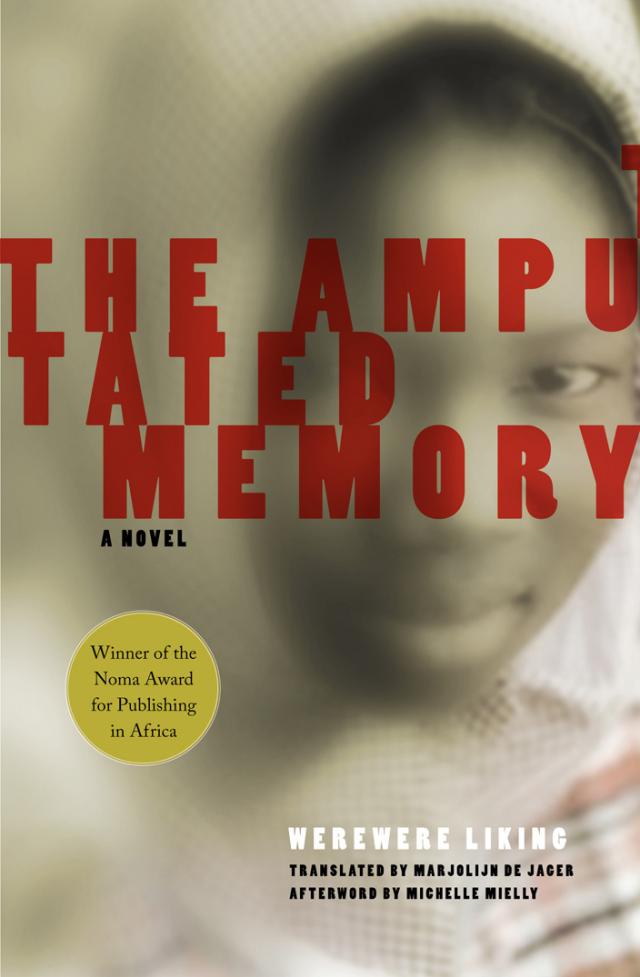


Published in 2007 by The Feminist Press at the City University of New York
The Graduate Center
365 Fifth Avenue
Suite 5406
New York, NY 10016
www.feministpress.org
Translation copyright © 2007 by Marjolijn de Jager
Afterword copyright © 2006 by Michelle Mielly
All rights reserved.
Originally published in French under the title La mémoire amputée by Wéréwéré Liking. Copyright © 2004 by NEI Abidjan. ISBN: 2-84487-236-0 NEI. All rights reserved for all countries.
No part of this book may be reproduced or used, stored in any information retrieval system or transmitted in any form or by any means, electronic, mechanical, photocopying, recording, or otherwise without prior written permission from The Feminist Press at the City University of New York, except in the case of brief quotations embodied in critical articles and reviews.
Library of Congress Cataloging-in-Publication Data
Werewere Liking, 1950-
[Mémoire amputée. English]
The amputated memory : mothers Naja and aunts Roz : a song-novel / by Werewere Liking ; translated from the French by Marjolijn de Jager.
p. cm.
ISBN-13: 978-1-55861-877-0
I. de Jager, Marjolijn. II. Title.
PQ3989.2.L54M4513 2007
843’.914—dc22
2007021440
This publication was made possible, in part, by the Carnegie Corporation of New York.
Text and cover design by Lisa Force
12 11 10 09 08 075 4 3 2 1
To All my Loves
From yesterday to tomorrow
My natural, spontaneous or invented, recreated Loves,
For, before all else,
We must first learn to create Love
For all my Friends in Madness, born that way or rendered mad
My Master Injectors of anguish,
For, before any wisdom gained,
We must all experience madness
To all my grandchildren, all the Yi in my Village
Who will never cease seeking the Ki
I dedicate what follows here. . . .
So, trying to pretend with eyebrows arched
That they were keeping calm
Each one wondered privately
What was coming next. And what is actually coming next?
Hey! I muttered behind their back
What is next is a novel, of course, you silly fools!
That is to say, fabrications or stories
But intensely lived or to be lived
If only in the imagination of the tale of love
Hey, hey, hey, that was your Grandmama!!!
—Werewere-Liking Gnepo
CONTENTS
TRANSLATOR’S NOTE
MOVEMENT ZERO
Chapter 1
MOVEMENT ONE
Chapter 1
Chapter 2
Chapter 3
Chapter 4
Chapter 5
Chapter 6
Chapter 7
Chapter 8
MOVEMENT TWO
Chapter 9
MOVEMENT THREE
Chapter 10
Chapter 11
Chapter 12
Chapter 13
Chapter 14
Chapter 15
Chapter 16
MOVEMENT FOUR
Chapter 17
Chapter 18
Chapter 19
Chapter 20
Chapter 21
MOVEMENT FIVE
Chapter 22
MOVEMENT SIX
Chapter 23
Chapter 24
MOVEMENT SEVEN
Chapter 25
Chapter 26
Chapter 27
Chapter 28
MOVEMENT EIGHT
Chapter 29
Chapter 30
Chapter 31
Chapter 32
MOVEMENT NINE
Chapter 33
Chapter 34
MOVEMENT TEN
Chapter 35
Chapter 36
MOVEMENT ELEVEN
Chapter 37
Chapter 38
Chapter 39
Chapter 40
Chapter 41
Chapter 42
Chapter 43
MOVEMENT TWELVE
Chapter 44
Chapter 45
Chapter 46
MOVEMENT THIRTEEN
Chapter 47
Chapter 48
GLOSSARY
AFTERWORD
TRANSLATOR’S NOTE
My deep appreciation goes to Judith Miller who read the manuscript of this translation in its early stages and, as always, contributed greatly with her invaluable comments and suggestions, most of which I gratefully accepted. I always learn from her! My warm thanks to Michelle Mielly for her fine and thoughtful Afterword, once again carefully read and edited by the inexhaustible Judith Miller. I am deeply indebted to Jean Casella for her meticulous editing and her finely tuned ear, which certainly improved the final version of the text. I am equally grateful to Anjoli Roy, Assistant Editor of The Feminist Press, whose generous help and constant vigilance go beyond the call of duty. To the multitalented Werewere Liking go my boundless admiration and gratitude for yet another beautiful work, for her devotion to helping the flowering embodied in all children, and for reminding me that she began writing this book at the kitchen table in our home in Astoria, Queens, some ten years ago. As always, my work—and life—would be diminished without the concrete and emotional support of my husband, David Vita. And last but certainly not least, profound gratitude to Florence Howe herself, without whose lifelong dedication to publishing the wisdom and talents of writing women, works such as these would not make their entrance in this country.
Marjolijn de Jager
Stamford, Connecticut
June 2007
The Amputated Memory takes place in an unnamed West African nation, clearly representing the author’s home country, Cameroon. The central story focuses on the Bassa people, and is set in their part of this unnamed country and in a city called Wouri, a stand-in for Cameroon’s largest city, Douala.
MOVEMENT ZERO
1
I am Halla Njokè.
My family affectionately calls me Fitini Halla—little Halla—to set me apart from my paternal grandmother, whose namesake I am, and who was known as Great Halla or Great Madja. I am in my eighth decade. Tired of pursuing a thousand different professions, I am, more than anything, a singer. At one point in my life I became a writer, thinking that’s what I would always be. But I grew weary of vainly writing words or marks that none of my own people could read. It’s discouraging to describe emotions that only you seem to have, and all they ever say to you is: “Now, where did you get that?”—especially when you are surrounded by family every day of your life.
So I tried looking elsewhere and with different eyes, creating simpler things: food, clothes, jewelry, and especially songs, since they are more likely to make people happy and bring them closer to at least a modicum of lasting contentment with life, whether times are tough or trouble-free. From then on, the folks around seemed to be more in tune with me.
So it had been a long time since I’d written anything at all, and then one day, on my seventy-fifth birthday, the same desire came to me again. It happened when I was watching the peaceful face of my Aunt Roz, the third one of that name and a distant cousin of my father, whom I found again in Laguna, the town where I retired.
“Auntie Roz,” as everyone here calls her to tell her apart from the other two (“Aunt Roz” and “Tata Roz”), was on the terrace resting on a Senufo bed that served as our couch. She had to be a good fifteen years older than I, and yet her gaze breathed the innocence of happy childhood.
Every day she rises between four and five in the morning to visit the inmates in Laguna’s large jail, as big as a whole city neighborhood. Working as a volunteer, she prays for and with them, runs errands for the imprisoned pregnant mothers, and helps their children. She walks miles and miles just to go back and forth. In the afternoon she visits those who are confined to hospitals. And still she finds time to remember birthdays, prepare cookies made with peanuts or cucumber seeds, and bring us her good wishes, as old as we are! All of it in complete serenity. I wanted to pay tribute to her.
Auntie Roz is single and has no children. But she has a thousand children all across the globe. She has so many that taking care of them has become more than a profession; it is a vocation, a calling. . . .
She never arrives anywhere with empty hands, and when she leaves, her hands are filled with things for the next person. Here, she may have brought some smoked fish given to her by a brother pastor, and she’ll use the money she receives for it to cover her return transportation, or to buy medicine for the daughter of a sister domestic worker who cannot find the time to take care of it. Clothes she receives as a token of appreciation from another sister go straight to some hospitalized female prisoner, and so on. All by herself, Auntie Roz embodies the entire circle of women through whose solidarity Africa will be reincarnated and restructured.
She prays here, intercedes there, and brings hope, comfort, and a zest for life with her wherever she goes. And when, exhausted, she is all alone again in the evening, the only purpose of her tiny television is to link her up once more with the other children for whom she had no time that day. The clichés that politicians spout remind he r how political prisoners are forced to endure the despotism of these men, and how the populace is turned into beasts of burden. Perversely violent movies make her ponder the people upon whom these crimes are inflicted, and in her nightly prayers she has a word or two for God about perversion, violence, and their innumerable victims—prostitutes and delinquents, her other brood, who have been dumped into the street and for whom her heart bleeds in compassion. Even in her delayed and furtive sleep, Auntie Roz is never cut off from her thousands of children: In her dreams she fights the crooked cops who, on every corner and for all to see, rip off her poor little public transportation drivers and street vendors and get away with it! She fights and fights, surrounded by angels with swords of light, striking the evildoers and liberating the virtuous, healing some and feeding others, until she wakes up, always with a start. And once she’s up, the first prayer is a new surge of inspiration to serve her youthful thousands. For them, Auntie Roz imagines a better world made up of small certainties, a world just livable enough for all of them as they wait for the Eden that’s far too long in coming and impossible to foresee honestly, at the center of a world that’s worse than hell and not even truthful enough to call itself by that name.
With each rising day, Auntie Roz creates new pieces of advice for all her sons and daughters. For an all-too-silent girl, she suggests rebellion: “Ask God and be more insistent, protest strongly with all your heart, and he will hear you. Sometimes God is distracted because he is so absorbed in the untold number of his creatures in distress on the earth, deep down in the water, and in the air. You may have to persevere to get his attention, stand up for yourself, and also plead with others—men and women—but especially yourself, as you wait for God to make a move.”
To a boy who is quick to be impatient, she says: “Hey, do you really think your problem is the only important thing in the world? It’s because you have no imagination and creativity, and you’re too lazy and self-centered. What if you were caught in a flood or buried in the lava flow of a volcano or gripped by the winds of a hurricane? Can’t you find anything else to do while you wait for divine intervention?”
Alternating between God and people, she asks for clemency and revenge, generosity and thrift, forcefulness and patience. She doesn’t believe there’s any situation to which you can’t comfortably adapt if you are one with your God. In short, Auntie Roz is in the service of her children and of God at every moment of her life.
When my decision to write about her and pay her tribute had fully gestated, I told her about it and tried to get her to tell me the story of her life.
“How did you manage to have such a fascinating life?”
“Because of everything that has happened to me—or at least, what I remember of it,” she answered with a smile. And instead of telling me about this mysterious life of hers, she turned the question back to me.
“Look at you, for instance: What has happened to you to make you what you are? Delve back into your own memory. What you’ll draw from that will allow you to know me thoroughly, and then you’ll be better able to talk about me and appreciate why I am as I am.”
“I don’t see the connection between you and me, Auntie Roz. We haven’t had the same life. . . .”
“How do you know? Sometimes we don’t really know what’s happening to us. Our only truth is the memory of our memory. Actually, we often perceive what happens in a light that’s totally opposite from what’s really going on. An important lesson may become a torment or a joke. An exit door may become the bars of a prison, a dead end, or the underpinning of success. We are marked by the things that stay engraved in our memory. So try to remember. . . .”
“Where the confusion of memory is concerned I agree with you, Auntie Roz; but I still don’t see where you’re heading. Just tell me this: Will you give me permission to write your life, yes or no?”
“Yes, my little Halla, but if you really want to honor me, you should first unearth what your own memory holds. Track down its transformations and metamorphoses in its double game of surfacing and receding. Pull out some snatches of our Unwritten History. You know we’ve been living in a context that made us choose oblivion as a survival method, a secret of life, an art of living. And surely you know what a colossal joke, what a farce Africa’s history is, especially when they try to refer to ‘records.’ The civil registries don’t list who we are, who was born where and when, who are siblings or husband and wife, who has died, who is alive, who is son or daughter, and on and on. More than ninety percent of the data is made up in wild and perfectly fiendish confusion.”
“Yes, but who or what’s to blame, Auntie?”
She argued that our ways of identification had not been able to withstand the global assault on African spirituality and cultures by the dominant civilizations. That it was no longer really a question of identifying who or what might be the cause, but of surviving, climbing over walls, and attempting to escape the ghettos.
“So they’re happy to forget to register a birth or a death. To the living without any papers they give those of the dead, they claim to be the wife of an unmarried brother, or the sister if not the daughter of what is actually a husband.
“And the thickness of the layers of silence became shamefully tangible, since the governments had total control over the records and made sure that every trace of every deed that disturbed them disappeared. Once so-called democracy made its entrance the journalists were in on it, too, reporting opinions rather than facts. Under such conditions, when the atrocities a person has lived through are passed over in silence for lack of any trace or archive, paying tribute to someone would be a hoax. How do you convey Africa’s silences?”
Then Auntie Roz stopped talking, absolutely refusing to have her story told. It was a wasted effort. And so I was obliged to begin exploring my own memory, as distant images actually began to emerge. Bits of stories, and the emotions that accompanied them, increased in number every day. Finally I had to admit that my aunt was right: If I were to truly get hold of my share of both individual and collective memory again, it was through myself that I would discover her. Then I would be able to pay her a well-deserved tribute and, through her, honor all the women of my clan, who, in spite of all the vile acts perpetrated against them, had nevertheless managed—and were still managing—to remain cherished, indispensable, and self-possessed.
But for this homage to be truly worthy of their sacrifices and battles, of the gift of themselves they had been forced to make, I needed to break the silence myself, to wrench from my personal memory some harrowing secrets. I needed to shake loose the silences about experiences that should have been told, seeing them as facts of life if not test cases, and at least force my own people to say, “Never again!”
Thousands of memories flooded in. Yes, at all cost, I would have to shed light on all the swallowed and forgotten words. I wanted them to brand the memories, indelibly imprinting these reminiscences on the spirit, so that at the moment of death, that great leap toward greater perfection, the memories will be ready, fresh, at any time in any place.
I wanted to raise my voice and set a new path, as firm and trenchant as that of a Gandhi or a King, and just as nonviolent, before our pierced eardrums would forever erase from our memories the true exaltation of a word at the door of perfection.
Then, in my memory, three images rushed forward—three kinds of images of women:
The image of my namesake, my paternal grandmother, Grand Madja,
The image of my mother, Naja,
And that of my Aunt Roz.
From the depth of and all through my earliest childhood, I have images of women, beloved or rejected, scorned or confronted, but always inseparably planted on the edge of my destiny like road signs, luminous signals that drivers could not ignore without impunity, without dangerously exposing their own lives.
So I resolved to write down what my memory would release, without imposing on it any order or priority, and certainly no exterior rhythm.
MOVEMENT ONE
1
The moment of first words takes us back to early childhood.
Childhood, innocence, luck—the marvelous luck that protects the steps of the beginner and the innocence that becomes a formidable rebuttal to malice.
We speak of an unhappy childhood when someone hasn’t been this lucky and, with precocious insight, discovers the pettiness of adults; when someone learns to feel fear and abhorrence for growing up; when the child is caught in the web of condescension. Yes, I, Halla Njokè, was really lucky.






