

The winged man, p.1
The Winged Man, page 1
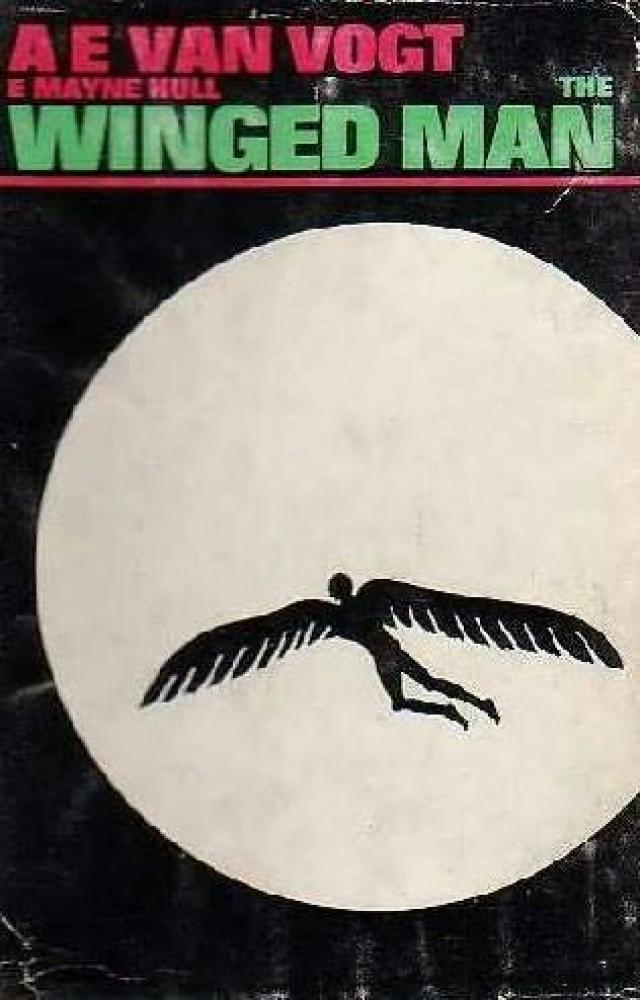


THE WINGED MAN
By
A.E. VAN VOGT
and
E. MAYNE HULL
Version 1.0
COPYRIGHT © 1966 by A. E. van Vogt
COPYRIGHT 1944 by Street & Smith Publications, Inc.
SBN 425-01946-2
Chapter 1
In the darkness, the bird swept the submarine from stem to stern, swooping along almost at deck level and about a dozen yards to port. It was an enormous shape; and Kenlon, who saw the movement of it against the clouded sky, turned and watched it swerve away and vanish, flying strongly, into the northwest.
Kenlon glanced questioningly at Quartermaster Reichert, who was busy with the electric steering gear. But the man seemed not to have noticed the strange bird's passage. Once again, Kenlon faced in the direction the bird had taken. He said under his breath:
"Wrong direction, birdie! If you want to stay alive, the route is not in the direction of Tokyo. In fact—"
He stopped, frowning. Funny, he thought, funny! He picked the phone out of its waterproof box.
"Tedders speaking," said the voice of Lieutenant Tedders.
"It's a game I'm playing," said Kenlon. "And I ran out of fingers to count. How far are we from the nearest land?"
"You awaken me, sir," said Tedders indignantly, "out of the soundest sleep I've had in weeks—"
Kenlon grinned. There was a standing lottery among the crew members, which would be won by the first man who, when sent to rouse Tedders for special duty, found him asleep. The Sea Serpent's third officer had the astonishing faculty of waking up a few seconds before he was called.
No one had ever seen him nodding when he was on duty. He was on duty now.
Tedders finished his plaint; then: "In response to your question, Mr. Kenlon, the Pacific is perhaps the largest body of ocean in this hemisphere, and the U.S.S. Sea Serpent, heading out from base on the longest trial run of its short career, is now some twelve hundred miles from the nearest known atoll. Maybe that's a little exaggerated."
"Dazzle me further," Kenlon coaxed, "with your knowledge. String me off quite casually the names of all the large birds you know of that can fly twenty-four hundred miles."
"We-e-l-ll, there's the albatross."
He paused, and Kenlon urged: "Yes, yes, go on."
"See here," Tedders said irritably, "I'll have you know that when the Korean War began, back there aways, I was just getting comfortably settled into a large chair with a cushion in the firm of Carruthers, Carruthers, Tait, and Carruthers, who are not ornithologists. No one will ever be able to give me a rational explanation of why, after the war was over, I decided to stay in the service and spend the rest of my life in a mechanical sewer pipe under the sea."
"Albatross," Kenlon mused aloud. "That's a chap with a twelve- to fourteen-foot wing spread?"
"That's right."
"With a long, strong bill, hooked at the end?"
"Huhuh!"
"Fourteen feathers in its rounded tail and very narrow Wings?"
"You're getting awfully warm."
"You'll have to do better than that," Kenlon announced. "That isn't the one. The one I saw had an eighteen-foot wing spread, with rather wide wings—"
"Maybe it's the daddy of all albatrosses."
"—no bill, no tail feathers at all," Kenlon went on, "and a body that seemed awkwardly large even for that wing spread. Question: Do bats grow to the size of small airplanes?"
"Question," said Tedders. "Do first officers go batty after they've spent a certain amount of time each night above the hatch? Or is this a case of too much down the hatch from a secret supply of joy juice?"
Kenlon, who never drank, frowned. He had, he knew, no business being offended, since it was he who had started the little byplay. To be practically told, however, that he was mentally disembarked, was hard taking. He said curtly:
"I'll make further observations, Mr. Tedders, and this time I shall wear glasses."
He hung up, and stood there in the darkness, staring up into the night sky. The clouds had thickened where the bird had disappeared, but to the southwest, where the moon rode behind white cumulus, there were patches of blue sky, from which starlight flickered.
Up in those heights a wind must have been blowing. Because abruptly the moon swam into one of the dark-blue windows. Its light streamed from an opening that widened rapidly. Through the expanding channel, the white moon rays poured down over the submarine and fired the intensely black sea with a lane of light.
A shadow darkened the face of the moon. Kenlon, on the verge of turning away, glanced up again. Then he gasped. And caught at the railing with tense fingers.
Plainly silhouetted against the moon was the figure of a tall man with wings. The wings were only partly spread; and they were not moving. He seemed to be poised there like a creature out of a nightmare, black as only a shadowed outline can be. Intently he stared down toward Kenlon.
For a long instant, that was the picture, like a "still" taken at night. And then, the legs drew up, the body lost its manlike appearance.
A great bird swooped out of the path of the moon into the covering darkness.
The minutes trickled by. The long, gleaming supership rolled and hissed through the slow swell, a monster surging at speed through a dark sea.
The atomic-powered steam turbines maintained their strong forward drive. A head poked up through the hatch.
"May I come up, Mr. Kenlon?" said Tedders.
Kenlon nodded. "What is it?"
Tedders climbed up beside him. "I've been thinking," he said, "of birds with eighteen-foot wing spreads, of an officer named William Kenlon who is famed for his snap judgments as to distance, and whose estimates of the length of ships seen a mile or more away are final. And lastly I've been thinking very hard indeed of a certain guy named Tedders, who isn't bright enough to realize when a conversation is serious." He broke off. "You actually saw that bird?"
It was an apology. Which meant that Kenlon's final words on the phone had shown his pique.
Kenlon hesitated. He went over in his mind the words he would have to use to explain exactly what his last visualization had been. And shook his head ever so slightly.
"It was dark," he said, "and it was over there" — he pointed into the night — "and all I really got was an impression."
"Aeronautically speaking," said Tedders, "I'm only a lightweight. I almost joined the air force — almost meaning that they turned me down flat. But could it possibly have been a very slow, small plane? Some kind of an observational plane? After all, a lot of people would like to know just what we've got here."
Kenlon did not reply immediately. And it wasn't that he considered the other's argument worth thinking about. It was Tedders' assumption that he had been deadly serious on the phone that brought the startled realization — that he had been.
He thought intensely: What did I see? A manlike bird with a wing spread of eighteen feet!
He found himself, uncertainly, wondering if some country had succeeded in inventing wing attachments for human beings.
It was a new idea completely; and it took a minute to fix the mechanical problems of such an invention in his mind.
He came out of the brief reverie with the conviction that he had better say as little as possible. He mustered a grin and stared down at the dapper Tedders.
"A plane of that kind away out here?" he said incredulously. "Besides, a plane would have registered on our instruments; but there have been no reports. Apparently, I was the only one who saw it, and even I'm not sure—"
"Mr. Kenlon."
It was Quartermaster Reichert. Kenlon half-turned, startled by the interruption.
"Yes?" he said.
"Did you send somebody down to the end of the for'ard deck, sir?"
"Did I what?" Kenlon asked.
He twisted. Then he was down on the deck, racing along toward the shape that was clinging to the prow. He could hear Reichert's heavy footsteps close behind him; and, somewhere in the rear, Tedders was shouting muffled commands down the hatch.
As Kenlon approached, the winged man looked up. In the darkness, his great eyes shone like dull jewels. It was too dark to make out the features of his face, or even the contours of his body.
All that mattered, all that Kenlon concentrated on after one flashing look, was that the birdman was in some way fastening what looked like a brassy pie tin to the out-jutting edge of the prow of the Sea Serpent.
The metal thing shone and danced with streaking flashes of dimly reflecting light from a now partially hidden moon. Above it towered the crouching man, his monstrous wings flapping from well down behind his shoulder blades.
And he didn't move. He clung there, with a curious desperation, and pressed his metal pan against the metal of the submarine — as Kenlon vaulted over the low railing, and, clutching the flagpole for support, jabbed with his fist. He struck a very light, fuzzy body that, somehow, retreated before his blow, and then lunged forward. Hands grabbed him; and he was plummeted back over the railing to the safety of the deck.
The creature followed, striking its wings against the air as it dived at him.
Exactly what instant the searchlight went on, Kenlon had no clear idea. He was fighting, struggling with a human body that was as light as thistledown, but as strong as he was.
Great wings beat down at his head. Abruptly, the bird-man broke free.
Kenlon had a flashing glimpse of a lean, intent face, with human lips drawn back to show white teeth. Then the slend
Behind Kenlon, like an anticlimax, a machine gun began to stutter uncertainly into the night.
Chapter 2
Tugging did no good. The shiny pie-plate-like object clung unmoving to the hard steel prow.
Sweating, Kenlon looked up to where Lieutenant Commander Jones-Gordon was kneeling beside the flagpole holding with strong fingers to Kenlon's right wrist while Kenlon worked with his left hand. Trembling from exhaustion, Kenlon finally said:
"What do you think, sir — a blowtorch to burn it off?"
"Who'll wield it?" the commander said drably. "The heat may set off the bomb!"
Incredibly, Kenlon hadn't even thought of it as a bomb. In the excitement, he had forgotten everything but the necessities of the moment.
Now, he felt himself change color. He stared at the object with a horror that presently submerged into the memory that he was a married man with one kid, who had no business getting himself killed.
For a brief moment, that thought held him rigid; then he looked up into Jones-Gordon's eyes. He said with a stiff smile:
"I'm here; I'll do what's necessary."
He raised his voice: "Reichert, bring a blowtorch, and rope scaffolding. Get a couple of men to help. On the double!"
"Aye, aye, sir!"
"It looks transparent; it doesn't look like a bomb," said the commander thoughtfully. He was a square-jawed young man with warm blue eyes. "And besides it's too small to do us any real damage. Come up here, Mr. Kenlon."
Kenlon couldn't have made it himself. Jones-Gordon's strong hands pulled his weakened body over the railing; and only naval training made it possible for him to straighten his trembling form, and stand there rigidly.
His superior said unsmilingly, "It's a good thing I hadn't gone to bed. I wouldn't have believed it if I hadn't seen it myself. Bill, what was it?"
"A man with wings like a bird," Kenlon began.
He stopped. The words jarred through his mind; his whole body grew taut with the unheard-of-reality that was here. He repeated softly:
"A man with wings… sir, we must be mad."
Slantwise, out of the corners of his eyes, Kenlon saw the pie tin-shaped "bomb" that the creature had left. And the thought suffered a relapse. If there was madness here, it wasn't of the officers and crew of the Sea Serpent. Jones-Gordon was speaking again:
"There are several questions that arise: Where did… it … come from? What is… it? What was its purpose? And where is it now?"
The questions remained unanswered, as Reichert and two men arrived with the required paraphernalia. In a minute Kenlon was dangling from the railing, this time without physical strain.
"It's transparent, all right," he announced, "and the interior looks like an oddly designed radio tube. Get MacRae."
While they waited for the radio operator, Kenlon had time to grasp the eeriness of this scene here in the middle of the Pacific. The glaring searchlight had been shut off. In a darkness broken only by the cautious probings of flashlights, the submarine was like a ghost in an endless black sea.
Now that the marvelous and intricate warship had slowed to a snail's pace, the breeze created by its movement had ceased; and it was hot. Where he was, slung just above the abyss of sea, it seemed even hotter and, as always at night, the area just above water was infinitely blacker.
It was a world apart; somewhere up there in the cloudy skies, the creature was winging back toward the ship from which it must have come, or perhaps there was no ship.
Kenlon gasped: "Commander, do you realize that there is a possibility the creature has no other point where it can land, except this submarine?"
The odd thing was that he had no doubt of it at all now. The birdman would have to come back.
MacRae lowered himself gingerly over the bulging front of the sling on which Kenlon sat. He was a small, chunky man, and he moaned softly to Kenlon:
"If only Mother could see her boy now. But I rise bravely to the emergency, daring all, promising nothing. Hold that flash at an angle, Mr. Kenlon. I'll look in from this side." Kenlon obliged silently.
"Definitely not a bomb," MacRae grunted. "Electronic, all right, multigrid. Some of the connections don't make much sense." He broke off. "Huh!" he said violently. "What's the matter?" Kenlon asked quickly. "There's a little tube inside that's just hanging there in the center of a vacuum. It's not attached to anything. Take a look, Mr. Kenlon, and tell me if I'm crazy. Over to the right 'Scuse me, that'll be left to you."
Kenlon started to bend down, but before he could get a good look, Lieutenant Commander Jones-Gordon called sharply:
"Mr. MacRae, could that device be used by an enemy submarine to locate us?"
It was a silly question. It didn't sound silly, Kenlon knew that. But it was. It was possible, however, that no one but himself would realize why.
They had only seen the creature flashingly, and from a distance. But he had fought him. He had felt the soft, fuzzy skin; the great living wings had hammered at his head. His fingers had clutched a man's slight but powerful body, a body inhumanly light, weighing not more than thirty-five pounds.
Their minds were already growing vague on the details, on the alienness, seeking some natural explanation, something that fitted in with life as it had been lived for ten thousand years, and particularly as it fitted with wars and nations suspicious of each other's weaponry.
But not so long as he lived would he forget the nerve-tingling, the amazing, reality of what he had seen and touched.
And his mind wouldn't reach down to the depths or up to the heights that hid the explanation.
He heard MacRae say: "There's no power source, sir, no battery. I don't see how it can be used for anything as it is now."
The commander must have reached his decision in advance. For he said instantly:
"Both of you come up. Mr. MacRae, you may return below. Mr. Kenlon, I want to talk to you. Paley" — he turned to one of the two assistant machinists — "burn that thing off, but don't let it drop into the sea. We want it Munson, give Paley a hand."
It was an action taken, a positivity. And it cleared the air. It was a base from which to work. The menace, the sense of alienness, grew dimmer.
When they were alone on the conning tower, Jones-Gordon said grimly:
"Why did he stay? What was his reason for fighting you those few minutes?"
It was not a question to which Kenlon felt he had the correct answer, but he had considered it. He said:
"I think, Commander, he wanted to gain time."
"Time for what?"
"He was fastening that… well… radio device onto our prow. The solder, or whatever welding process was used, had to be allowed to set."
Jones-Gordon grunted. "Sounds reasonable," he admitted. "He took grave risks."
He added as an afterthought: "We're not through with him yet."
In the darkness, Kenlon stared keenly at his skipper. He had always thought Jones-Gordon a superior businessman type, who had somehow been sidetracked to Annapolis.
His estimate of the officer's capabilities rocketed before this example of adaptability. His earlier opinion, that Jones-Gordon had asked a silly question, had failed to take into account the fact that a commander was required to go to extreme lengths to insure the safety of his ship. And in this particular instance it was also required that he see to it that no other power gained any knowledge of the craft or its performance while it was under his command.
"Have you," Jones-Gordon said, "any suggestions?"
Kenlon shrugged. "We must get that tube off. That's a priority. And I would suggest that the deck patrol carry on all night. It would be a great thing if we could catch him alive. Otherwise" — his lips twisted wryly — "we'd better not even report what we saw."
Lieutenant Commander Jones-Gordon's voice came dryly out of the night: "I see exactly what you mean, Lieutenant. I—"
He broke off, called sharply: "What is it, Munson?"
"Paley asks me to tell you, sir, that the blowtorch won't work on either the thing or the steel around it. Doesn't even get soft, he says. He wants to know what he should do."






