The matchmaker, p.1
The Matchmaker, page 1


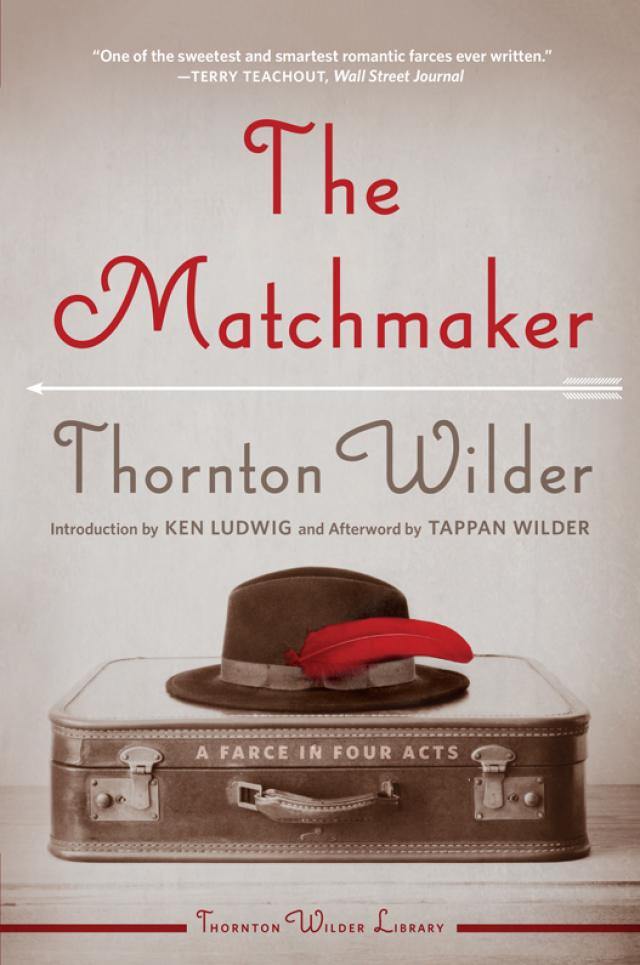
Contents
Cover
Title Page
Introduction by Ken Ludwig
The Matchmaker: A Farce in Four Acts Act I
Act II
Act III
Act IV
Afterword by Tappan Wilder
Acknowledgments
About the Author
Also by Thornton Wilder
Credits
Copyright
About the Publisher
Introduction
Thornton Wilder’s The Matchmaker is that rarest of birds: a virtually perfect stage comedy. Indeed, along with Hecht and MacArthur’s The Front Page and Kaufman and Hart’s You Can’t Take It With You, it is one of the three or four greatest American comedies of the twentieth century.
Successfully creating timeless comedy for the stage is an art of enormous rarity. Shakespeare and Shaw managed it over ten times each. After that, the roll call includes Farquhar, Goldsmith, Sheridan, O’Keeffe, A. W. Pinero, Wilde, and Coward. And among that number we can count Wilder’s The Matchmaker.
The play started life with a different title, The Merchant of Yonkers, and when it opened on Broadway in 1938, directed by the famous Max Reinhardt, it failed with the critics and closed quickly. Then, sixteen years later, something remarkable happened: the play reopened in a slightly altered version with a new director and cast, and it was a triumph, traveling from the Edinburgh Festival to London, then back to New York in a resurrection of a scope heretofore known only to the Christian religion, and certainly unprecedented in the history of Broadway. It is a testament not only to Wilder’s faith in the play but also to the quality of the play itself.
So how did Wilder do it? How did he write this mini miracle of construction, high spirits, and emotional wallop? I’ve spent a great deal of my writing life thinking about the structure and content of stage comedy in the English language, from Twelfth Night to One Man, Two Guvnors, and I’ve concluded that in order to write a good one, you need four ingredients: a strong premise, a solid structure, wit, and resonance. The Matchmaker has all of these in abundance.
As for premise, The Matchmaker has not one but two strong story lines. The first is about two country mice who escape to the big city for a day of adventure. The mice in question, Cornelius Hackl and Barnaby Tucker, are clerks in a dry goods store in the small town of Yonkers, New York, in the early 1880s. When their employer, Horace Vandergelder, tells them he’ll be away for the day, they resolve to spend that day living large in New York City so that they’ll have a past to remember in the years ahead. In the end, the day of adventure changes their lives forever.
The second story concerns a middle-aged heroine named Dolly Levi who yearns for a second chance at life. She gets it by coming to terms with the memory of her late husband, then marrying a lovable curmudgeon, Horace Vandergelder, who can give her something to look forward to.
Wilder based the first of these plots on a comedy titled Einen Jux will er sich machen, written in 1842 by the popular Viennese playwright Johann Nestroy. Comedy, even more than tragedy and melodrama, seems to require a strong premise, and the greatest playwrights have often looked backwards, seeking plots in the works of their literary forebears. Shakespeare was the master of borrowed plots, and Wilder did it several times in his career.
In 1932, Wilder adapted a German translation of the successful, contemporary Hungarian comedy The Bride of Torozko by Ottó Indig. The lively story is set in a small village in Eastern Europe and concerns a spunky young woman who discovers, just before she’s about to be married, that she’s Jewish—and during the course of the play she falls in love with her Jewish roots and out of love with her anti-Semitic fiancé. (Wilder, of mostly Protestant stock, liked to remind people that one of his ancestors was Jewish.)
Sometime before 1939, Wilder was asked by two notable Broadway producers to do an adaptation of a play with another strong storyline, The Beaux’ Stratagem, a late Restoration comedy by George Farquhar. It concerns two down-on-their-luck city bucks who travel to the countryside to find rich wives; and as they travel from town to town, they switch identities as servant and master. Wilder abandoned the adaptation halfway through. Lucky me, a few years ago I was asked by the Wilder estate to finish it, and it has been playing in theaters around the country ever since. Knowing the original Farquhar play and Wilder adaptation as well as I do, I can see with absolute clarity why Wilder agreed to refashion the original play: because the backbone of the story is as strong as an oak. It has just the kind of sturdy, specific plot that a classic comedy needs.
As for the Dolly Levi portion of the plot, it was invented by Wilder from whole cloth. That said, it has strong roots in two traditions of comic drama that Wilder knew well. First, it tips its hat to Molière, particularly in Act One where Dolly tempts Vandergelder with the domestic delights of Ernestina Simple, using dialogue from Molière’s L’Avare. Second, Dolly herself is in the great tradition of comic servants and factotums who save the day, her most obvious forebear being Figaro in The Barber of Seville. Like Figaro, Dolly has a number of skills that she markets with glee (she sells hosiery, gives guitar lessons, reduces varicose veins), and, like Figaro, she arranges marriages. In these homages to Molière and Beaumarchais (and thereby to Plautus and Shakespeare), Wilder acknowledges the debt he owes to the comic tradition that has come before him. As Wilder himself once said: “Literature has always more resembled a torch race than a furious dispute among heirs.”
In one of his typical moments of modesty, Wilder put it this way: “I am not an innovator, but a rediscoverer of forgotten goods.” Well, yes and no. Yes, The Matchmaker is a tip of the hat to the Ye Liberty Playhouse plays of Wilder’s youth; yes, the one-act plays and Our Town owe a debt to Shakespeare, as well as, to a lesser extent, Japanese Noh drama; and yes, as A. R. Gurney has observed, Wilder shared a belief with Sophocles, Shakespeare, and George Bernard Shaw in the ability of the human struggle to circumvent the Olympic order of things. But despite his own statements to the contrary, Wilder wasn’t merely a rediscoverer, he was one of the greatest innovators in the history of American drama.
Turning to structure, Wilder had a lot to draw on. He was an intellectual at heart who knew the history of drama as well as anyone of his generation. He started early, hiding in the back rows of local theaters, and one of his hobbies in later life was dating the hundreds of plays of Lope de Vega. As he said once in an interview:
I would always advise any young writer for the theater to do everything—to adapt plays, to translate plays, to hang around theaters, to paint scenery, to become an actor. . . . There’s a bottomless pit in the acquisition of how to tell an imagined story to listeners and viewers.
The Matchmaker is a masterpiece of plotting. A play needs an overall arc of action—at least the kind of play that Wilder loved—and each act of a comedy needs the same sort of arc. Just look at how Wilder handles this in The Matchmaker. Act One opens with Vandergelder juggling the demands of family and business, and it ends with an explosion of canned goods as his employees declare their day of freedom. Act Two opens with a sensible woman vowing to marry a man she doesn’t love and ends with a song by the man she’s beginning to love as they stand on the brink of the biggest night of their lives. Act Three opens quietly as Vandergelder instructs a waiter on how to serve him a sensible dinner and ends in comic chaos that is full of discoveries.
MRS. LEVI:
Well, there’s your life, Mr. Vandergelder! Without niece—without clerks—without bride—and without your purse. Will you marry me now?
VANDERGELDER:
No!
MRS. LEVI:
Damn!!
THE CURTAIN FALLS
Wilder was a “playwright” in the true sense of the word. He was a wright, a craftsman, a writer who feels a kinship to the shipwright and the wheelwright and all the other wrights whose livelihoods depend on training and technique.
Wilder was also a master of a second kind of comic structure: he built his play on certain traditional comic motifs, some of which were established by Plautus, others of which were invented by Shakespeare. By my count, there are about twelve basic motifs, or themes, that recur again and again in comedies down through the ages, and The Matchmaker contains quite a handful of them.
One of the foremost of these is when the older generation tries to stand in the way of the sexual urges of the younger generation, and Wilder pounces on it in the very first line of the play. The lights come up and Vandergelder, who is getting a shave, declares to a young man standing nearby:
VANDERGELDER:
Loudly.
I tell you for the hundredth time, you will never marry my niece.
Did Wilder know A Midsummer Night’s Dream, She Stoops to Conquer, and The Rivals like the back of his hand? You bet he did. This is no coincidence.
Other time-honored comic motifs that Wilder drew upon include that of the country mice going to the big city (compare The Taming of the Shrew, Pots of Money), the bickering couple who end up together (Much Ado About Nothing, Private Lives), the older man who desires a young wife (The School for Scandal, London Assurance), the wily servant who saves the day (A Servant of Two Masters, One Man, Two Guvnors), and on it goes with at least three or four more motifs clearly in evidence. Wilder turned The Matchmaker into a master class of comic themes.
As for the element of wit, The Matchmaker abounds in verbal virtuosity on every page. Five lines after Vandergelder’s opening gambit, Joe the barber says, “Mr. Vandergelder, will you please sit still o ne minute? If I cut your throat it’ll be practically unintentional.” Four pages later, Wilder layers two great lines on top of each other:
VANDERGELDER:
A man’s not worth a cent until he’s forty. We just pay ’em wages to make mistakes—don’t we, Joe?
JOE:
You almost lost an ear on it, Mr. Vandergelder.
In his first soliloquy, Vandergelder opines: “Marriage is a bribe to make a housekeeper think she’s a householder.” And my favorite of all is in Act Three when an apoplectic Vandergelder hires the Cabman to try to stop his niece Ermengarde from eloping with her boyfriend. The Cabman responds calmly: “Oh I know them, sir. They’ll win in the end. Rivers don’t run uphill.”
Here, in just four words, Wilder tells us all we need to know about the unstoppable determination of love and youth. “Rivers don’t run uphill.” It reminds me of the beauty of Puck’s lines in A Midsummer Night’s Dream when the lovers finally, inevitably, come together: “Jack shall have Jill, / Naught shall go ill, / The man shall have his mare again and all shall be well.”
As for the resonance of the play, it has the ping of a Stradivarius in the way all great plays do, by a sort of alchemy made up of all the right elements. It’s concise, it’s specific, it’s universal, it’s observant, it’s entertaining, it’s sparkling, it’s challenging, and it’s reassuring, all at once. It is set in a time and place where we’d all like to live, and the very names of the characters evoke the spirit of the play: Cornelius Hackl, Barnaby Tucker, Ermengarde, Ernestina Simple, Minnie Fay. These are fairytale names with a knowing smile.
Wilder has a lot to say in The Matchmaker and his serious themes are woven seamlessly into the farcical horseplay. The value of money to cure social ills is a theme that Dolly herself expands on several times in the play. Another theme, as Wilder describes it, is “the aspiration of human beings” for a “fuller, freer participation in life.” Young Barnaby sums up this key theme at the end of the play with disarming simplicity when he addresses the audience directly and says: “We all hope that in your lives you have just the right amount of sitting quietly at home, and just the right amount of . . . adventure. Goodnight!”
Wilder was wary of imposing themes too explicitly in his plays and he admired Shakespeare above all other playwrights for being profound without grinding axes. In an interview with The Paris Review, he said:
[A]ll the great dramatists, except the very greatest one, have precisely employed the stage to convey a moral or religious point of view concerning the action. The theater is supremely fitted to say: “Behold! These things are.” Yet most dramatists employ it to say: “This moral truth can be learned from beholding this action.” . . . Only in Shakespeare are we free of hearing axes grind.
In the end—and this may explain why I love it so much—The Matchmaker is a genuine, good-hearted, good-natured comedy and there simply aren’t enough of them in the world’s repertoire. As a species, we have a tendency to wallow in our tragedies, often at the expense of those kinder spirits that put us back on our feet when we need a helping hand. Yes, all those thunderous theatrical ordeals are heart-stopping, yes, they’re cathartic, yes, they make us suffer, and sometimes we’re the better for it. But my loyalty is to those works of art that make my heart take wing. Jane Austen puts it this way at the end of Mansfield Park:
Let other pens dwell on guilt and misery. I quit such odious subjects as soon as I can, impatient to restore everybody, not greatly in fault themselves, to tolerable comfort, and to have done with all the rest.
Wilder himself puts it best of all:
Anybody can make a comedy which is cruel. It is very hard to make a comedy which is kind. To give a fellow feeling between the young and old, that is art.
And that is The Matchmaker.
KEN LUDWIG
Wesley Heights, Washington, D.C.
Ken Ludwig is a two-time Olivier Award-winning playwright whose work has been performed in more than thirty countries in over twenty languages. He has written twenty-four plays and musicals, among them Lend Me A Tenor, which won two Tony Awards, Crazy For You, which won the Tony Award for Best Musical, Moon Over Buffalo, and Baskerville. His shows have had six productions on Broadway and seven in London’s West End. His book How To Teach Your Children Shakespeare is published by Random House.
The Matchmaker: A Farce in Four Acts
The Merchant of Yonkers was produced by Herman Shumlin and directed by Max Reinhardt. The production was designed by Boris Aronson. The cast included Jane Cowl, June Walker, Nydia Westman, Minna Phillips, Percy Waram, Tom Ewell, John Call, Joseph Sweeney, Philip Coolidge, and Edward Nannery. It was first performed on December 12, 1938, at the Colonial Theatre, Boston. The New York engagement opened at the Guild Theatre on December 28, 1938.
The Matchmaker was produced for the Edinburgh Festival by Tennent Productions. It was directed by Dr. Tyrone Guthrie, and the production was designed by Tanya Moiseiwitsch. The first performance was at the Royal Lyceum Theatre, Edinburgh, on August 23, 1954.
The same production opened at the Theatre Royal, Hay-market, London, on November 4, 1954. Without changes in the principal roles—with the exception of that of Mr. Vandergelder, which was played successively by Sam Levene, Eddie Mayehoff, and Loring Smith—the play was performed at the Locust Street Theatre, Philadelphia, on October 27, 1955.
The cast of the play from Edinburgh to New York, with the exceptions noted, included:
HORACE VANDERGELDER
Loring Smith
CORNELIUS HACKL
Arthur Hill
BARNABY TUCKER
Robert Morse (following Alec McCowen)
MALACHI STACK
Patrick McAlinney
AMBROSE KEMPER
Alexander Davion (following Lee Montague)
WAITERS
William Lanteau (following and followed by Timothy Findley) and John Milligan
CABMAN
Peter Bayliss
DOLLY LEVI
Ruth Gordon
IRENE MOLLOY
Eileen Herlie
MINNIE FAY
Rosamund Greenwood
ERMENGARDE
Prunella Scales
GERTRUDE
Charity Grace (following Henzie Raeburn)
FLORA VAN HUYSEN
Esme Church
COOK
Christine Thomas (following Daphne Newton)
This play is a rewritten version of The Merchant of Yonkers, which was directed in 1938 by Max Reinhardt and is again dedicated to Max Reinhardt with deep admiration and indebtedness.
CHARACTERS
TIME: 1880s.
Act I. Vandergelder’s house in Yonkers, New York.
Act II. Mrs. Molloy’s hat shop, New York.
Act III. The Harmonia Gardens Restaurant
on the Battery, New York.
Act IV. Miss Van Huysen’s house, New York.
This play is based upon a comedy by Johann Nestroy, Einen Jux will er sich machen (Vienna, 1842), which was in turn based upon an English original, A Day Well Spent (London, 1835) by John Oxenford.
Act I
Living room of Mr. Vandergelder’s house, over his hay, feed and provision store in Yonkers, fifteen miles north of New York City. Articles from the store have overflowed into this room; it has not been cleaned for a long time and is in some disorder, but it is not sordid or gloomy.
There are three entrances. One at the center back leads into the principal rooms of the house. One on the back right (all the directions are from the point of view of the actors) opens on steps which descend to the street door. One on the left leads to Ermengarde’s room.
In the center of the room is a trap door; below it is a ladder descending to the store below.
Behind the trap door and to the left of it is a tall accountant’s desk; to the left of it is an old-fashioned stove with a stovepipe going up into the ceiling. Before the desk is a tall stool. On the right of the stage is a table with some chairs about it.