

Herc, p.1
Herc, page 1
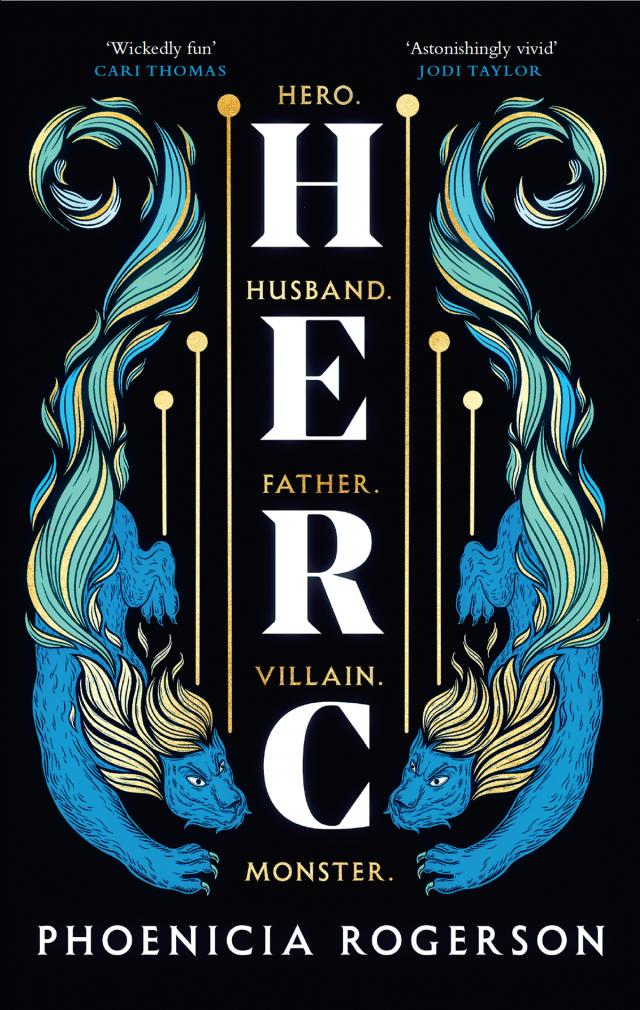


‘Alternately hilarious and shocking, this is an astonishingly vivid retelling of the story of Hercules, and these are not the Greek myths I learned in school.’
Jodi Taylor, author of Just One Damned Thing After Another
‘A brilliant debut! Rogerson has produced a fresh and totally original retelling of the Hercules myth. For the first time, long-silent characters from the hero’s story are given a voice. They provide a sparkling new perspective on the club-wielding, all-daring son of Zeus.
A Herculean triumph of creative writing, and a joy to read. Finally, a Hercules for the twenty-first century!’
Alex Rowson, author of The Young Alexander
‘Hercules had his story, now it’s time for everyone else to get their say. Wickedly fun and devilishly dark – the tell-all for our times.’
Cari Thomas, author of Threadneedle
‘A captivating retelling with a very definite, personal voice, and a sharp, fresh perspective on the lives surrounding the hero.’
Genevieve Cogman, author of The Invisible Library
‘A brilliant, witty and unique retelling of the myths that at times had me laughing out loud. Rogerson’s impressive talent leaps from the pages.’
Carly Reagon, author of The Toll House
‘Funny, action-packed, violent, tragic … this is the story of Hercules as you’ve never experienced it before! An eye-opening treat.’
A.J. Elwood, author of The Cottingley Cuckoo
Readers are loving Herc!
‘A fun, modern and hilarious take on the Greek tale’ 5-star Netgalley review
‘I was hooked’ 5-star Netgalley review
‘A brilliant retelling of the story of Hercules with a unique twist’ 5-star Netgalley review
‘Like Narcissus looking in a mirror, I couldn’t put it down. It was an easy five stars’ 5-star Netgalley review
‘There’s love, there’s humour and there’s tragedy, all wrapped up in a tale that twists the source material to create a fresh and engaging look at Hercules’ 5-star Netgalley review
PHOENICIA ROGERSON is altogether mortal with a rather less chequered past than Hercules. After a decade of not being able to find his complete story on bookshelves, she decided to pull her socks up and write it herself. She’s had two short stories published in the UCL Publisher’s Prize. She lives and works in London. Herc is her first novel.
Copyright
An imprint of HarperCollinsPublishers Ltd
1 London Bridge Street
London SE1 9GF
www.harpercollins.co.uk
HarperCollinsPublishers
Macken House, 39/40 Mayor Street Upper,
Dublin 1, D01 C9W8, Ireland
This edition 2023
First published in Great Britain by HQ in 2023
Copyright © Phoenicia Rogerson 2023
Phoenicia Rogerson asserts the moral right to be identified as the author of this work.
A catalogue record for this book is available from the British Library.
This novel is entirely a work of fiction. The names, characters and incidents portrayed in it are the work of the author’s imagination. Any resemblance to actual persons, living or dead, events or localities is entirely coincidental.
All rights reserved under International and Pan-American Copyright Conventions. By payment of the required fees, you have been granted the non-exclusive, non-transferable right to access and read the text of this e-book on-screen. No part of this text may be reproduced, transmitted, downloaded, decompiled, reverse engineered, or stored in or introduced into any information storage and retrieval system, in any form or by any means, whether electronic or mechanical, now known or hereinafter invented, without the express written permission of HarperCollins.
Source ISBN: 9780008589820
Ebook Edition © AUGUST 2023 ISBN: 9780008589851
Version 2023-07-04
Note to Readers
This ebook contains the following accessibility features which, if supported by your device, can be accessed via your ereader/accessibility settings:
Change of font size and line height
Change of background and font colours
Change of font
Change justification
Text to speech
Page numbers taken from the following print edition: ISBN 9780008589820
For Hope
Contents
Cover
About the Author
Title Page
Copyright
Note to Readers
Dedication
Amphitryon I
Iphicles I
The Linus Letters
Trial Summary of Thrace vs Heracles
Amphitryon II
Hylas I
Megara I
Doctor’s Notes
Eurystheus I
Iolaus I
Hylas II
Jason I
Laonome I
Hylas III
Iphicles II
Theseus I
Eurystheus/Augeas Letters
Eurystheus II
Hippolyta I
Hylas IV
Doodles on a Throne
Eurystheus III
Iolaus II
Race Report, Olympics
Iole I
Iphitus I
Theseus II
Augeas I
Deiphobus I
Xenoclea I
Iolaus III
Sale Note
Wedding Invitation
Omphale I
Icarus
A Request
Atalanta I
Omphale II
Ariadne I
Marina I
Fifty
Graffiti
Laonome II
Iphicles III
Priam I
Laonome III
Wedding Notice
Eurystheus IV
Last Will and Testament of Eurystheus
Iphicles IV
Hippocoon I
Iolaus IV
Iolaus’ Speech at Iph’s Funeral
Deianira I
Hylas V
Deianira II
Iole II
Nessus I
Iole’s Note
Deianira III
Iolaus V
The Epitaph
Dramatis Personae
Author’s Note
Acknowledgements
About the Publisher
Amphitryon I
We wanted a girl. Alcmene, my wife, and I were born of heroes, which sounds dramatic but mostly meant we had a family history of fire, glory, and dying young. So it came up one night, our legs tangled around each other. I’d like a girl, for our first, whispered, like it was something to be ashamed of. But being born of heroes means nothing runs smooth and we had twin boys.
The conception took place over three nights, and one.
Alcmene was an incredible woman. Smarter than I am, by half. She could hold a thousand thoughts in her head at once and always know exactly which one she needed. She was beautiful too. She stood tall and straight, with muscles in her arms and with eyes that took in everything around her, and she loved me. I defy any man not to find that beautiful.
Maybe, then, it shouldn’t have come as a surprise when she attracted the attention of a god – Zeus, the king himself – but it did, because when he appeared to her, he was wearing my face.
There was a prophecy. It said a descendant of Zeus born around a certain time would rule all those around him. I don’t know why this particular prophecy was so important to Zeus – his progeny tended to grow up to be kings anyway – but it’s best not to question the gods. He decided this son should have a particularly impressive bloodline, so he turned to my wife, born of heroes.
I’m older than I was. I’ve had time to come to terms with it. I’ve tried very hard not to be angry with her. I know, logically, there’s nothing to be done when the king of the gods appears looking like your husband, but I have to wonder. Did he have my mannerisms too? My thoughts and my words and my movements?
The night Zeus appeared to my wife – did he knock on our door? – the world went dark.
I was away, trying to mint myself as a military leader before our family grew. I wanted to be a father to be proud of.
Three days, it stayed dark. What should have been the first morning, we brushed it off. We laughed that Apollo, who drives the sun, was being lazy, distracted by some nymph, maybe. By afternoon we’d stopped laughing – something about the utter blackness choked it off – and quietly speculated that this was the end for man. We supposed the Titans had risen from their prison in Tartarus and deposed their children, the gods, dragged them someplace even darker than the world we inhabited.
By what should have been the evening, I was riding home. Screw war. Screw honour. If this was the end, I wanted to spend it with my wife. By the end of the ride, my steed, a warhorse from as long and splendid a lineage as my own, was fit for nothing but pasture, but it didn’t matter. As our house crept into sight, so did the sun, rising behind it. I didn’t stop to speak to Alcmene, save fervent whispers of relief, as I scooped her up and carried her to bed.
Even in that state, I noticed the smell. The sheets were well worn, if we’re being polite. I thought nothing of it; my wife was probably lonely while I was at war. I told myself she didn’t want to wash my smell from the pillows in case it was the last she ever saw of me, but it wasn’t. I came home.
We enjoyed each other’s bodies and, for all the fear that preceded it, it was the la st time my life was truly simple. When she woke, Alcmene stretched. I’ve always loved the way she stretches, her arms reaching behind her as though she’ll be able to catch the world within them, but this time she winced.
‘Not that I didn’t have fun,’ she said. ‘But that last round may have been one too many for me.’ She grinned. A woman may have said she was glowing. My soldiers would have offered a coarser adjective.
‘What last round?’ I mumbled sleepily, enjoying the feeling of my own bed as much as I was the woman beside me. It was good to be home.
‘The last one,’ she said slowly, like I was some kind of idiot. I often am when I’m half asleep. Less often when I’m fully awake, but it happens.
‘There was only one.’
‘If that’s your definition of one round then I’m worried for my back, dear. Just because it was one night—’
‘It was morning,’ I said, frowning now.
‘Yes, the last round was in the morning. The rest of it was—’ She trailed off, the shape of a no forming on our lips as we realised we’d been opposite punchlines in a terrible joke. ‘We should go to the priest.’
‘Let’s,’ I said, wrapping an arm around her shoulder so she’d know, for all my shortness of words, I was with her.
The priest confirmed everything I’ve just told you, though by the end of it he couldn’t look Alcmene in the eye. Rather uptight creature, that priest. He added something, too, much scarier than any army or monster I’ve ever faced – twins. One for each father, he said. At least one is yours, he meant, which was wrong. They were both mine.
Well, they were both Alcmene’s and I was also there. The point is, I never thought of Iph as more mine than his brother. I worked hard not to.
The pregnancy felt unusually fast and unusually hard, but maybe that’s the fear speaking. Alcmene’s aunts certainly thought so, laughing it off as the paranoia of any new parent, but I couldn’t shake the feeling that something was off.
‘I like Alcaeus. Alcaeus and Iphicles,’ my wife said when we talked about their names. ‘What do you think?’ Personally I thought Alcmene, Amphitryon, Alcaeus, and Iphicles sounded like we were singling Iph out from the start, but they were inside her. She could have wanted to call them both Zeus and I’d agree.
‘Sounds wonderful, dear.’
‘It would be nice if they shared a room, I think. They should be friends, as well as brothers.’
‘Sounds wonderful, dear.’
And on and on it went, Alcmene trying to choose which way to go, as if we’d get a say.
The birth was another horrible three-day saga. After months spent praying to, and blessing, and offering dedications to the goddess of childbirth, she took the day off. No matter how hard Alcmene breathed and pushed and cursed, nothing happened. Not until the middle of the night ticked by and Artemis moved her moon beyond our seeing; then it all happened at once.
I’m told that was because of the prophecy too, that Hera didn’t want Zeus’ preferred offspring to rule, so she delayed his birth until after my brother’s son, Eurystheus, was born. That stung. It wasn’t the child’s fault, but one day he would rule the city that was meant to be mine – it would have been mine, bar an accident in my adolescence. But I couldn’t complain about that. My wife had been in labour for three days.
Our eldest was born, the son of Zeus himself. He was big, for a baby, but that was good. It meant he was healthy. As did the bellow he immediately emitted, scaring off every bird for miles. We handed him to his mother. She must have been shattered, the gods know I was shattered, but the smile on her face when she took him was breathtaking, like everything was suddenly right in this world.
After that, I almost missed Iph being born. He was smaller, but still healthy, still crying with a fine set of lungs. We – and by that I mean she – had done it. We were parents, juggling the boys to and fro as we tried to get them cleaned up.
Alcmene insisted on putting them to bed.
‘The first time at least.’ She smiled.
‘Sounds wonderful, dear.’
Only it wasn’t. No sooner had we sunk to sleep – honestly more of a plummet – than we were woken by a bloodcurdling cry.
‘Iphicles,’ Alcmene whispered. A laxer parent, I couldn’t tell the difference between the cries of our newborns. ‘There’s trouble.’
‘Babies cry, love. We shouldn’t pander to them,’ I mumbled, but she’d already left.
She was right, of course. Our eldest son had disappeared.
‘Where’s he gone?’ she said, almost too fast for me to follow. ‘How can he – the servants? No. Hera?’
Hera was, for lack of a better word, our eldest’s stepmother. She’s Zeus’ wife, and the goddess of marriage – a combination that must have been equal parts infuriating and embarrassing given Zeus’ general inability to remain faithful to her. She was never a huge fan of his illegitimate offspring, but I couldn’t imagine she’d stoop to killing an infant.
‘He probably just rolled out. We’ll find him,’ I tried to reassure her, but I was panicking too, and the panic made me stupid. We woke the servants and got to searching. We checked every inch of our home and grounds, but nothing showed, not until morning came. We were half mad by then, jumping at every little noise. It’s a wonder my heart didn’t stop altogether when we heard one of the maids scream.
‘Ma’am?’ She sounded afraid as she approached Alcmene. My heart plummeted in my chest. No no no no no. ‘I got him. He’s okay.’
He was more than okay. He was beaming where he lay, two feet deep in a muddy hole that fit his shape as if it’d been dug around him.
The story they tell is that one of the gods stole him from his crib, then gave him to Hera to nurse. If she had, it would’ve granted him more strength, something he really didn’t need. As it was, she realised who he was – salt rubbed into the still-open wound of Zeus’ infidelity – and flung him back to earth, the milk from her breast spreading across the sky, staining it with stars.
Stories. New stars were always appearing, marking the death or birth of someone or other. It would be vain to claim so many for my son.
Whatever the reason, we got him cleaned up and back to bed, none the worse for his little adventure. If anything his face said: please, Dad, can I go again?
The next night I put them to bed, just in case. We were woken by a scream, again. Iphicles, again. We went running, again, but they were both fine. Iph was crying, our eldest gurgling happily.
We looked more closely. Our eldest held the mashed remains of a snake in either hand, curled possessively towards his chest. Alcmene scooped him up.
‘Shh, Mummy’s here, you’re going to be safe. We’ve got you.’
I felt only seconds away from being called over to tell our newborn that yes, I was here too, and he was safe. I moved over to Iphicles instead. He was still screaming. I held him so he’d know he wasn’t alone. I didn’t promise him anything.
We called the priest, the same one as before, who seemed particularly grumpy to be making early morning house calls but there you go. He ummed and ahhed while he avoided touching the snake-mash that seemed to be getting everywhere.
‘Maybe it was a coincidence?’
‘No,’ Alcmene said, her tone implying the priest possessed some mental deficiency. ‘I don’t think an incredibly rare venomous snake coincidentally slithered into my newborn’s fists.’
I thought it was a bluff, about the snake being venomous, but she shook her head when I asked.
‘I asked an expert. With the pregnancy, it seemed prudent.’
Over the years I’d find hundreds of things my wife had learned because it seemed prudent. Emergency medical care. The smell and colour of any easily available poisons, and many of the more difficult ones too. How to pacify wild animals, and wilder men. She kept knives in her sandals, and I found them hidden on high shelves more than once.
‘That’s two in two nights,’ I said quietly to the priest. ‘What do we do?’
‘Appease whoever’s trying to kill him,’ he said flippantly, before realising who he was talking to and flinching. ‘I am sorry, my lord. It’s early – I forget myself.’
‘Don’t be,’ Alcmene said. ‘You’re right.’
How does one appease a goddess? We couldn’t make offerings that would have any meaning to her – what does a mortal, even a general, have that a god wants?






