Lalo lesperance never fo.., p.1
Lalo Lespérance Never Forgot, page 1


DUTTON CHILDREN’S BOOKS
An imprint of Penguin Random House LLC, New York
First published in the United States of America by Dutton Children’s Books, an imprint of Penguin Random House LLC, 2023
Copyright © 2023 by Phillippe Diederich
Penguin supports copyright. Copyright fuels creativity, encourages diverse voices, promotes free speech, and creates a vibrant culture. Thank you for buying an authorized edition of this book and for complying with copyright laws by not reproducing, scanning, or distributing any part of it in any form without permission. You are supporting writers and allowing Penguin to continue to publish books for every reader.
Dutton is a registered trademark of Penguin Random House LLC.
The Penguin colophon is a registered trademark of Penguin Books Limited.
Visit us online at PenguinRandomHouse.com.
Library of Congress Cataloging-in-Publication Data is available.
Ebook ISBN 9780593354308
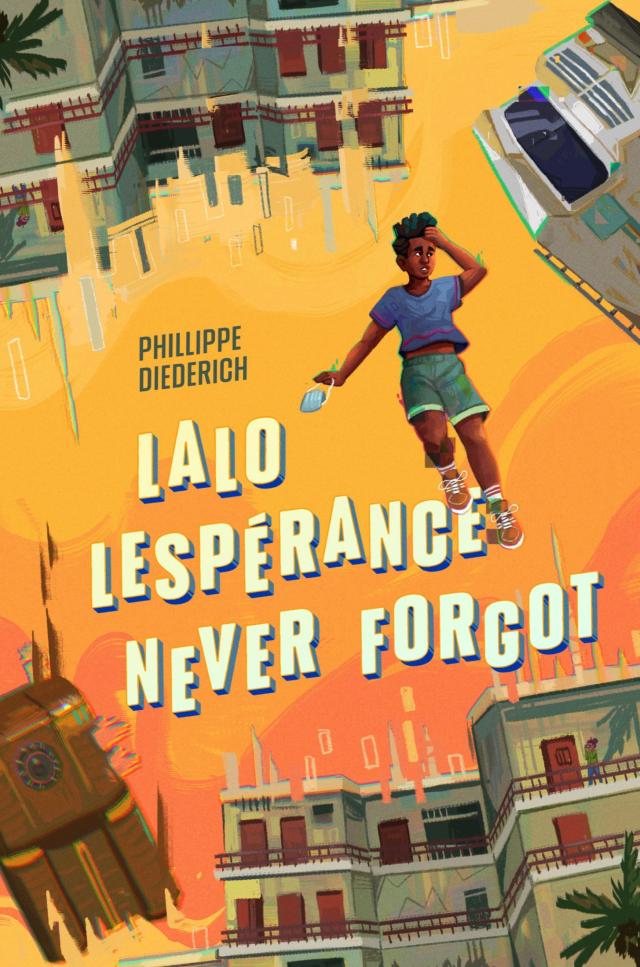
Cover art © 2023 by Richy Sanchez Ayala
Cover design by Kristie Radwilowicz
Design by Anna Booth, adapted for ebook by Andrew Wheatley
This book is a work of fiction. Any references to historical events, real people, or real places are used fictitiously. Other names, characters, places, and events are products of the author’s imagination, and any resemblance to actual events or places or persons, living or dead, is entirely coincidental.
The publisher does not have any control over and does not assume any responsibility for author or third-party websites or their content.
pid_prh_6.1_144870801_c0_r0
CONTENTS
Cover
Title Page
Copyright
Dedication
Chapter 1
Chapter 2
Chapter 3
Chapter 4
Chapter 5
Chapter 6
Chapter 7
Chapter 8
Chapter 9
Chapter 10
Chapter 11
Chapter 12
Chapter 13
Chapter 14
Chapter 15
Chapter 16
Chapter 17
Chapter 18
Chapter 19
Chapter 20
Chapter 21
Chapter 22
Chapter 23
Chapter 24
Chapter 25
Chapter 26
Chapter 27
Chapter 28
Chapter 29
Chapter 30
Chapter 31
Chapter 32
Chapter 33
Chapter 34
Chapter 35
Chapter 36
Chapter 37
Chapter 38
Chapter 39
Chapter 40
Chapter 41
Chapter 42
Chapter 43
Chapter 44
Chapter 45
Chapter 46
Chapter 47
Chapter 48
Chapter 49
Chapter 50
Acknowledgments
About the Author
_144870801_
To frontline workers
1.
Seventeen days after we went into lockdown, we started spying on the man who stole children. It was early April, just after spring break, and the world felt as if it had suddenly stood still. The streets and sidewalks were empty, and an eerie silence had taken over.
It was Vivi’s idea to spy on the man who stole children. We were leaning on the railing of the third-floor walkway in front of her apartment, looking at the mysterious motor home that had appeared at the far end of the parking lot.
“Vintage,” Vivi said, her voice muffled by her cloth face mask. “Orange stripes on the side, the brown and tan colors. Trust me. It’s vintage.”
I thought it was just ugly. But Vivi knew what she was talking about. She dressed like that—bell-bottom jeans, jackets with iron-on patches, mismatched Converse high-tops, that kind of thing. It was her way of hiding the fact that she wore clothes from the Goodwill—we all did—but Vivi had this unique fashion sense. She could take any old piece of clothing and improve it, make it funky, which matched her personality.
The motor home sat quietly, separate from everyone and everything. And it never moved. Day after day it sat there like a big ugly box on wheels.
“It’s creepy,” Vivi said, and crossed her arms, shifted her weight onto one leg so it made her look angry even though she wasn’t. “I mean, who would even park there?”
“Well,” I said, “it is a parking lot.”
“No, don’t believe it. There has to be more to it than that.”
“Maybe they ran out of gas.”
“Lalo.” She gave me this look like I’d just farted. “Have you ever heard of ghost ships?”
I wasn’t sure. Ever since I was little, I’d had a weird amnesia where I couldn’t remember things. My memories were like secret notes in bottles floating in the ocean. If I found one, it was usually vague or written in code. I rarely knew what it meant. Sometimes, I couldn’t even remember what I did the day before.
I didn’t want to sound dumb, so I said, “Yeah sure, the ghost ships.”
“Well, that right there,” she said, and pointed over the railing, “is a ghost motor home.”
I was sure I’d never heard of a ghost motor home. They probably didn’t exist. And honestly, I didn’t see anything ghostlike about the one in our parking lot. It looked like a regular dilapidated old motor home, kind of reminded me of Doña Chela’s taco truck that used to park in the field on the other side of the highway behind our apartment building before we went into lockdown.
Vivi leaned forward and rested her chin on the rail. “We need to find out who lives there.”
“Why?”
“Because.”
“What if it’s abandoned?”
“It’s not,” she said. “I can tell.”
It looked abandoned to me. Someone probably dumped it there because our block was a dump—like a big, giant trash can in North Fort Myers—a place where old cars rested on blocks, sneakers hung from electric wires, and the walls of the buildings were covered with graffiti. But it was also home. The air smelled of garlic, frying oil, and tortillas. Cumbia, ranchera, and salsa music played so loud the speakers rattled, and everyone knew everyone.
“For real, Lalo. Someone’s in there for sure.” She placed her index finger over her thumb like a cross and kissed it. “I swear. I can feel it. Lo siento en mi corazón.”
Vivi did that sometimes, flipped from English to Spanish as if they were one language. Her parents were Mexican. My mom’s Mexican. Well, kind of. Her grandfather was from Mexico. But not my father. He’s dead.
2.
Our apartment complex was one of those old Florida buildings from the fifties, all concrete block, four stories with a walkway along the front of each floor with a white metal railing where everyone draped their laundry to dry. It had a set of stairs at each end, but the one on the side closest to the street had been blocked for years, so we really only had one set of stairs. One of the few memories I had from when we moved in was Ma saying it looked like a motel, just needed a big pink neon sign flashing out front.
There were four apartments on each floor. We lived on the second floor. Vivi lived above us. That’s where we were when we saw my brother in the parking lot. Claudio was seventeen and not someone you’d wanna hang around with, especially when he was with Hugo and Jesse.
I’d already forgotten about the motor home. But when Vivi made up her mind, she stuck to it. My mom would probably say that was an admirable quality, one of those that define good character. I wasn’t so sure.
“¡Oye!” Vivi pulled her mask down to her chin and called, “Claudio, hold up.”
Claudio stopped and waited for us to catch up. He adjusted his mask, then buried his hands in the pockets of his black hoodie with the skull of the Punisher on the back. Dude never took that thing off.
“You know the guy that lives in the motor home?” Vivi asked.
Claudio looked at me, his eyes half closed as if he were real sleepy. Then he looked at Vivi, then at me. Then at Vivi again.
“She asked you a question,” I said.
“I heard her, fool.” Claudio was always calling me fool. I don’t think he’s ever said a sentence to me that didn’t end in “fool.”
“So?” Vivi said. “Do you, o qué?”
“No. And I don’t wanna see his ugly face. Hugo says el cabrón’s disfigured, looks like a monster. Besides . . . ,” he said, and lowered his voice just enough so that Vivi and I had to lean in to hear him. “Dude’s a fugitive. He’s wanted.”
“What do you mean, wanted?” I said.
“By the po-lice, fool.”
I knew my brother. I’d known him for eleven years, five months, and nine days. He wasn’t someone you could trust, not one hundred percent. Not even fifty or forty-two percent—probably a lot less.
“You’re just trying to scare us.” My guess was that the guy was a hermit. Although, right now, with Covid, we were all hermits.
; “Believe whatchoo want, fool. But if I were you, I’d stay as far away from that motor home as I could. You never know.”
“You never know what?”
But that was it. He just made a face that could be interpreted as a warning or, as Vivi said later, a joke. Then he walked away, shoulders slouched, head covered by the black hood.
“Oye,” Vivi called after him. She wasn’t going to let things hang just like that. “Why’d the cops want him?”
Claudio turned real slow, pulled his mask down, and spelled it out nice and slow: “Crimes. Against. Humanity.”
We shared this long, weird silence, Claudio staring at us like he was waiting for each word to sink deep into our souls. Then Vivi laughed. “That’s loco, dude.”
I had no idea what a crime against humanity was, but it didn’t sound good. I had to ask. “Like what kind of crimes?”
Claudio grinned. “He’s a robachico.”
“¡Mentiroso!” Vivi laughed, and waved him off as he walked away. “First of all, it’s robachicos, and someone like that wouldn’t just park their motor home in our parking lot.”
Robachicos: someone who steals children. It’s a stupid myth—something Mexican moms tell their children so they’ll behave—kind of like el Coco or la Llorona.
“For sure.” I adjusted my mask. “Anyone in the building could call the cops, right?”
“Exactly,” Vivi said. “We need to find out who lives there.”
“What?”
“Claudio’s lying. It’s our job to find out the truth.”
I didn’t ask her why it was our job. It wasn’t as if someone was paying us. And we weren’t superheroes or anything. Even though Vivi and I had known each other for years, we were only hanging out now because of the pandemic. We weren’t allowed to leave the building and there was no one else to hang out with. Covid made us friends. Besides, there was nothing else to do during lockdown.
3.
The next morning when I woke up, I couldn’t remember what happened the day before. All I got were small moments, most of which didn’t make any sense. I did get these weird images of a blue wall, the alley behind our building, and something about a robachicos—an ugly homeless-looking guy carrying a stinky sack full of children he’d stolen from the streets.
After I got dressed, I met Claudio in the kitchen. “Did Ma come home last night?”
He ignored me, poured himself a bowl of Cap’n Crunch, no milk, and ate standing up at the counter.
“That’s three days and three nights in a row,” I said.
Ma was always at work. She was a nursing assistant at the community clinic. Claudio told me once she does all the heavy lifting. She has to move and bathe and dress and feed the patients, and also clean their rooms and change their bedpans—where they poop—and take their blood pressure and all that. But Vivi, whose mom is also a nursing assistant, said they do way more than that. She said they give the patients a sense of dignity—they’re the ones who help them feel human.
Sometimes when Ma came home, we didn’t talk. She was under a ton of stress, putting in a million hours at the clinic ever since Covid started. Claudio was always telling me to chill, not to attack her with a bunch of questions the second she walked in the door.
I hated that, Claudio acting as if he was my father. If Ma didn’t want me hanging around her when she got home, she’d tell me. She’d say, “Ya, Lalo, let me catch my breath, por favor.”
I watched Claudio eat, chomping on the cereal with his mouth open like a dog. “I’m serious,” I said, “she said she was going to get me a soldering kit.”
“You can’t fix the PlayStation, fool.”
“You don’t know that.”
What Claudio didn’t know was that I wasn’t fixing the PlayStation. I was going to use it to build a memory machine. I had the whole thing planned out. I was going to connect it to my brain and use it to retrieve and record my memories, maybe even project them on the TV.
“Anyway, it’s my PlayStation,” he said. “If you screw it up more, you’re going to have to pay for it.”
“I know.” I wasn’t worried about that. When he bought the PS3 at a garage sale for, like, twenty bucks, he thought he was getting a deal, but the stupid thing never worked. It had been sitting under my bed for years. “So, when’s Ma coming home?”
“Today,” he said, and put on his hoodie. “So you better clean the bathroom before she gets here.” Then he stomped away.
Claudio didn’t have to tell me. I always did my chores. Always. I had them listed on a piece of paper on the wall by my bed so I wouldn’t forget. The ones in red were my daily chores, like making my bed and showering and stuff, and the ones in blue were my weekly chores, like cleaning the bathroom, doing my laundry, and all that.
Still, I wrote a daily note on my hand so I wouldn’t forget—just in case. That was my thing. I’d been doing it since the third grade when I asked Coach Díaz about the tattoo of a mean-looking pitchfork he had on his forearm. I thought it had something to do with the devil, but he said it was to remind him of his grandfather who had been a farmer in Cuba. I figured I could do that, too, write stuff on my hand to remember things I liked, like maduros and guarapo and important stuff from class and what I had to do at home and the names of kids who’d been mean to me.
I grabbed my backpack and followed Claudio out of the apartment. “At what time?”
He didn’t answer, just walked up the stairs with his head slouched, staring at his phone like a zombie.
When we went into lockdown and school went virtual, Claudio and I had to go to class at Vivi’s apartment because we didn’t have internet at our place. Ma said she forgot to pay the bill and the cable company was demanding a huge deposit to reconnect us. When Claudio told her maybe she should just pay it, she went loca. “Never. I’m not falling for that.” Then she called them racists, thieves, sinvergüenzas, and a bunch of other fine words we’re not supposed to say.
Later, Claudio told me Ma was lying about the internet, that it was just a convenient excuse because she didn’t want us to be alone in the house when we were supposed to be in school. “Ma ain’t no dummy, fool,” he’d said, and slapped me on the back of the head. “She knows if we stay home by ourselves, we’ll just watch TV and sleep all day.”
I didn’t trust Claudio, but he was probably right because that was pretty much what we did after school before lockdown.
4.
When Claudio and I got to Vivi’s apartment, he put his mask on, pumped out a squirt of hand sanitizer from the bottle on the dining room table, and parked himself at the kitchen counter, where he took his classes on his phone. Vivi and I were in sixth grade, so we sat together at the dining room table with a laptop we got from school. We actually got two laptops—one for her and one for me—but mine broke the first week of virtual school and they hadn’t replaced it yet. Which was fine. It was more fun like this. It felt as if we were in school together. Vivi’s older sister, Lupe, was a sophomore. She stayed in the bedroom she shared with Vivi, never came out.
Their apartment was exactly like ours. One bedroom for Lupe and Vivi and one for their mom and grandmother, with a bathroom between the two rooms. Even the kitchen was in the same place, with the same brown counter and white cabinets. The only difference was that they had their living room set up different from ours. We had the couch with its back to the big window that faced the front walkway. They had theirs against the side wall just past the front door. That’s where Alita always sat, unless she was at her sewing machine by the big front window.
Vivi’s mom was a nursing assistant like my mom, but she worked at the big hospital downtown. Vivi told me she was living at a motel near the hospital with someone she worked with because she didn’t want to risk bringing Covid home and infecting anyone. She only came back like once a week for dinner and to do laundry. So Alita took care of Vivi and Lupe and watched all of us during school. She was from Mexico and spoke English with a real heavy accent. Alita is short for “abuelita,” but it’s funny because it’s also what Ma calls chicken wings—alitas—“small wings.” She bakes them in the oven with salt and chile piquín until they’re brown and crispy and a little spicy.