The empty place, p.1
The Empty Place, page 1


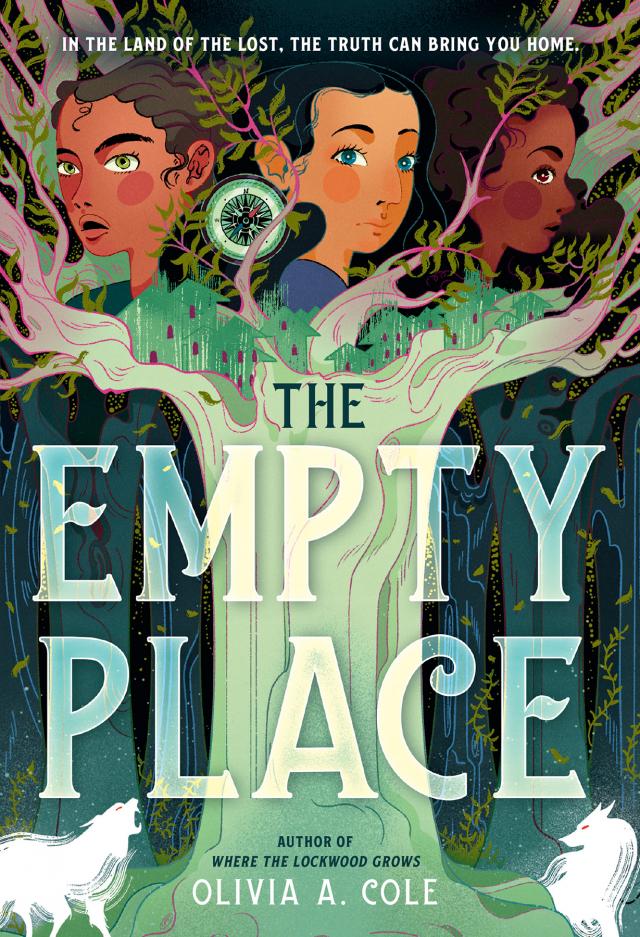
This book is a work of fiction. Names, characters, places, and incidents are the product of the author’s imagination or are used fictitiously. Any resemblance to actual events, locales, or persons, living or dead, is coincidental.
Copyright © 2024 by Olivia A. Cole
Bird in tree silhouette and tree branch silhouette © andreashofmann7777/Shutterstock.com. Compass © watermelon_k/Shutterstock.com. Tree branch silhouette © sema srinouljan/Shutterstock.com. Tree silhouette © Matus Madzik/Shutterstock.com.
Cover art copyright © 2024 by Islenia Mil. Cover design by Jenny Kimura.
Cover copyright © 2024 by Hachette Book Group, Inc.
Interior design by Michelle Gengaro-Kokmen.
Hachette Book Group supports the right to free expression and the value of copyright. The purpose of copyright is to encourage writers and artists to produce the creative works that enrich our culture.
The scanning, uploading, and distribution of this book without permission is a theft of the author’s intellectual property. If you would like permission to use material from the book (other than for review purposes), please contact permissions@hbgusa.com. Thank you for your support of the author’s rights.
Little, Brown and Company
Hachette Book Group
1290 Avenue of the Americas, New York, NY 10104
Visit us at LBYR.com
First Edition: November 2024
Little, Brown and Company is a division of Hachette Book Group, Inc. The Little, Brown name and logo are registered trademarks of Hachette Book Group, Inc.
The publisher is not responsible for websites (or their content) that are not owned by the publisher.
Little, Brown and Company books may be purchased in bulk for business, educational, or promotional use. For information, please contact your local bookseller or the Hachette Book Group Special Markets Department at special.markets@hbgusa.com.
Library of Congress Cataloging-in-Publication Data
Names: Cole, Olivia A., author.
Title: The empty place / Olivia A. Cole.
Description: First edition. | New York : Little, Brown and Company, 2024. | Audience: Ages 8–12. | Summary: “A girl falls into a parallel universe where all lost things go.” —Provided by publisher.
Identifiers: LCCN 2023051681 | ISBN 9780316449427 (hardcover) | ISBN 9780316449533 (ebook)
Subjects: CYAC: Space and time—Fiction. | Missing persons—Fiction. | Lost and found possessions—Fiction. | Friendship—Fiction. | Parent and child—Fiction.
Classification: LCC PZ7.1.C6429 Em 2024 | DDC [Fic]—dc23
LC record available at https://lccn.loc.gov/2023051681
ISBNs: 978-0-316-44942-7 (hardcover), 978-0-316-44953-3 (ebook)
E3-20241009-JV-NF-ORI
Contents
Cover
Title Page
Copyright
Dedication
Chapter 1
Chapter 2
Chapter 3
Chapter 4
Chapter 5
Chapter 6
Chapter 7
Chapter 8
Chapter 9
Chapter 10
Chapter 11
Chapter 12
Chapter 13
Chapter 14
Chapter 15
Chapter 16
Chapter 17
Chapter 18
Chapter 19
Chapter 20
Chapter 21
Chapter 22
Chapter 23
Chapter 24
Chapter 25
Chapter 26
Chapter 27
Chapter 28
Chapter 29
Chapter 30
Chapter 31
Chapter 32
Chapter 33
Acknowledgments
About the Author
By Olivia A. Cole
For Asha
SOMETIMES HENRY WAKES up thinking her father is alive. She stopped dreaming about him three months ago—at least every night—but there are still nights when she wakes up and hears his voice. She tries hard not to believe in ghosts, and for months, that’s what it sounded like when she’d open her eyes in the dark and hear him talking. But by now, she knows the truth.
Tonight when she hears his voice, she gets up from her bed, her feet panther-soft across the carpet. She goes to the door, then down the hall. From there she can look over the banister down at the living room, where her mother hunches over a laptop at the dining room table, speakers blaring. She has her back to Henry, Henry’s father’s face grinning through the screen.
“Now, if you’ve been watching me for a long time, then you already know what I’m about to say!”
Henry knows this YouTube episode by heart. She can’t see it all from here, but she remembers that behind her father is a mountain. He’s surrounded by thick green.
“If you ever get lost, go downhill! Well, that’s what you’re supposed to do. But if you know me, you know I always go up. I go to the highest point because if I’m lost, I want to see the whole world before the vultures get me!”
He laughs, and the camera follows him up a trail. On-screen, his thirty million subscribers still have his thousands of videos to watch. On-screen, it’s almost as if he never went missing.
“I’ve got my compass here just in case,” he says. He holds it up to the camera. It’s the one Henry and her mother gave him on Father’s Day a couple of years ago. Engraved on the back is Home is the best North Star.
Henry’s mother had that put on especially for him, and this is the part of the video when her mother’s shoulders start to shake. Henry hates this part. The part where they both know he’s the last person on earth who should have gotten lost and there’s nothing they can do. Her father was an experienced hiker, but the rangers said he must have gotten separated from his personal location device. He must have lost his map.
The rangers said the only thing they had to go on was conjecture. Henry heard conjecture so many times that eventually she looked it up: It meant “a conclusion formed with incomplete information,” which Henry decided was a fancy way of saying “we have no idea what happened to your dad.” Either way, no number of “conjectures” brought Henry’s father back, and Quinvandel Forest was big enough that even after months of searching, they never found a trace of him.
Over two thousand people get lost hiking every year, though not all of them on their daughter’s eleventh birthday.
Still, Henry’s father got lost. He wasn’t the first. He wasn’t even the last. But he was one.
Henry’s twelfth birthday party starts in an hour, and she’s six blocks away from her house, sifting through a mound of trash.
This empty lot used to be a garden before Mr. Phillips moved away, and like with most empty lots, no one is really sure where the trash in it comes from—no one ever remembers littering. Henry thinks one bottle cap must put out a signal, and trash from all over slowly crawls there to gather. It made her sad to watch the garden fade. But now whenever she’s starting a new collage, she comes here first.
“Anything good?” Ibtihaj joins Henry like she said she would. Her house is six blocks in the other direction, and always has been.
“Just trash.”
“Henry.” Ibtihaj rolls her eyes playfully because Henry says this every time. Just trash, when trash is what they’re looking for.
Ibtihaj is the only one who calls Henry, Henry. It’s one of two things that made them friends to begin with. The first was that in third grade they were both eating cheese pizza on a day that cheese pizza wasn’t being served in the lunch line. Henry is a vegetarian and Ibtihaj is Muslim, and they decided that the chili being served that day in the cafeteria was mysterious and probably not halal. Both girls have permission slips signed so whenever there is something they can’t eat on the menu, they are given flavorless rectangles of cheese pizza.
The second thing that made them friends was that when Ibtihaj sat down next to Henry, she asked her name. Henry told her—Henrietta—and Ibtihaj studied her the way Henry now knows she studies everyone.
Does anyone call you Henry? Ibtihaj asked.
No, Henry said, because usually people shorten it to Etta.
Can I call you Henry? Ibtihaj asked.
Henry decided that yes, she could. And they have been friends ever since.
Together now, they both scan the dirt. They’ve only ever had one fight, and it was over who got to keep the M-shaped piece of pipe they found here once. Henry let her have it. Henry remembers that fight especially because it was two days before her father disappeared and Ibtihaj brought the pipe the day after as an offering. It’s still in Henry’s drawer. And her dad is still gone.
Henry holds up a calcified red wire. It’s bent into the shape of a perfect cursive O.
“Nice,” Ibtihaj says. She has something behind her back. “I brought you your present,” she says. “Do you want it now or later?”
“Later.”
Ibtihaj shrugs and slips it into her back pocket. Then she crouches down to eye the trash more closely.
“Working on something new?”
“Maybe. I’m done with the metal-theme one. I’ll show you.”
“Yay.”
Henry unearths something small and black with the stick she’s been using as a shovel. The tire of a Lego car.
“Good find,” Ibtihaj says.
Henry nods and put it in the canvas bag that hangs from her shoulder. Ibtihaj notices the bag not only because she notices most things but also because it’s not the one Henry usually carries—this one is beige and on the side is printed NATURE IS NEUTRAL in big green letters. Then smaller underneath: KEEP PUBLIC LANDS PUBLIC.
“Was that your dad’s?” Ibtihaj asks, but she knows that it had to have been. And because Ibtihaj notices everything, she also notices how Henry does not look her in the eye when she answers.
“Yeah. My old one got a hole in the bottom corner. I’d found a cool copper washer, and it fell out on my walk home.”
“Bummer. Was definitely time for a new bag.”
“Yeah.”
Henry is thinking about her father, and she thinks Ibtihaj is too. She’s never said that she misses him—not to Ibtihaj and not even to her mother. People always avoid the big things. She doesn’t know why other people do, but she knows why she does. She’s afraid the missing will get bigger. And bigger. Sometimes the feeling of missing him is so big it feels like Quinvandel itself. Can you get lost in a feeling?
“I’m okay,” Henry says. She scrapes dirt out of the toy tire.
“I can’t always tell,” Ibtihaj says.
There are other things Henry is avoiding too. Her therapist told her that her mother had mentioned Henry had been quiet. She wonders if Ibtihaj thinks she has too. Henry could ask, but that’s another thing she thinks she has to avoid, the same way Henry knows how much her mother cries but never asks her about it. Just like how Henry’s mother never asks why Henry is quiet. A careful balance: like maybe they both hope that if they stay very still and silent, the sadness won’t swallow them whole.
Henry thinks it’s a little late for that.
“Did you invite anybody else to your birthday party?” Ibtihaj asks while they sift through more junk.
“Yeah right.”
She laughs, and Henry does, too, to show she’s okay.
“Let me guess,” Ibtihaj says. “Your mom invited Uncle Cecil.”
Now Henry really does laugh. She and Ibtihaj have been friends long enough for her to know how things go in Henry’s family. Henry’s parents, social butterflies. Henry, their earthworm daughter. They were both happiest when surrounded by people, buzzing around. Hiking. Parks. Horseback riding. Henry? Long, slow walks with Ibtihaj, sometimes not talking for an hour. She once almost missed a piece of volcanic glass out in the woods because she was trying to keep up with her dad, the way he marched through the trees. They were different in that way, and they both knew it. An outdoor father and an indoor daughter, her father had said. One spry and one shy.
Henry turns to Ibtihaj.
“Can I ask you a question?”
Ibtihaj looks surprised. Also maybe relieved.
“Definitely.”
“Do you think I’m shy?”
Ibtihaj gives it some thought. This is another reason she and Henry are best friends. Ibtihaj takes her time.
“No,” she says finally. “You don’t have a problem talking to people. You don’t even mind, like, confronting people. Like last year. Melinda.”
Henry nods, remembering. They go to school with Melinda, who is the kind of person who laughs at everything, including people. Including Eun-ji, who was learning English last year. There was a day in art class when Melinda thought Eun-ji’s accent was funny, and when she laughed she looked at Henry and expected Henry to laugh too. Henry wasn’t sure if it was because they were both white or because they’d gone to school together for a while and Eun-ji was new. It was the sort of thing that made Henry angry, and she had told Melinda to stop it; then she asked Eun-ji if she wanted to switch desks that day. And they did. But this year Eun-ji had switched schools. Henry and Ibtihaj privately blamed Melinda, and neither had spoken to her since.
“Why do you ask?” Ibtihaj says. She unearths a really good tiny spring.
“Just wondering.”
“Are you thinking about your dad?” Ibtihaj asks.
Henry hadn’t realized she was staring at Quinvandel. The forest was so big and the town so small that there was no escaping it, really. It was always over her shoulder or around the corner. That was part of the reason her father wanted to live here. His own private forest. Adventure always within arm’s reach when the house began to feel too small. Trying to ignore the forest is like trying to ignore a wolf chewing on your ankle. It’s always right there, and Henry is always looking at it, knowing that somewhere inside it, her father got lost.
“Yeah,” Henry answers.
Ibtihaj shifts.
“I haven’t said anything, but… did you hear they’re doing a memorial? A one-year thing? The mayor’s office.”
Henry had not heard of this. It makes her feel cold.
“My mom probably knew. Maybe that’s why she asked Uncle Cecil to stay after the party for a few days.”
“Distraction.”
“Yeah. She’s good when she’s busy.”
Henry’s mother works extra shifts at the hospital most days. Henry wishes she were old enough to do that too. Instead, she digs through trash.
“Blueprint?” Ibtihaj says suddenly.
Just one word, but Henry grins.
“Definitely.”
A moment later they’re crouched in the dirt, dumping out all the things Henry has collected so far: three letters from a computer keyboard, a short length of tiny chain. Other little pieces of nothing that she would turn into something. Ibtihaj uses a shard of plastic to draw a big rectangle in the dust.
“You first,” she says when she’s finished.
They take turns adding one piece. A dust collage, they used to call it when they were littler. But as they started spending their allowance money on the good kind of glue and strong canvas, they’d started to think of dust collages differently. They felt like blueprints. Sometimes Ibtihaj will put a piece somewhere Henry didn’t expect. It makes Henry change her own mind about what she’ll place next. Nothing is stuck, because it’s just in the dust—not a real collage, glued down. With dust collages, she can change anything.
They admire their work when they’re finished. It’s messy and strange: Screws grow from the bottom of the rectangle like robot flowers.
“I hate to mess it up,” Ibtihaj says. “This is a really good one.”
“Wanna leave it?”
“We could see if raccoons come and add anything overnight.”
Henry giggles, imagining the not-quite-human handprints decorating their work.
“Let’s leave it and come back tomorrow,” she decides. “But not the red wire. It’s too good.”
Ibtihaj plucks it out of the dust and hands it over.
“Because what if the raccoons took it?” she says, eyes wide. “My dad already says they’re too smart. They know how to open our trash cans.”
“What would they use the wire for?”
“Inventions!” Ibtihaj cries.
They come up with raccoon inventions the whole walk home—grappling hooks for climbing into dumpsters, tightropes to cross from roof to roof. It feels good to laugh. Henry’s still laughing when they get to her block and see Uncle Cecil’s car in the driveway. Uncle Cecil is standing at the front door surrounded by a suitcase and two duffel bags. He always packs most of his house every time he comes to visit. Henry calls to him:
“Do you need help carrying anything?”
He wheels on her, looking annoyed. She was a little afraid of Uncle Cecil when she was little, but now she knows that’s just the way he looks.
“On your birthday?” he snorts. And that’s just the way he sounds. “Not likely. Where’s your mom? I knocked but no answer.”
“Probably out back setting up.”
“Way too much food, I bet,” he mutters. “Way too much everything.”
“Probably.”
Once inside, he finds his own way to the guest room. Henry can hear her mother come in the back door, then go to the kitchen, opening and closing drawers. When Henry walks in, Ibtihaj at her heels, Henry’s mother looks up from the tray of crackers she’s spreading into a fan pattern.
“Mom, Uncle Cecil is here.”
“Oh, good. Can you carry the potato salad out to the backyard? Tracy and Willow are out there already.”
Tracy is Mom’s colleague, an ER nurse. Willow is her older, cool daughter, who wears all black and gives Henry Ziploc smiles, tight and contained. Henry wonders why they’re here, but she doesn’t ask. She always has questions like these, things that never make it out into the world.
Do you think Dad found a cave?