The flames, p.1
The Flames, page 1
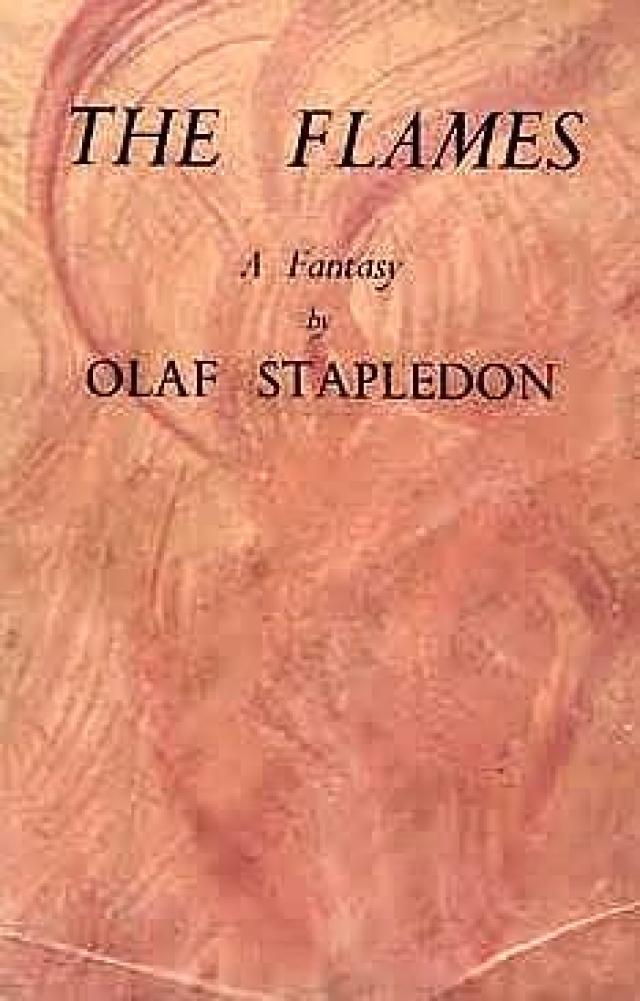


Title: The Flames
Author: Olaf Stapledon * A Project Gutenberg of Australia eBook * eBook No.: 0601131h.html Edition: 1 Language: English Character set encoding: HTML--Latin-1(ISO-8859-1)--8 bit Date first posted: June 2006 Date most recently updated: June 2006 This eBook was produced by: Richard Scott and Colin Choat Project Gutenberg of Australia eBooks are created from printed editions which are in the public domain in Australia, unless a copyright notice is included. We do NOT keep any eBooks in compliance with a particular paper edition. Copyright laws are changing all over the world. Be sure to check the copyright laws for your country before downloading or redistributing this file. This eBook is made available at no cost and with almost no restrictions whatsoever. You may copy it, give it away or re-use it under the terms of the Project Gutenberg of Australia License which may be viewed online at http://gutenberg.net.au/licence.html To contact Project Gutenberg of Australia go to http://gutenberg.net.au
* * *
The Flames
by
Olaf Stapledon
* * *
INTRODUCTORY NOTE
An introductory note seems called for to explain to the reader the origin of the following strange document, which I have received from a friend with a view to publication. The author has given it the form of a letter to myself, and he signs himself with his nickname, "Cass," which is an abbreviation of Cassandra. I have seldom met Cass since we were undergraduates together at Oxford before the war of 1914. Even in those days he was addicted to lurid forebodings, hence his nickname. My last meeting with him was in one of the great London blitzes of 1941, when he reminded me that he had long ago prophesied the end of civilization in world-wide fire. The Battle of London, he affirmed, was the beginning of the long-drawn-out disaster.
Cass will not, I am sure, mind my saying that he always seemed to us a bit crazy: but he certainly had a queer knack of prophesy, and though we thought him sometimes curiously unable to understand the springs of his own behaviour, he had a remarkable gift of insight into the minds of others. This enabled him to help some of us to straighten out our tangles, and I for one owe him a debt of deep gratitude. He saw me heading for a most disastrous love affair, and by magic (no other word seems adequate) he opened my eyes to the folly of it. It is for this reason that I feel bound to carry out his request to publish the following statement. I cannot myself vouch for its truth. Cass knows very well that I am an inveterate sceptic about all his fantastic ideas. It was on this account that he invented my nickname. "Thos," which most of my Oxford friends adopted. "Thos," of course, is an abbreviation for Thomas, and refers to the "doubting Thomas" of the New Testament.
Cass, I feel confident, is sufficiently detached and sane to realize that what is veridical for him may be sheer extravagance for others, who have no direct experience by which to judge his claims. But if I refrain from believing, I also refrain from disbelieving. Too often in the past I have known his wild prophesies come true.
The head of the following bulky letter bears the address of a well- known mental home.
"THOS."
* * *
THE LETTER
DEAR THOS,
My present address is bound to prejudice you against me, but do please reserve judgment until you have read this letter. No doubt most of us in this comfortable prison think we ought to be at large, and most are mistaken. But not all, so for God's sake keep an open mind. I am not concerned for myself. They treat me well here, and I can carry on my research in para-norrnal and super-normal psychology as well here as anywhere, since I am used to being my own guinea-pig. But by accident (yet it was really no accident at all, as you will learn) I have come into momentous knowledge; and if mankind is to be saved from a prodigious and hitherto entirely unforeseen disaster, the facts must somehow be made known.
So I urge you to publish this letter as soon as possible. Of course I realize that its only chance is to be accepted by some publisher as flction; but I have a hope that, even as fiction, it will take effect. It will be enough if I can rouse those who have sufficient imaginative insight to distinguish between mere fiction and stark truth paraded as fiction. My only doubt is as to whether any publisher will accept my story even as fiction. I am no writer; and people are more interested in clever yarns of love or crime than in matters that lie beyond the familiar horizon. As for the literary critics, with a few brilliant exceptions, they seem to be far more concerned to maintain their own reputations as connoscenti than to call attention to new ideas.
Well, here goes, anyhow! You remember how in the old days, I suspected that I had certain unusual powers, and you all laughed at me; specially you, Thos, with your passion for intellectual honesty. But though you were always the most sceptical, you were also in a way the most understanding, and sympathetic. Your laughter, somehow, didn't ostracize me. Theirs did. Besides, even when you were in your most perverse and blind mood, you somehow "smelt" right, in spite of your scepticism. You were indeed sceptical, but emotionally you were open- minded and interested.
Recently I have developed those unusual powers quite a lot, and I am studying them scientifically: inspired by you. I should love to tell you all about it, and have your criticism, some day. But at present I am concerned with something far more important; infinitely important, from the human point of view, anyhow.
A couple of months before I was put in this place, I went to the Lakes for a holiday. I had recently done a job in Germany, writing up conditions, and things had got on my nerves; both the physical misery and also certain terrifying psychical reverberations which will sooner or later react on us all. When I returned to England, I was near a breakdown, and I needed that holiday desperately. So I found a farm where I could be comfortable and alone. I intended to do a lot of walking, and in the dark evenings I would read through a bundle of books on the para-normal stuff.
When I arrived, the whole countryside was under snow. Next morning I scrambled up the gill at the head of the valley and set my course for the most interesting of the local mountains. (I won't trouble you with names, you miserable clod-hopper of the valleys!) All went well until the late afternoon, when, as I was coming down from the peak, a blizzard caught me. The wind went through my trousers like water through a sieve, and my legs stiffened with the cold, the hellish cold. I felt the beginnings of cramp. The driving snow shut out everything. The whole world was white, and yet at the same time black, so dark was it. (Why am I telling you all this? Frankly, I don't see how it is relevant to my story, and yet I feel strongly that it is relevant: and must he reported, if you are to get things in the right proportion.) You remember how painfully sensitive I always was to the temper of a situation, a scene or a crowd of people. Well, this situation upset me horribly. I had to keep telling myself that, after all, I was not the last man on earth about to succumb to the ultimate frost. A queer terror seized me, not simply for myself, though I was very doubtful about finding my way down before nightfall, but for the whole human race. Something like this, I told myself, will really happen on the last man's last day, when the sun is dying, and the whole planet is arctic. And it seemed to me that an icy and malignant presence, that had been waiting in the outer darkness ever since the universe blazed into being, was now closing in on all the frail offspring of that initial divine act of creation. I had felt the same terrifying presence in Germany too, but in a different mood. There, it was the presence not of the outer cold and darkness but of the inner spirit of madness and meanness that is always lying in wait to make nonsense of all our actions. Everything that any of the Allies did in that partitioned and tragic country seemed fated to go awry. And then, the food shortage. The children wizened and pinched; and fighting over our refuse bins! And in England one finds people grumbling about their quite adequate rations, and calmly saying that the fate of Germans doesn't matter.
Thos, we're all human, aren't we, all equally persons? Surely persons ought to be able to feel their fundamental kinship whatever their race. Even if they were of different species, if they were bred in different worlds, surely they ought to accept full responsibility for one another simply in virtue of their personality. But, my God! I see I have said something that will look mighty foolish in relation to what I am going to say later in this letter. I must emphatically disown my own thoughtless remarks. Indeed, as I shall later explain, I am not always able to resist the influence of certain alien powers that are at work in my mind.
But I am straying from the point.
I floundered down the stony snowed-up shoulder of the mountain, and soon I realized that I was completely lost. There was nothing for it but to press on downwards, hoping for a change of weather, and a release from the gripping cramp in my thighs. After an hour or so, a change did come. The snow stopped, the sky lightened. The surrounding mist glowed from the still-hidden sun. Presently the veil was lifted, and I found myself on a familiar ridge between two wide valleys. The view was--well, brilliant, so dazzlingly beautiful that I felt my throat tighten as if I was going to blubber or vomit. Imagine a panorama of blanch mountain shapes, all snow-clad. Those to the east were faintly pink in the level rays of the sun. Those to the west were a strange translucent grey-green, like blocks of ice cut into the familiar shapes. The cold and malignant presence was seemingly still in possession of the world; but now, having blotted out all life from the universe, it was amusing itself with miracles of beauty.
I came down the ridge at a trot, taking a header now and then in the snow. After a while, a disused mine attracted my attention. By an odd trick of the setting sun, a g reat heap of stones looked like a smouldering hillock, seen against the background of the dark valley. I could imagine this excrescence as an efflux of glowing lava that had welled out of the mine. The tone of the whole world was now changed. I was thrown back into some remote age, when the solidifying crust of the earth was still fragile, and constantly breaking under the pressure of the turbulent lava beneath. It was almost as though, in descending the mountain, I had also descended the piled eons of time, from the earth's future icebound death to its fiery youth.
Then I had a strange experience. First, a whim (which now I know to have been no whim at all) impelled me to turn aside from my route, and explore the sunlit rubbish. Reaching it, I climbed its slope. At a certain point I stood still, wondering what to do next. I turned to rejoin the track, but an irresistable impulse brought me back to the same spot. I stooped down, and began lifting the stones away, till I had made a little hollow in the rough slope. I worked steadily on, as though I had a purpose, laughing at my own aimless persistence. As the hollow deepened, I grew excited, as though I were "getting warmer" in my search. But presently the impulse to burrow left me, and after a moment's blankness I began to feel about in the pit, as though I were searching for some familiar object in a cupboard in a dark room. Then contact with one particular little stone gave me a sudden satisfaction. My fingers closed on it, and I straightened my back. It was just an ordinary stone, quite irregular, and about the size of a matchbox. I peered at it in the dusk, but could see nothing remarkable about it. In a moment of exasperation, I flung it away; but no sooner had it left my hand than I was after it in an agony of desire and alarm. Not till I had done some anxious groping, did I have the satisfaction of touching it again. I now began to realize that my behaviour was queer, in fact quite irrational. Why, I asked myself, did I value this particular stone? Was I merely mad, or did some ulterior power possess me? If so, what did it will of me? Was it benevolent or malignant? I tried an experiment on myself. Putting the stone down carefully where I could easily find it again, I walked away, expecting once more to feel the distress that I had felt on throwing the stone from me. To my surprise, I felt nothing but a very mild anxiety. Of course, I reminded myself, on this occasion there was no real danger of losing the stone. The power, or whatever it was that possessed me, was not to be deceived. I returned to the stone, picked it up almost lovingly, and put it in my pocket. Then I hurried down the slope, guided by a distant light, which I guessed to be the farm- house where I was staying.
As I walked through the deep twilight, an extraordinary exhilaration possessed me. Hoar frost was forming on the moorland grass. The stars one by one emerged in the indigo sky. It was indeed an inspiring evening; but my exhilaration was too intoxicating to be caused solely by the beauty of the night. I had a sense that I had been chosen as an instrument for some unknown and exalted task. What could it be? And what power was it that had influenced me?
After I had changed into dry clothes I stuffed myself with a good farm-house high tea. How do they manage it in these times of scarcity? Thoughts of starving German children did occur to me, but I am ashamed to confess that they did not spoil my meal. I sat down to read in the decrepit armchair by the fire. But the day of fresh air had made me drowsy, and I found myself just sitting and gazing at the bright embers. Curiously I had forgotten about my stone since the moment when I had arrived and put it on the mantelpiece. Now, with a little shock I remembered it, reached for it, and examined it in the light of the oil lamp.
It still appeared to be just an ordinary stone, a little bit of some kind of igneous rock. Using my field-glass, back to front, as a magnifier, I still found nothing unusual about it. It was a commonplace medley of little nodules and crystals all jambed together, and weathered into a uniform greenish grey. Here and there I saw minute black marks that might perhaps be little holes, the mouths of microscopic caves. I thought of breaking the stone, to see what it was like inside; but no sooner had the idea occurred to me than I was checked by a wave of superstitious horror. Such an act, I felt, would have been sacrilege.
I fell into a reverie about the stone's antiquity. How many millions of years, I wondered, had passed since its molten substance had congealed? For aeons it had lain waiting, a mere abstract volume, continuous with a vast bulk of identical rock. Then miners had blasted the rock, and brought the debris to the surface. And there it had lain, perhaps for a whole human generation, a mere moment of geological time. Well, what next? A sudden thought struck me. Why not let the little stone enjoy once more some measure of the heat that it had so long lacked? This time no horror stayed me. I threw the stone into the fire, into the glowing centre of the little furnace that my kind landlady had prepared for me on that frosty evening.
The cold stone produced a dark patch in its fiery environment; but the fire was a hot one, and very soon the surrounding heat had re-invaded its lost territory. I watched with a degree of excitement that seemed quite unjustified. After a while the stone itself began to glow. I piled on fresh fuel, carefully leavitig a hole through which I could watch the stone. Presently it was almost as bright as the surrounding coal. After all those millions of years it was at last alive once more! Foolish thought! Of course it was not alive: and my excitement was ridiculous, childish. I must pull myself together. But awe, and unreasoning dread, still gripped rue.
Suddenly a minute white flame appeared to issue from the stone itself. It grew, till it was nearly an inch tall; and stood for a moment, in the draught of the fire. It was the most remarkable flamelet that I had ever seen, a little incandescent leaf or seedling, or upstanding worm, leaning in the breeze. Its core seemed to be more brilliant than its surface, for the dazzlng interior was edged with a vague, yellowish aura. Near the flame's tip, surprisingly, was a ring or bulging collar of darkness, but the tip itself was a point of brilliant peacock blue. Certainly this was no ordinary flame, though it fluttered and changed its shape in the air-current much like any other flame.
Presently, to my amazement, the strange object detached itself from the stone, spread itself into an almost bird-like shape, and then, rather like a gull negotiating a strong breeze before alighting, it hovered across the windy little hollow in the fire's heart, and settled on the brightest of the coals. There, it regained its flame- like shape, and slowly moved hither and thither over the glowing lumps, keeping always to the brightest regions. In its wanderings, it left behind it on the coal's surface a wake of darkness, or rather of "dead" coal or cinder. This slowly reassimilated itself to the surrounding glow. Sometimes the flame, in the course of its wanderings, disappeared behind a bright shoulder of coal, or vanished round a bend in some incandescent cave, to reappear in a different part of the fire. Sometimes it climbed a glowing cliff, or moved, head downwards, along a ceiling. Always its form streamed away from its purchase on the coal's surface, in the direction of the draught. Once or twice it seemed to pass right through an ordinary flame. And once a large piece of the roof of its little world crashed down upon it, spreading it in all directions; but it immediately reshaped itself, and continued its wandering. After some minutes, it came to rest in the brightest region of all. By now its coloured tip had grown into a slender snake, quivering in the breeze.
I now became aware that I was in extra-sensory contact with some other mind. A very rapid and very alien stream of consciousness was running, so to speak, parallel with my own consciousness, and was open to my inspection. I ought to have mentioned earlier, Thos, that I had developed my "telepathic" power very considerably, and had often succeeded in observing continuous streams of thought in other human minds. But this experience was remarkable both for its detail and the entirely nonhuman type of consciousness that it revealed. I at once assumed, and the assumption was soon justified, that this alien mind must be connected with the flame. For my attention had been concentrated on the flame; and I have always found that the most effective way to make telepathic contact with any person is to concentrate attention on him.