

Terminal boredom, p.1
Terminal Boredom, page 1
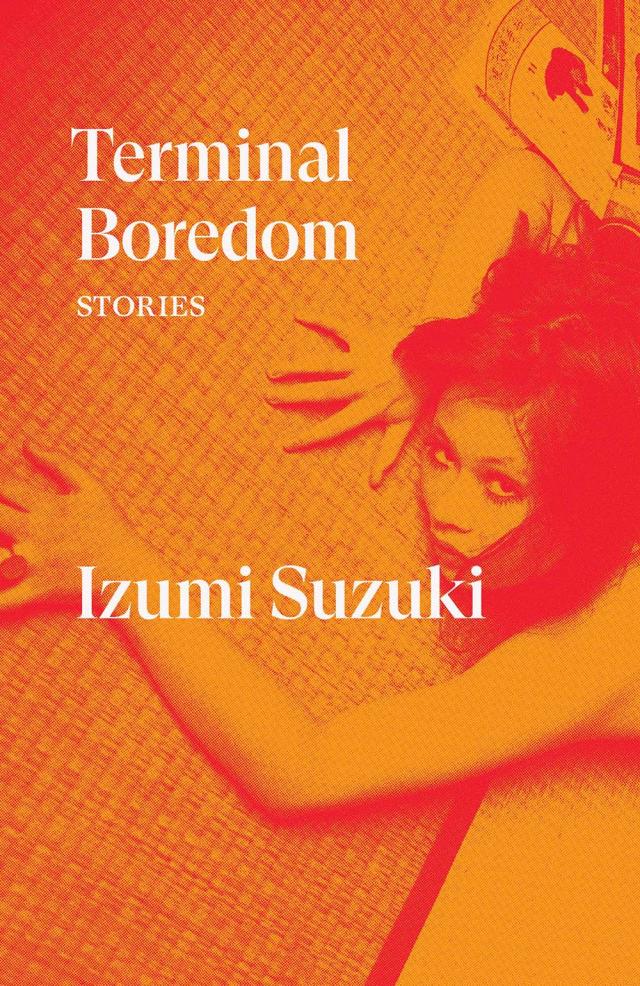


TERMINAL BOREDOM
TERMINAL BOREDOM
Stories
Izumi Suzuki
Translated by Polly Barton, Sam Bett,
David Boyd, Daniel Joseph,
Aiko Masubuchi, and Helen O’Horan
With support from the Japan Foundation
First published by Verso 2021
The stories here appeared in Japanese in The Covenant
a larger collection of Izumi Suzuki’s short stories © Bunyusha 2014
Translation of ‘Women and Women’ and ‘Terminal Boredom’ © Daniel Joseph 2021
Translation of ‘You May Dream’ © David Boyd 2021
Translation of ‘Night Picnic’ © Sam Bett 2021
Translation of ‘That Old Seaside Club’ © Helen O’Horan 2021
Translation of ‘Smoke Gets in Your Eyes’ © Aiko Masubuchi 2021
Translation of ‘Forgotten’ © Polly Barton 2021
All rights reserved
The moral rights of the author have been asserted
1 3 5 7 9 10 8 6 4 2
Verso
UK: 6 Meard Street, London W1F 0EG
US: 20 Jay Street, Suite 1010, Brooklyn, NY 11201
versobooks.com
Verso is the imprint of New Left Books
ISBN-13: 978-1-78873-988-7
ISBN-13: 978-1-78873-989-4 (UK EBK)
ISBN-13: 978-1-78873-990-0 (US EBK)
British Library Cataloguing in Publication Data
A catalogue record for this book is available from the British Library
Library of Congress Cataloging-in-Publication Data
Names: Suzuki, Izumi, 1949–1986, author. |; Barton, Polly (Translator), translator. |; Bett, Sam, 1986–, translator. |; Boyd, David (David G.), translator. |; Joseph, Daniel (Translator), translator. |; Masubuchi, Aiko, translator. |; O’Horan, Helen, translator.
Title: Terminal boredom: stories / Izumi Suzuki, translated by Polly Barton, Sam Bett, David Boyd, Daniel Joseph, Aiko Masubuchi, and Helen O’Horan.
Description: London; New York: Verso, 2021. |; Summary: ‘Born from the obsessive and highly idiosyncratic mind of a cult figure of the Japanese underground, these stories borrow themes and subjects familiar to readers of Philip K. Dick and fuses them with a conflicted, tortured, and intense imagination’ – Provided by publisher.
Identifiers: LCCN 2020047575 (print) |; LCCN 2020047576 (ebook) |; ISBN 9781788739887 (paperback) |; ISBN 9781788739900 (ebk)
Subjects: LCSH: Suzuki, Izumi, 1949–1986 – Translations into English. |; LCGFT: Short stories.
Classification: LCC PL861.U9265 A2 2021 (print) |; LCC PL861.U9265 (ebook) |; DDC 895.63/5 – dc23
LC record available at https://lccn.loc.gov/2020047575
LC ebook record available at https://lccn.loc.gov/2020047576
Typeset in Electra by Hewer Text UK Ltd, Edinburgh
Printed and bound by CPI Group (UK) Ltd, Croydon CR0 4YY
CONTENTS
Women and Women
You May Dream
Night Picnic
That Old Seaside Club
Smoke Gets in Your Eyes
Forgotten
Terminal Boredom
WOMEN AND WOMEN
This morning a boy passed by my house.
When I told my sister Asako about it, she just said, ‘Dummy, you know there aren’t any boys around here.’
And she was right.
Long ago, the Earth was peopled only by women. They lived in peace until one day a certain woman gave birth to a child unlike any that had come before: its body was misshapen, it was rough and careless in everything it did, and it made a great deal of trouble for everyone before it produced a few offspring and then died. Such was the advent of man. From there, the number of men increased steadily. It was they who invented war and its requisite implements. Worse still, they began to toy with notions like revolution, work, and art, wasting their energy on all manner of abstract pursuits. And they even had the audacity to claim that this, this was the greatest characteristic of mankind – this zealous pursuit of adventure, romance, all things that were utterly useless in everyday life. Though men were adults they were children, seemingly complex but as simple as could be; they were utterly unmanageable creatures.
Women had something as well, something called ‘love’, but this was much more concrete. It was putting up with a crying baby, changing its diapers even though you were exhausted. It was sharing any food you found with the weak little beings in your care. But not with outsiders. Because if you did that, you and your bloodline would not survive.
As the number of men increased, the women had to keep a close eye on each and every one of them. This was a truly onerous task, but most women seemed to have the knack for it. They had to safeguard home and family.
With the passage of many long years, men came to dominate society through violence and cunning, and thereafter they made nothing but war. They seemed to find their raison d’être in conflicts both great and small. War found its way even into everyday life, and so were born ‘traffic wars’ and ‘admissions wars’. Such terms became so common that the word ‘war’ lost all meaning. This deplorable situation was of course the men’s fault. And, when the traffic snarls and college entrance competition got so bad that people could hardly bear it, they replaced the word ‘war’ with ‘hell’, coining phrases like ‘traffic hell’ and ‘exam hell’.
Factories continued to operate, and the age resounded with hymns of progress and harmony. But then, in the latter half of the twentieth century, a strange thing happened: the male birth rate began to decline. This was apparently due to something called pollution. The men who invented the steam engine probably never expected to set in motion events that would bring an end to their own kind.
In any case, men became scarce. For some reason women had developed the habit of each finding a particular man to love, so they were terribly sad about this. Nevertheless, the number of men continued to dwindle.
Nowadays, you’ll never even lay eyes on one unless you visit the Gender Exclusion Terminal Occupancy Zone.
‘You sure you weren’t just seeing things?’
Asako poured some tea. My confidence evaporated in the face of her question.
‘Maybe. But afterwards I looked it up in a book, and the clothes he was wearing were a lot like the ones boys wore towards the end of the twentieth century. His hair was short, and he was wearing trousers.’
‘Same goes for me.’
Asako’s hair was indeed cropped short, and she had on a pair of light cotton bell-bottoms.
‘I mean, sure, but his trousers were a lot tighter and not so wide at the bottom. And his chest was flat as a board.’
‘There are women like that too, you know.’
‘His whole vibe was different. He was solidly built and tall, with a spring in his step. There was something … intense about him.’
‘Wow. Well, looks like you’ve got all the answers, never mind the fact that you’ve never even seen a man before. The year I graduated high school we went on a field trip to the Occupancy Zone, but men turned out to be nothing like I expected. They were scraggly and smelled funny, and they all gave me the creeps. Maybe it’s because they’re stuck in that place, but they all seemed so lazy. You’ll understand when you go and see them. They’re awful. But you said you looked it up in a book. Where did you see a book like that?’
The publication of material concerning men is strictly prohibited.
‘A friend’s house.’
‘Well, how’d it get there?’
‘I guess her mother works for the Information Bureau. My friend doesn’t really know either. She opened the door to the study with a hairpin and said I could read any book I wanted.’
‘Such a little hoodlum.’
‘There were lots of films, too.’
‘If that got out, it would mean real trouble. Yūko, I know you don’t really understand, but that kind of thing could throw society into chaos. I want you to remember this: order is the most important thing. Abiding by the rules. If we all do that, humanity can avoid destruction.’
She gave this lecture gently, like a proper big sister.
I poured some milk into my tea. ‘By humanity, you mean women?’
‘Of course. Didn’t you learn that in school?’
‘Yeah.’
‘Well, there you go.’
‘And men?’
‘Men are an offshoot of humanity as well, but they’re a deviant strain. They’re freaks.’
‘But there was a time when they flourished, wasn’t there?’ They don’t teach us much about that in school. You only learn about such taboo subjects through whispered conversations among friends. Two or three years back, someone secretly published a pamphlet called On Men, and a friend showed it to me. Eventually the police cracked down and seized all the copies. The culprits were quickly caught and put in a detention facility.
The news posters branded it a dangerous publication because it ‘stimulated curiosity’.
My grandmother told me that when she was young they used to deliver the newspaper door to door each morning, and the transportation network extended to every corner of the country. Even now you can go see the massive concrete pillars that used to hold up the highways. You never know when they might collapse, though, so it’s dangerous to get too close. It was around the same time resources started to become scarce and they scaled back production in the factories that the number of men also started to decrease. We were taught that it was the men who had created that horrifying culture. By the end, they had used up almost all of the oil; the deposits are all but depleted now, so we rely almost entirely on the heat of the sun. Women have been left carefully husbanding the scant resources of a planet stripped bare by men.
Apparently back then there was also something called a TV in every home. I can’t even imagine – all kinds of programmes coming at you from morning till night, at the twist of a knob. And all for free! I guess something called NHK collected money for it, but towards the end nobody paid anymore. TV was one of women’s greatest pleasures. Grandma says when she was a kid she used to watch it every day. Back then girls and boys alike were immersed in exam hell, but her mother didn’t give her any grief about school. Grandma wanted to be a singer. She told me so. Apparently at that time, these singers would appear on TV constantly. And since just about everyone watched TV, they were famous, and if you were famous, throngs of people would come to your concerts. I don’t really believe the part about everybody watching TV, though. Grandma also told me it was really sad when the TV stations went under and men weren’t around as much anymore.
‘Stop talking nonsense and go to bed already … It’s eight o’clock, the electricity’s about to get shut off.’
And sure enough, just as my sister said this, the already dim bulb went dark. In its wake, the moonlight lay in stripes across the tabletop.
‘Look, the moon’s so big and red,’ Asako pointed. ‘Look where it is.’
We sat together, sipping the last of our tea as we gazed out at the moon hanging low in the sky, its unsettling colour giving it a bloated, spongy look.
‘I wonder what Mum’s doing now.’
This was something we were never supposed to talk about. But my sister didn’t reprimand me. In fact, she tried to console me.
‘We’ll see her again next month.’
‘Yeah.’
But our monthly meetings only lasted for ten minutes or so. And there was always a guard present, so we could never say what we were actually thinking. Lately Mother had been getting weepy every time we had to say goodbye.
‘Why did they put her in a detention centre?’
‘Because she broke the law,’ Asako answered automatically. But the truth was, she didn’t know much about the circumstances of her arrest. One day some strangers showed up out of the blue and just took our mother away. Asako was four or five at the time, and she remembers it pretty well considering.
‘According to Grandma, she was harbouring a dangerous individual.’ Her tone started to falter.
‘What happened to that person?’
‘Arrested, of course, and most likely sent away someplace else. But it’s blessing enough that we get to see Mum face to face, since I’m pretty sure it was the secret police who took her away.’
‘Is there really such a thing?’
‘I think so … This is all just a guess, though, and you mustn’t tell anyone.’
‘I know that.’
‘I think they might be connected to the Information Bureau somehow, but keep that just between ourselves as well.’
‘Okay, I get it already.’
‘As far as anyone knows, our mother is dead. If this got out, it could upset the social order.’
‘Okay.’
I think my sister’s a little too high-strung. Maybe because Mum was taken away when she was so little.
‘I wouldn’t be able to go to work anymore, either.’
Asako’s such a nag. I lit a candle. It was a cheap, smelly thing, but it was better than what most of our neighbours used: wicks dipped in animal fat. They were smoky and smelled horrible. We decided not to be stingy when it comes to light.
‘I’m going to bed. I’ll do the dishes in the morning.’ I stood up to leave.
‘It’s fine, I’ll wash them tonight,’ my sister replied. ‘The stairs are dark, why don’t you take the candle with you.’
‘I’m used to it.’
I paused at the foot of the stairs. Here, too, moonlight was streaming in through the window. I had been up since early that morning and now I was exhausted.
I’d woken up around four a.m., unable to stand the sweltering heat. The little window in my bedroom was shut, so I went over and opened it up wide. That’s when I saw the boy, going by on the road below. No one should be out and about at that hour, so I studied him carefully.
In my room on the second floor, I opened my diary in the small patch of moonlight. The diary was a present from Grandma for my sixteenth birthday; I’d been writing in it for two years now.
I intended to write about what had happened that morning, but my sister’s words had shaken my confidence. My eyesight’s really good, but it’s not going to stay that way if I keep on writing by moonlight every night. Since I’d decided not to tell anyone else about the boy, I wouldn’t mention it in my diary either. I wrote the date, paused, and then thought for a minute.
Today our teacher took us to the theatre. They had the marquee lights on even during the daytime, and I was shocked at how bright it was. I’ve never been somewhere so lively, and so many things were new to me. Maki said, ‘I hear sometimes they put men on stage here. They do something called boxing.’ And Rei said, ‘Not here, they don’t. That happens at a gymnasium or something.’ Then the teacher walked by, so we all clammed up and went inside. The lighting on the inside was bright too, it was so pretty. On the way back we rode in a horse-drawn carriage.
Asako says that horse-drawn carriages are on the way out too. Come to think of it, I haven’t seen as many lately. Then again, it’s a real luxury just to ride in anything, whether it’s a horse-drawn carriage or the more common pollution-free automobiles. If it’s not going to take more than an hour or so, most people just walk. I was literally bursting with joy that I’d gotten to ride in a carriage, so I had to put it in my diary. Asako works at an energy research facility. She says they’re gradually implementing the use of uranium and plutonium. And solar technology is getting better and better all the time. But she also said something disturbing about how ‘the sun is sort of like a big cluster of hydrogen bombs’.
I opened the window and looked down at the road below, but of course there was no one there.
Had my eyes been playing tricks on me that morning after all?
I got into bed.
The zelkovas were rustling outside.
I heard the stairs creak.
‘Are you asleep?’ my sister asked from the other side of my door.
‘Uhh …’
My non-committal reply came out sounding like a moan. ‘You understand, right? Not to tell anyone what you told me.’ Asako lowered her voice even further.
‘Yeah, I understand,’ I answered in a drowsy voice.
‘You can’t go around telling people you saw a boy.’
Enough already.
‘Don’t worry about it.’
I could picture Asako standing at the head of the stairs holding the candle. She was silent for a while. I guess she must’ve been mulling something over. Or maybe it was supposed to be one of those demonstrative silences.
‘… Right. Okay, good night then.’
She finally went to her room.
‘Night,’ I muttered curtly (though I don’t think she heard me) and pulled the covers up to my chest. I always lie awake in bed for two or three hours before I fall asleep. But this time I felt like I could drift off right away.
When I awoke, it was still dark.
I couldn’t tell what time it was. The clock’s in the living room, and it was too much of a pain to go check, so I just lay there.
I tried to reconnect the fragments of my dreams but without much success. And I felt well-rested enough that there was no point trying to go back to sleep. I wasn’t the slightest bit tired.
I got up and put my clothes on in the dark.
Opening the desk drawer, I took out a cigarette I had filched from my sister’s room. She smokes herself, so I wasn’t worried about the smell giving me away. And Grandma almost never comes upstairs.
I lit the cigarette and took a drag, and within a few seconds I felt like all the blood was ebbing away from my body. It was as if all the air inside my head had been let out. I started to feel dizzy, so I sat down. My fingertips felt cold.
In that moment the music from the previous afternoon’s performance came back to me. It was a new musical, a love story about a heroine named Sappo or Sappho or something, and everyone had been crazy about the actor playing her. Most of the students raved about how gorgeous she was, and it was clear everyone had a huge crush on her. I felt the same way, but I kept my mouth shut. It rubbed me the wrong way – I was finally at the age to start dating, but the most excitement I’d had in that department was an anonymous love letter or two.






