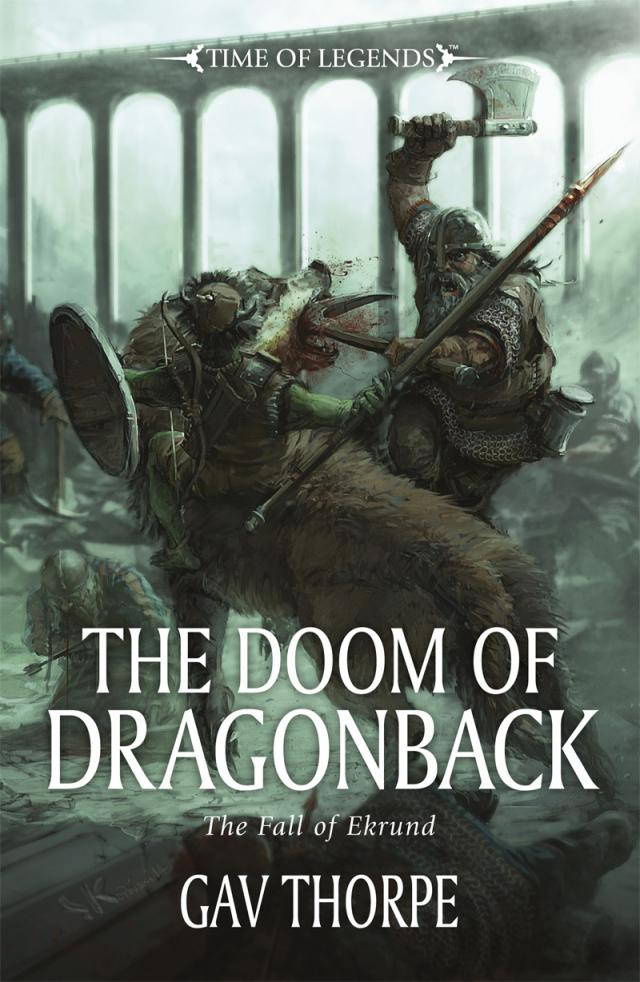
The doom of dragonback, p.1
The Doom of Dragonback, page 1


It is an age of legend.
Sixty years have passed since the War of Vengeance came to an end and the elves left the Old World to return to their distant island home. Victorious, but at great cost, the dwarfs set about the long task of rebuilding their empire, shattered by half a millennium of bitter conflict. But the elves are not the only enemies of the mountain folk.
Long ago, when dwarf and elf stood together as friends, the orcs and goblins – green-skinned savages who live only for battle – were driven into the dark lands to the north and east. Now, sensing the precarious state of the dwarf empire and driven by great earthquakes that split the Worlds Edge Mountains asunder, they have returned with vengeance in mind.
Armies of greenskins march through the mountain passes and the Underway, the great subterranean tunnel system linking the dwarf cities. Hold after hold fall to the invaders, thousands of years of culture and achievements swept away in a tide of savage hatred.
In the distant Dragonback Mountains, the dwarfs of Ekrund work their mines and tend their herds, thinking themselves safe, insulated from the woes of their eastern cousins.
They are wrong.
‘There are many famous dwarf ales, and many renowned brewers, but the name of Josef Bugman stands as a paragon of quality. His family originally came from the Dragonback Mountains. The tale of Josef and his ancestors is one of hardship and loss, and from their story comes the ancient dwarf phrase “There’s no beer as bitter as its history”.’
‘Dwarfs of the Empire, a Brief History’, by Rikard
the Holy and Njel of the Stills
Prologue
The rasp of a small flint on metal broke the still, followed a moment later by the glow of a pale yellow flame as the old dwarf lifted a small firebox, the deep lines of her face starkly etched by its light. Her pipe was a simple clay affair, glazed a dark blue, long in the stem, with a piece of plain bronze banding just behind the bowl where in the past it had been repaired.
Deep brown eyes looked out from under greying eyebrows, not unkindly, but carrying the weight of much life and toil. The hand that lifted the pipe from her mouth, releasing a swirl of bluish smoke between cracked lips, was gnarled, the fingernails cropped square and short, with many small scars across rough knuckles. There was a deep-rooted darkness in the skin – not dirt as such but the accumulated grime of centuries.
She wore a heavy smock of deep red linen and over that crumpled a leather apron marked by many burns and stains and made soft by long use. She crossed her feet on the low stool as she rocked back her chair, revealing the hobnails in the soles of her boots, each piece of metal worn almost to nothing. Bright iron toecaps glinted in the light of the fire beside her.
Around the old madam dwarf sat a semicircle of youngsters – five boys and one girl, all staring at her with rapt attention. Another, a little younger still, stood at the arched doorway, trying to hide. He didn’t succeed. She saw him and smiled, beckoning the dwarf boy to enter.
‘Come, Gabbik, be in or out, but not both.’
The young dwarf entered and squeezed his way between two of the others, right in front of the old dwarf lady. He leaned forward, chin in his hands, elbows on his knees.
‘Settled?’ There were nods from the assembled children. The dwarf took a puff on her pipe and then laid it to one side on a small table by her right hand. She folded her fingers together in her lap and nodded to herself. ‘I have lived a long life, and a good one for the most part. It has not been easy and there has been much woe, but that is the lot for all of us in these later years. It was not always so. There was a time, though we choose to forget it, when elf and dwarf were friends. Can you imagine such a thing?’
There were scowls and shaking of heads.
‘No, I don’t suppose you can. It is hard to think that there was a glorious time, before the wars and the disasters. It was in those ancient days that our story begins. Our story really starts in Karak Eight Peaks, where our earliest forefathers were born. In the great times our ancestors desired to improve their standing and with others of like mind they moved westwards, to find a place where they could mine ore for themselves and brew their own beer and delve homes the like of which they could only dream of. Amongst them were the Angbok clan.’
Chapter One
‘The Angboks were miners by inclination for the most part, neither the largest nor the most powerful to live in Karak Eight Peaks, but also not the weakest or smallest. Our people since the ancestors walked among us have held to tradition and custom as the bedrock of existence, and so it must be today, for if we forget where we have come from we will wander without end. But even so, the Angboks and others of similar mind were perhaps given to a more outward-looking temperament. They were not discontent, but there was set in their thoughts a notion that the halls of Karak Eight Peaks did not contain all that they desired. So it was that a great number of them gathered and with permission from their king ventured forth, heading towards the sunset to find a new land they could add to the great empire of our people.’
Biting her lip to stop it trembling, Haldora barely listened to her father’s words as he recited the life-wreaths of her grandmother, Awdhelga. Instead, Haldora’s thoughts were filled with more personal memories than those bold achievements listed by rote on the tomb-slab of the family crypt. She thought of ‘Gramma Awdie’ working the valves on the small brewery she built; sharpening her axe on the whetstone at the top of the western delves; telling the story of how she killed five goblins in as many heartbeats while she polished their gilded skulls.
‘Five years, to this day,’ Haldora’s father intoned as he stepped away from the tombstone, letting his hand drop to his side from where his fingers had been following the lines of runes cut into the granite. With due ceremony concluded, Gabbik allowed himself a sniff of grief; a personal moment as a tear glistened in his eye. ‘A fine mam.’
He was dressed in his best clothes, like all of them, his shirt tucked into his woollen breeches, boots polished to glisten like fresh coal, hair neatly combed into a single knot, beard and moustache plaited into long braids.
Beside him was a more unkempt, older figure, one shirt tail half-out of his leather work trousers, beard hastily combed, the scent of ale about him. ‘A fine dwarf,’ added Skraffi, widower to the renowned, some would say infamous, Awdhelga Angbok. ‘The best.’
‘Blackbeer and skrob kuri tonight,’ announced Friedra, Haldora’s mother. She wore a long black dress embroidered with complex knotwork in thick silver thread. Her hair was tied in two bunches held by gold-studded leather thongs. Her eyes were cast down to the bare stone floor of the mausoleum, hands fidgeting with the square of a handkerchief. ‘Awdhelga’s recipe, like always.’
‘My favourite,’ said Gabbik, wiping the back of his hand across his nose. ‘Aww, mam, keep safe in yonder halls.’
In silence they filed out of the crypt, back up a short passage to the family shrine adjoining Skraffi’s meadery. The room was egg-like in shape, the fatter end of the oval carved into tiers like steps, six in all. Arranged on the highest shelf were three figurines almost as tall as the dwarfs – Grungni, Valaya and Grimnir. Ancestors to the whole dwarf race, they took pride of place: Grungni with hammer and anvil, Valaya with cloak and herbs, and Grimnir with axe and orc skull.
On the step below were the five oldest fathers of the Angbok clan, rendered as metal discs with stylised faces, helms and beards. Beneath them the family ancestors, a mix of clay and metal badges, figurines, busts and other ornaments each made to the fashion and preference of the family at the time. A likeness of Awdhelga took pride of place in the middle of the tier, rendered out of a single piece of coal hewn by her own hand the day before she had finally died of old age.
Next to it was a simple clay pipe, fixed just behind the bowl with a strip of bronze. This triggered the strongest memories of all – Gramma Awdie with all the clan beardlings gathered around to hear tales of the old days before the War of Vengeance and elf-brought grief.
‘She made herself mistress of many things,’ Haldora said with a sigh, ‘but her stories I’ll miss the most. She spun tales better than her yarn.’
‘And was never shy to share them, neither,’ said Skraffi. He patted his son on the shoulder. ‘Very generous was your mam.’ Skraffi turned his attention to Haldora and winked. ‘And right proud of you too, she was. ‘Tis a shame she ain’t here to teach you more.’
‘Everything important, she told me ‘fore she went,’ said Haldora.
‘That’s as you like, but there’s still plenty a trick round fireplace and kitchen you need to learn,’ said Friedra. ‘You’ll be helping me with the kuri, won’t you now?’
‘Oh mam, we’re breaking into a new seam today. The gang’ll need every pick and shovel to help.’
‘It’s all well and good you doing your part down the mines, but you’ll not catch the eye of a future husband covered in coal dust and without a pot of something filling on your arm.’
‘I’m just two years past my thirtieth birthday, plenty of time for that sort of thing once I know I can earn my keep.’
‘You earn your keep by having floors swept, bellies full and bringing on the patter of little boots,’ said Gabbik. ‘It was a blessing the day I had a daughter, but for all the way you act we might have had a son.’
‘Gramma Awdie killed goblins and brewed beer and stitched the standard of Ekrund, all ‘fore she was one hundred – there’s no good reason I have to be chained to the ovens.’
‘Nobod
‘Grammi, tell them!’ Haldora said when her mother had left, turning her attention to Skraffi, who had started to absent-mindedly polish the metal ancestor badges with the tail of his shirt.
‘Your mam is right, and so are you,’ he said. He fumbled in the pocket of his waistcoat and pulled out a set of thick-rimmed nose-pinch spectacles. He ceremoniously put them on and looked at the inscription of the golden badge in his other hand. ‘Grafgar Angbok. My great-uncle. Lost his left thumb in the war.’
‘Grammi, that’s no answer!’
‘Only one you’ll be getting today, Haldi.’
‘My name is Haldora. I am a grown-up now.’
‘Whatever you say, Haldi.’
‘We should be off to break that new seam,’ said Gabbik, heading towards the door. He looked back at Haldora and Skraffi. ‘If you two have finished with your mooning about, of course.’
Skraffi put down the ancestor badge and followed Gabbik out.
Alone with her ancestors, Haldora took a moment for herself. She stood in front of all the badges, deathmasks, busts and statuettes, curling a tress of hair around her left thumb. She looked at Awdhelga’s symbol on the ledge and took a deep breath.
‘Gramma Awdie? Thank you. Look over us today.’ On a whim she lifted the old pipe and took it with her as she turned away. ‘I hope I will be half the dwarf you were.’
Like all dwarfs, the Angboks were right at home when underground, though even they could not see in absolute darkness. The light of lanterns swinging from rods and candles fixed to helmets glimmered along the rough-hewn tunnel as Gabbik accompanied the next shift down to the mines. This part of Ekrund was a working mine, the living seams still yielding ore for the craftsdwarfs and furnaces above. The floor was uneven but sloped gradually downwards and curved to the right following the course of an excavated seam; the walls and ceiling were marked by pick and lever bar, pitted and broken in places. Every dozen paces a strong timber joist held up the roof, which in places was barely higher than the heads of the dwarfs and in others three or four times their height.
The illumination from candles and lamps did not stretch far and the winding nature of the tunnels, with many cross-junctions and forks, meant that the dwarfs advanced in a bubble of light that barely stretched a few dozen paces. At the fore of the group Gabbik’s cousin, Grothrund, whistled, low and constant, the tight walls reverberating the sound to the back of the group some three dozen paces behind. There were fifty-two dwarfs in the work party, all part of the Angbok clan through birth or marriage, each decked in heavy clothes, hands protected by thick gauntlets, picks and shovels and crowbars carried over their shoulders.
They pulled several small carts with them, laden at the moment with more tools and small blackpowder breaching charges. In one was carried the food supplies – piles of hard bread and linen-wrapped cheese, along with a small hogshead of beer and leather skins of fresh water from the springs that fed Ekrund’s many waterways. The beardlings – those dwarf lads not yet come of age – rode on the carts, each with a whetstone, working on the blades of the picks of those around them, riding the bumpy wagon train with stout poise.
Now and then Grothrund would stop and raise his voice in a high-note, low-note call that echoed far down the tunnels. By the sound of the reverberations that disappeared into the gloom the older dwarfs could check their location.
Often these calls were repeated by similar high-low replies in the distance as other mining teams called back, coordinating with each other so that they did not end up working the same seams. By such means Grothrund effortlessly led the miners into the depths towards the new seam without once making a wrong turn or leading them into a dead end.
Towards the back of the group Gabbik conducted a whispered debate with Skraffi. Usually the older dwarf spent his time working in the meadery or tinkering in his workshop, but the breaking of a new seam required every able-bodied dwarf and Skraffi’s experience in the mines was second-to-none despite his eccentricities. The dwarfs around them possessed keen hearing – it was said Lorgi Troggklad could hear a coin drop at a thousand paces – but the rumble of the wagons and the tramp of booted feet masked their low conversation.
‘You indulge Haldora too much,’ Gabbik complained. His daughter was a few paces ahead, chatting with her cousins. ‘You make me look like a stubborn wazzock.’
‘You are a stubborn wazzock. Ancestors bless you, Gabbik, but you have to give Haldi some space.’
‘We don’t have the luxury of that. It’s not like back in your day when the Angboks controlled half the mines. We’ve lost our best to other clans. We mostly dig coal now. You find me some nice quartz or sapphire or ruby again and maybe I’ll let up. And her name’s Haldora. If she can marry into the Brikboks, or, ancestors smile upon us, the king’s clan itself, it would bring much-needed investment. That’s coin we can use for more prospecting. Don’t you want your grand-daughter to have a good home?’
‘Always counting gold and never blessings, you are. I can’t believe you’re my son sometimes.’
‘It’s all good for you, sitting on your little hoard eking it out til the grey days end. Some of us have families to support, futures to plan for. Haldora’s come of marriage years and there’s many as would pay a healthy dowry for a fine Angbok wife. You think that meadery of yours makes us money? We still haven’t paid back the loans from the king we got last year.’
‘Still perfecting me recipes.’ Skraffi sniffed disdainfully. ‘Been trying the honey from hives in the orange groves. That’ll be a winner, mark my words.’
‘Ekrundfolk drink beer. They’ve always drunk beer. They’ll always drink beer. Mam knew that, brewed the best blackbeer in the hold. Then you sell up the brewery and waste it all on bees!’ Gabbik became aware that his voice had risen, attracting the attention of the dwarfs nearby. They’d had this conversation two dozen times if they’d had it once and still Skraffi wouldn’t admit that the meadery had almost sunk the clan’s finances. The vaults were only half full! ‘Anyway, she’s my daughter, I’ll judge what’s best.’
Skraffi nodded and stroked a gloved hand through the thick curls of his beard. ‘I’m sure you will, lad.’ He laid a hand on his son’s shoulder and suddenly Gabbik could see the hurt in Skraffi’s eyes. ‘You’re a good pa to Haldi, I don’t say otherwise. But you push her one way and she’ll run t’other, mark my words. More than a streak of Awdhelga about her.’
‘More than a streak, you’re right,’ said Gabbik, patting his father’s hand. ‘Sorry, I know it’s mam’s deathday and all, and I didn’t mean to stir up troubles. We all miss her.’
Skraffi shrugged and gave Gabbik an encouraging half-smile. They carried on down to the end of the tunnel, about another seven hundred paces down the newest mine, the tunnel switching back on itself several times as it descended. At the bottom the lanterns caught the gleam of the new seam. Gabbik’s heart beat a little faster still when he noticed an even brighter glitter amongst the water-polished black.
‘Is that…?’ He pushed his way to the front and crouched beside Grothrund, who was running a hand over the narrow seam exposed by the prospectors the previous day. There was a tiny vein of bright metal in the coal. Gabbik’s hands shook as he laid his pick to one side and took off his gloves. He reached with a hesitant finger. ‘Gold?’
Grothrund grinned and waggled his eyebrows.
‘Why didn’t you say?’ Gabbik demanded, turning on Fleinn, the leader of the prospecting team. He grabbed the other dwarf’s jerkin, a tear of happiness in his eye. ‘Angbok gold?’
‘Wait now a moment,’ said Fleinn, waving a finger at Gabbik. ‘We don’t know how much there is, if anything’s worth taking. Don’t go counting coins we haven’t got yet.’
‘But…’ Gabbik couldn’t help himself. A gold seam in a coal bed wasn’t unknown, but it wasn’t common, and certainly not in the Dragonbacks. Even a small gold haul could see the clan right for many years to come, on top of what they’d get for the coal. ‘It’s a sign,’ he muttered, taking his hand from Fleinn and clenching his fist. ‘Gold on mam’s deathday. It’s got to be her, looking after us still.’