

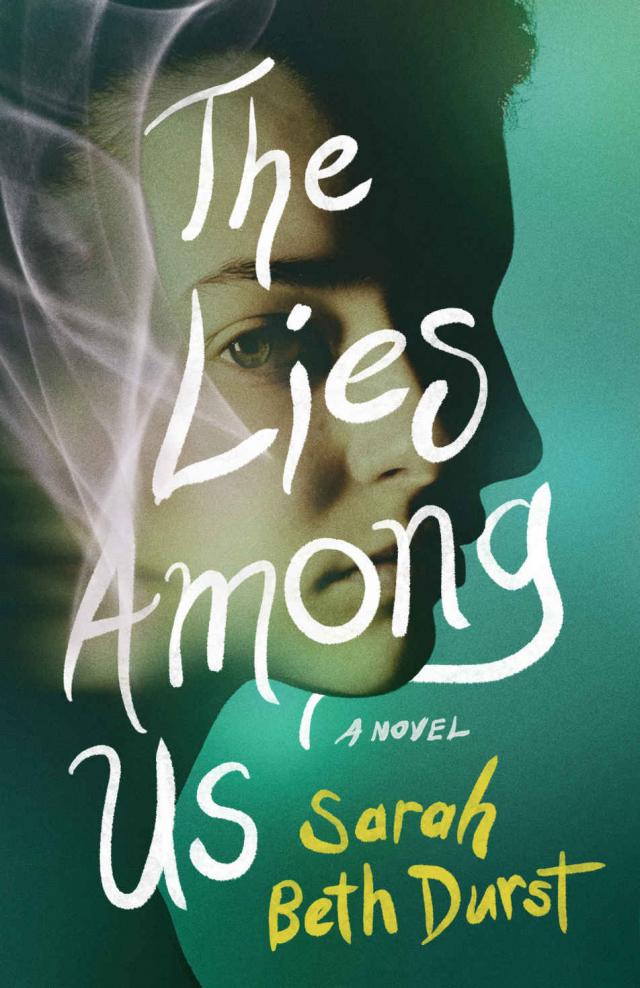
The lies among us, p.1
The Lies Among Us, page 1


OTHER TITLES BY SARAH BETH DURST
Books for Adults
The Bone Maker
Race the Sands
The Deepest Blue
The Queen of Blood: Book One of the Queens of Renthia
The Reluctant Queen: Book Two of the Queens of Renthia
The Queen of Sorrow: Book Three of the Queens of Renthia
The Lost
Books for Teens
The Lake House
Fire and Heist
Drink, Slay, Love
Chasing Power
Conjured
Vessel
Enchanted Ivy
Ice
Books for Kids
The Shelterlings
Even and Odd
Catalyst
Spark
The Stone Girl’s Story
Journey Across the Hidden Islands
The Girl Who Could Not Dream
Out of the Wild
Into the Wild
This is a work of fiction. Names, characters, organizations, places, events, and incidents are either products of the author’s imagination or are used fictitiously. Otherwise, any resemblance to actual persons, living or dead, is purely coincidental.
Text copyright © 2024 by Sarah Beth Durst
All rights reserved.
No part of this book may be reproduced, or stored in a retrieval system, or transmitted in any form or by any means, electronic, mechanical, photocopying, recording, or otherwise, without express written permission of the publisher.
Published by Lake Union Publishing, Seattle
www.apub.com
Amazon, the Amazon logo, and Lake Union Publishing are trademarks of Amazon.com, Inc., or its affiliates.
ISBN-13: 9781662514722 (paperback)
ISBN-13: 9781662514715 (digital)
Cover design by Faceout Studio, Tim Green
Cover images: © Rubberball/Mike Kemp / Getty; © suteishi / Getty; © Trinette Reed / Stocksy United
For Amy Johnson
CONTENTS
CHAPTER ONE
CHAPTER TWO
CHAPTER THREE
CHAPTER FOUR
CHAPTER FIVE
CHAPTER SIX
CHAPTER SEVEN
CHAPTER EIGHT
CHAPTER NINE
CHAPTER TEN
CHAPTER ELEVEN
CHAPTER TWELVE
CHAPTER THIRTEEN
CHAPTER FOURTEEN
CHAPTER FIFTEEN
CHAPTER SIXTEEN
CHAPTER SEVENTEEN
CHAPTER EIGHTEEN
CHAPTER NINETEEN
CHAPTER TWENTY
CHAPTER TWENTY-ONE
CHAPTER TWENTY-TWO
CHAPTER TWENTY-THREE
CHAPTER TWENTY-FOUR
CHAPTER TWENTY-FIVE
CHAPTER TWENTY-SIX
CHAPTER TWENTY-SEVEN
CHAPTER TWENTY-EIGHT
CHAPTER TWENTY-NINE
CHAPTER THIRTY
CHAPTER THIRTY-ONE
CHAPTER THIRTY-TWO
CHAPTER THIRTY-THREE
CHAPTER THIRTY-FOUR
CHAPTER THIRTY-FIVE
CHAPTER THIRTY-SIX
CHAPTER THIRTY-SEVEN
CHAPTER THIRTY-EIGHT
CHAPTER THIRTY-NINE
CHAPTER FORTY
ACKNOWLEDGMENTS
ABOUT THE AUTHOR
CHAPTER ONE
It’s quiet inside my mother’s casket. Also, dark. And it smells of wood and the thick, cloying gardenia perfume she always used to like. I think they doused her body in it to disguise the odor of the chemicals they used to embalm her. Or maybe they knew she would have liked to wear her favorite scent, even now.
It’s not wide enough for me to lie fully beside Mother, but I am doing the best I can, pressed against the crepe-covered wall of the casket. Her right arm is beneath me, and it almost feels as if she has her arm around me. Almost, but not quite. There’s no warmth from her body. Or softness. She feels no different from the fabric or the wood that surrounds me. As close as I am to her, I have never felt farther away.
“You weren’t supposed to leave me,” I tell her. “I never left you.”
Even when Dad left us, even when Leah went off to college, I didn’t leave Mother’s side, and now that she’s dead . . . I don’t know how to be anywhere else.
I don’t want to be anywhere else. Even though I know she isn’t truly beside me, that her body is just a body without her to fill it with breath and life, and even though I know I won’t hear her voice again, reverberating through the house as she sings off key to the radio, that I won’t see her eyes crinkle in the corners as she squints to read, that I won’t hear her footfalls, her coughs, her sighs—the thousand little signs that say she’s near and alive and with me—I don’t want to leave her side.
That’s why I climbed into her casket after the funeral home employees completed their work with the formaldehyde, the wax, and the cosmetics. And that’s why I stayed through the service, through the ride in the hearse, through the unloading and the positioning of the casket on the winch at her grave site.
I don’t know what else to do.
Except to stay.
It occurs to me that I don’t have to leave Mother if I don’t want to. It’s the kind of thought that’s backed by so much truth that it shoots through me like a jolt of electricity. It’s not as if there’s anyone who will try to stop me. All I need to do is remain here when they lower the casket into the ground, and eventually . . . this will all be over.
It will be soon, I think. My sister and her boyfriend, as well as all our mother’s friends and acquaintances, will wend their way from the funeral home to the graveside service any minute now. I listen for the rumble of a car—and there it is, followed by a door slam, then a beep, which repeats as others arrive. Somber and muffled voices approach the grave.
“I’m so sorry for your loss.” A woman. I don’t recognize her voice.
“Thank you.” I do recognize hers. My sister, Leah.
She’s loud, which means she must be close to the casket. I hear her greet the mourners and, in a stilted tone that barely sounds like her, thank them for coming.
I recognize her boyfriend’s voice too. Jamie. He’s quieter. “Are you okay?”
She met him in a coffee shop a year ago, she told Mother, and they just clicked. Actual story: she met him in a bar, slept with him, intending a one-night stand, and he stuck around. Mother thinks—thought, I correct myself—he has too many piercings but nice manners. I have no opinion of him whatsoever.
“If one more person says that Mom was a wonderful woman, I will shiv them.” Leah’s voice is low, but I hear it. She raises it to say, “Thank you so much for coming.”
“Your mother . . . was complicated,” Jamie says.
“She wasn’t complicated; she was a liar.”
I suck in air so hard it sounds like a hiss. Touching Mother’s hand, I am grateful that at least she can’t hear Leah. Mother’s hand feels like it’s made of pliant plastic, but my fingers leave no dent.
“What I meant,” Jamie says, “is that it’s okay if you have complicated feelings today.”
“There’s nothing complex about my feelings,” Leah says. “I’m relieved, I’m angry, and I’m tired. I just want this over and done with.” Louder: “Mrs. Harrington, very kind of you to come.”
“Oh, my dear, I’m so sorry for your loss.”
There’s the sound of shuffling feet, and Leah’s muffled reply.
“I was hoping to meet your sister, Hannah, today,” Mrs. Harrington says. “Your mother always spoke so fondly of both her daughters. She was so proud of you girls. Please share my condolences with her.”
It’s an unexpected touch of kindness, especially since I never particularly liked her. One of our newer neighbors, she often received Mother’s mail, due to a similarity in house numbers, and would bring it over, always opened—by mistake, she’d say—then she’d comment on the size of the credit card bill, with copious amounts of unwanted advice. But now I warm toward her, and for an instant, the pain that I’ve been feeling since Mother died recedes like a wave pulling back from the shore.
“I don’t have a sister, but thank you,” Leah says.
And the grief floods back. I know she feels that way, but it still hurts to hear.
“Oh! Yes, of course. Your mother said you and your sister were estranged, but I thought at least today of all days, she’d be here. You need family around you in times of grief and sorrow. My apologies.”
“That’s not . . . You know what? Never mind.”
“Your mother was a wonderful woman. She will be sorely missed.”
There’s a pause, and I wish the lid were open so I could see Leah’s expression. I don’t think she’d attack Mrs. Harrington, but with Leah, one never knows. “She certainly made an impression on everyone she knew,” Leah says. “She won’t be forgotten.”
For Leah, that’s diplomatic.
Leah has always been difficult—Mother’s word. As a toddler, her favorite phrase was I do myself! Later, as a teenager, she used to slam her bedroom door when she didn’t get her way. One morning while Leah was at school, Mother unscrewed the hinges and removed it. She installed a shower curtain instead. Leah moved out for two weeks after that, living with her friends’ families. She even tried to reach out to Dad and only moved back in when that failed. As soon as it was time for college, she was gone. Now, nine years later, she only visits for the obligatory holidays, and she always comes with complaints.
The more she pulled away, the more I wanted to stay.
I only half listen as whoever Leah hired to lead the service mumbles through platitudes and reads passages that have nothing to do with who Mother was or what she would have wanted. Mother would have preferred that everyone meet at an ice cream store, order half-gallon tubs of every flavor, and share them while swapping increasingly outrageous stories about her life.
Like the time she backpacked through Europe on her own.
Or the time she drank the US Olympic swim team under the table.
Or the time she climbed halfway up the fake Eiffel Tower in Las Vegas before security chased her off.
Or the time she hiked with friends into the Grand Canyon, got separated, and was lost for three days but survived because she was carrying all the trail mix. She never ate trail mix again.
All her best adventures were from before Leah and I were born. She gave up her “wild ways” for us, she said, and had no regrets. “You never want to live with regrets,” she liked to say, but still, she talked about those days often. Only Leah complained about the inconsistencies in her stories. And Dad, of course. But I loved all her tall tales without reservation. I wish I could hear them one more time.
“You were eleven years old, and you missed the bus,” I tell her body. “So you ‘borrowed’ your neighbor’s motorbike. You knew how to ride a bike, and you’d watched your father ride the lawn mower, so you thought, How difficult could it be?” She rode it right past the school and didn’t stop until it was out of gas.
Outside, the service is concluding, and the casket jerks like an elevator descending. I hear the purr of a motor as Mother’s casket is lowered into the grave. Above, I hear the stream of condolences beginning again. So sorry. Much sympathy. Condolences. And the worst: “She’s gone to a better place.”
This is not that “better place.”
I don’t know if a better place exists, but I know she’s not here, in this box with its fake-silk fabric and mahogany walls. I can’t follow where she has gone.
Above me, I hear the plunk of dirt on wood. Someone has thrown the first shovelful of soil on the casket. Another plunk, then another. I think of Leah and wonder whether hers was the first or whether hers will be the last.
One last splatter of dirt, then voices, then silence. The service is over, and the cemetery workers will wait until all the mourners have left before they use the backhoe to fill in the rest of her grave. And I can’t help but feel like this is futile, being here where Mother isn’t. She won’t know if I stay until I fade into nothingness; she’s already gone.
Everyone else has said goodbye, and that means it’s my turn.
“I would have stayed by your side for always,” I say to Mother.
She does not—cannot—answer.
Carefully but deliberately, I push myself up through the lid of the casket, melting through the wood as if it weren’t there. It feels less substantial than mist on my skin. Listening to the cars drive off through the cemetery, I climb out of my mother’s grave and beach myself on the trimmed grass beside her family’s gravestone.
I expect to be alone, but when I sit up, I see that Leah and Jamie remain. Their backs are to the open grave, and Jamie has his arm around my sister’s shoulders. He’s speaking softly, murmuring in her ear, and I wish that someone would reassure me or at least tell me what to do now, where to go, who to be.
Crossing behind them, I hear Leah say, “Worst part: She can’t ever change now. Can’t get better. Be better. I’m not mourning her, you know? I am mourning the mother I didn’t have, the one she should have been and now can’t ever be.”
“Makes perfect sense.” He kisses her head through her hair. “Go easy on yourself. It’ll be rough for a while, and that’s okay. That’s how it works.”
“Strange to think I’m alone now,” Leah says. “I don’t even have one crappy, slightly problematic uncle or an annoying cousin with lousy hygiene. I’ve got no one.”
He wraps his arms fully around her. “Hey, don’t talk like that. You’re not alone.”
Behind her, I say, “You have me.”
A thought, or perhaps a hope, whispers through me: maybe this is it, the answer to where I go and what I do and how I keep from dwindling away. Mother may be gone, but Leah isn’t. I have family, and so does she.
“Leah, you have me,” I repeat.
Coming closer, I try to squeeze her arm, as if I could force her to look at me and hear what I’m saying to her. As always, my fingers do not dent her skin, no matter how hard I try to hold on. As always, she does not feel me or see me or hear me.
As always, to her—to everyone—I do not exist.
CHAPTER TWO
The blue sky feels as if it mocks me. I want a drizzle as gray as I feel, or a thunderstorm, hard and fast, that obscures everything in buckets of rain. But instead, abundant sunshine.
“It’s peaceful here,” Jamie says.
Leah snorts. “Sure. All the assholes are dead.”
Looking out across the cemetery, I see a haze that circles some of the newer stones. It was shed by mourners when they departed. It circles Mother’s as well, in wisps untouched by any wind. It’s the same cloudlike haze that encircles Leah like a shroud. I return to Mother’s grave and kneel beside her family stone. Her name has already been added, to the left of her parents’ names, beneath a carved rose:
ELEANOR RIGGS ALLEN
BELOVED MOTHER
Leah wasted no time arranging for the engraving. My finger hovers over each letter, tracing them in the air, and I wonder if she picked the word “beloved” or if she selected it from a menu of platitudes, much like she chose Mother’s Day cards: the blandest and easiest option available. Regardless of the card, Mother would always proudly display it on the mantel. After a few weeks, it went into a shoebox of similar cards inside the closet. I wonder if Leah knew she saved every single one. Probably not.
I deliberately do not look at the nearby stone that bears my name. It’s not my grave. It’s the grave of someone who could have become me if she’d lived, but didn’t.
Kindly, Jamie says, “We can stay as long as you need.”
“I need to have left twenty minutes ago.” Leah begins to walk toward the one remaining car, parked beneath a maple tree. It has duct tape around the side mirror, and rust has eaten half the back fender. I don’t think it’s her car. So far as I know, she doesn’t have one.
“Are you sure?” Jamie asks. “You haven’t . . .”
Leah halts. “Haven’t what?”
He shrugs, and it’s obvious that he’s wishing he hadn’t started that sentence. There’s an edge to her voice that cuts, and I shiver. Used to be, that kind of tone would signal the start of a screaming match between Leah and Mother. “We can leave,” Jamie says, trying to recover. “Wherever you want to go. I’ll drive.”
“No.” Leah bites off the word. “What were you going to say?”
I finish the sentence for him: “You haven’t cried.” Not the way I have, so hard that it feels like I’m crying blood and bile with the salt water. So hard it hurts instead of relieves.
He holds up his hands as if in surrender, and I can’t blame him. She looks as if any second she’ll spew shrapnel at anyone close enough. “Never mind,” he says. “I just . . . I’m here for you, whatever you need.”
She stalks toward him. “You were going to say I haven’t cried, as if it’s required. Stay strong through the service, and then weep on your boyfriend’s shoulder, and everything will be okay, because that’s how it’s all supposed to work?”
“It might help,” I say.
Jamie sighs. “I have no idea what you want me to say here.”
“I want you to not expect me to cry over the mother who made me cry every week of my childhood, who embarrassed me, humiliated me, with her stories and her lies and her constant—” She flaps her arms in the air as if words have failed her the way she thinks Mother failed her. “Whatever grief I’m supposed to feel, I don’t. I feel nothing for her. Get that? Nothing. If that makes me a monster in your eyes—”
He stops her, his hands on her shoulders. She tenses. Gently, he says, “Absolutely did not say you were a monster.”
His voice is calmer than mine would have been, and I wonder if he’s seen her this way before or if it’s only today that’s special. I haven’t seen this side of her since she was a teenager under Mother’s roof. Granted, these days, she only visits rarely and briefly, so there hasn’t been much opportunity to see if she’s changed; I haven’t truly known her in years. “I’ll say it,” I say. “You’re supposed to cry at your mother’s funeral. Or at least care that it’s been months since you visited.”






