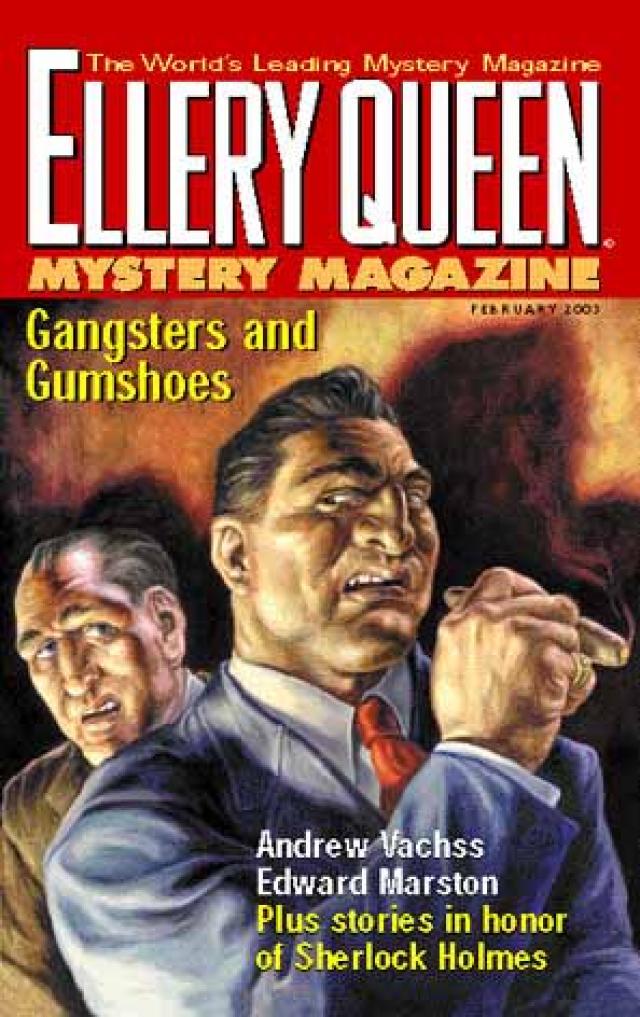
Ellery queens mystery ma.., p.1
Ellery Queen's Mystery Magazine, February 2003, page 1


* * *
Dell Magazines
www.dellmagazines.com
Copyright ©2002 Dell Magazines
* * *
NOTICE: This work is copyrighted. It is licensed only for use by the original purchaser. Making copies of this work or distributing it to any unauthorized person by any means, including without limit email, floppy disk, file transfer, paper print out, or any other method constitutes a violation of International copyright law and subjects the violator to severe fines or imprisonment.
* * *
CONTENTS
Dear Mr. Holmes by Steve Hockensmith
Totoo by William Hallstead
A Piece of the City by Andrew Vachss
The Voice of the Turtle by Neil Schofield
The Faraway Quilters by Edward D. Hoch
The Hunchback and the Stammerer by Edward Marston
The Survival of Miss Todd by Gwen Moffat
Remodeling by Kristine Kathryn Rusch
Stately Homes and the Invisible Giant by Arthur Porges
Contraband by Raymond Steiber
The Jury Box
Holmes Verse
Ellery Queen's
Mystery Magazine
February 2003
Vol. 120 No. 2
Dell Magazines
New York
Edition Copyright © 2002
by Dell Magazines,
a division of Crosstown Publications
Ellery Queen is a registered trade-
mark of the Estate of Ellery Queen
All rights reserved worldwide.
All stories in Ellery Queen's Mystery Magazine are fiction.
Any similarities are coincidental.
Ellery Queens's Mystery Magazine ISSN 1054-8122 published monthly except for a combined September/October double issue.
[Back to Table of Contents]
Janet Hutchings: Editor
Lauren Kuczala: Editorial Assistant
Carole Dixon: Production Manager
Victoria Green: Senior Art Director
June Levine: Assistant Art Director
Abigail Browning: Sub-Rights & Mktg
Scott Lais: Contracts & Permissions
Peter Kanter: Publisher & President
Bruce Sherbow: VP of Sales & Mktg
Sue Kendrioski Dir of Art & Production
Julia McEvoy: Print Advertising Sales
[Back to Table of Contents]
Ellery Queen's Mystery Magazine
Editorial Correspondence only:
475 Park Avenue South
New York, NY 10016
ElleryQueen@dellmagazines.com
Subscriptions to the print edition
One Year $33.97
Call toll free 1-800-333-3053
Or mail your order to Ellery Queen,
PO Box 54052
Boulder CO 80322-4052
[Back to Table of Contents]
Dear Mr. Holmes by Steve Hockensmith
Kicking off our yearly celebration of the birthday of Sherlock Holmes is a cowboy whodunit featuring some early fans of the great sleuth. “It was a real hoot to write, and I'm sure Big Red and Old Red haven't ridden off into the sunset for good,” says author Steve Hockensmith.
[Back to Table of Contents]
The Strand Magazine
George Newnes Ltd.
3 to 13 Southampton Street
Strand, London, England
Dear Mr. Holmes,
This is my third crack at writing this letter, and by God I'm going to get through it this time come Hell or high water. If Gabriel himself were to come down and blow on his bugle before I'm done, I'd just turn around and tell him, “Hold your horn, Gabe, I'm writing a letter to Mr. Sherlock Holmes.”
Part of my difficulty with this chore is that my book learning amounts to five years in a country school and two years clerking for a granary in Peabody, Kansas. And my brother Gustav's got four years less on the schooling and not a day wielding a clerk's pencil, yet he's trying to tell me how to write this letter.
Somehow I doubt if you're looking over that Watson fellow's shoulder when he's trying to write about you. But my brother is not a refined gentleman like yourself. So if you notice any bloodstains on the paper as you read this, you'll know he stuck his big nose in one time too many and I had to give it a good punch.
Now I've read about your way with “deductions,” so perhaps I don't need to introduce myself before I get to the nub of the matter. I can just see you taking one good whiff of this letter and saying to yourself, “This was sent by a cowboy—one who needed a good bath!” And you would be right. My name is Otto Amlingmeyer, I am what they call a “cowboy” working the Old Western Trail from Texas to Montana, and yes, I suppose I could use a good dunking—but not until I've written “And that's how it all happened, I swear on my dust-covered soul. Sincerely, O.A. Amlingmeyer.”
You being an uncommonly educated fellow and all, you surely don't put any stock in those dime novels about cowboy life. The way they tell it, your average drover spends his days fighting off fifty Comanche braves with one hand and untying a beautiful gal from the railroad tracks with the other, all the while with a lit stick of dynamite clenched in his teeth, pearl-handled six-guns in his holster, and a horse that dances the Texas two-step every time he whistles “She'll Be Coming ‘Round the Mountain.” Sure, we have plenty of adventures when we're on the trail, as long as your idea of an “adventure” is pulling a steer out of a sinkhole or throwing rocks at coyotes so they won't sneak into camp at night and eat your boots.
But on our latest cattle drive, my brother and I finally have had a genuine dime novel-type adventure. And we only lived to tell about it because of you.
“Ahhh!” I can hear you say. “At last! The point!”
You'll have to excuse me. I'm used to yarning around a campfire, where the idea is to keep your lips f lapping as long as possible so as to better distract your pals from how cold, tired, and miserable they are. If I try to write this letter that way, they'll have to cut down all the trees in Kansas just to make enough paper for me to get the job done. So I'd better just get to it.
Gustav and I first became acquainted with you and your reputation as a puzzle-breaker about three months ago. He and I had just made the trip down to Brownsville, Texas, to meet up with an old compadre of ours by the name of Charlie Higgebottom. Charlie was fixed to be caporal of a big drive—three thousand Mexican longhorns headed up through Texas, Oklahoma, Kansas, Nebraska, and Wyoming to the Blackfeet Agency up around Billings, Montana. That's as long as the Big Trail ever gets, so Charlie needed the best cow- and horsemen he could lay hands on. Charlie's been on enough drives with us to know that we can both handle cattle, so naturally he sent word that we should come along.
Now to Charlie and most of the other bull nurses we know, Gustav and I aren't “the Amlingmeyer brothers.” I guess that just doesn't slide off the tongue easy as it should. So instead we're “Big Red” and “Old Red,” or just “the Reds,” on account of our strawberry-red heads of hair. I'm Big Red for reasons a deep thinker such as yourself can surely work out. But my brother's Old Red not so much for his age (though at twenty-six he is a bit long in the tooth for a cowpuncher) as much as for his personality. Gustav's never cottoned much to japes or tomfoolery. He's a quiet fellow, always looking serious and a little down in the mouth—what you might call morose, like a dog you just kicked off the foot of your bed.
So to move along in the direction of that point I should be steering towards, maybe three days into this latest drive, when most of the hands were circled up around the fire after getting the herd bedded down for the night, Charlie pulled something out of his saddlebag and gave it to me. It was one of those story magazines, though not one I'd ever laid eyes on before.
“I've been holding on to this for eight weeks,” Charlie said. “Found it on a bench at the railroad station in San Antonio and figured it was the hand of fate. I had to hold on to it till I saw the Reds again.”
I didn't know what he was working his jaw about until I opened it up and started f lipping through the pages. About halfway through the magazine, I came across a story you know well—"The Red-Headed League.”
The title alone got a chuckle out of me. I read it out loud for Gustav (who can't tell his As from his Zs or anything in between), but he just grunted. The boys around the fire got a fine laugh from it, though, and they called out for me to read the whole story. Now along the trail I've got a reputation for oratory and poetry reciting and song singing and such, being under-blessed on modesty and powerful over-blessed on lung power. So I grabbed a lantern off the commissary and cleared my throat and gave the fellows a regular night at the theater.
Well, you'll have to tell that Dr. Watson he's a top-rail yarn spinner. The boys ate it up like it was hot donuts on Christmas morning. They were hooting and joshing me and Gustav fierce when they heard that burro milk about the locoed American tycoon giving away money to redheads. Not a one of them figured out it was just a bad man's scheme, and when you caught the rascal red-handed (so to speak) trying to dig his way into a bank, they cheered and clapped like you were right there with us doing backf lips.
Now usually the flannelmouthed whopper-swapping you'll hear around a cowboy campfire puts my brother straight to sleep. And for a minute or two I thought “The Red-Headed League” would be just another lullaby as far as he was concerned. But when I got to t
That dreamy-like look stayed on Old Red's face all the next day. And when we were gathered around the fire that night, he asked me to read the story again. Well, I rarely turn down an opportunity to practice my elocution, so I pulled out that magazine and gave it my all. As you might imagine, the fellows didn't get quite so worked up about it the second time, though they did give it a good listen. Gustav, on the other hand, was mesmerized. The next night, he asked me to read it again, but (no offense, now) the boys wouldn't stand for it. They got to stretching the blanket about ornery beeves they'd seen—a puncher by the name of Tornado Monroe even claimed a steer pulled a knife on him once—and Gustav got up and wandered away, as he will when the proceedings are not to his interest and he's not ready to sleep.
Now when you're working a herd all day long, you don't have time to work your gums at anybody who doesn't have hooves, which is why I hadn't had a chance to ask my brother why “The Red-Headed League” had him all google-eyed. So after listening to a few more whoppers from the boys, I got up and went looking for him. I found him out by the picket line, where we had our night horses hobbled. He was staring up at the black night sky like a coyote getting ready to let loose with a yodel. “They're called stars,” I said. “Don't worry—they ain't going to fall on you.”
Of course, that didn't even get a smile out of Old Red, though sometimes I can get him tickled if no one's around.
“What are you out here pondering on, old-timer?”
He just shrugged, looking kind of embarrassed.
“Now, come on, brother. You know you can unshuck your lips with me. That magazine story has got a fierce grip on your head, hasn't it?”
He nodded slowly, real thoughtful-like. “Yup, I s'pose it has,” he said, speaking just as slowly. “It's that Holmes feller—his whole way of lookin’ at things.”
“What about it?”
“Well, you know I like a man can think straight. And he seems to be the straightest thinker I ever heard of.”
“So you admire the man.”
“More than that. Hearin’ about him makes me wonder. You know ... well, you know about my schoolin'....”
Gustav got to looking all bashful again. He can be a mite prickly about his lack of letters. It's always seemed to sting him that our dear old mama had him working the fields while the younger kids got to go to school.
“I know,” I said.
“Well, the thing about it is, he don't need no book-learnin’ to do what he does. He didn't catch them bank-robbin’ snakes with some trick he learned at a university. He caught ‘em cuz he knows how to look at things—look and really see ‘em.”
I shrugged. “I guess you're right. So?”
“So, seems any man could do the same, he put his mind to it.”
Now I'm ashamed to admit I laughed when I saw what he was driving at.
“I know you're sharper than you look, big brother, but I don't think you could beat this Sherlock Holmes in any war of wits.”
Gustav gave me his best scowl—the one that makes a rabid badger look downright friendly by comparison.
“I don't aim to beat him,” he said. “I just think he's worth studyin’ on, that's all. Seems like he don't do nothin’ but sit around and cogitate and whammy—things happen. Whereas fellers like you and me and the boys back there, we never think at all, just do, and we don't get no whammy at all.”
“Cowpunchin’ ain't a thinker's game.”
“Don't I know it.”
The bitterness in his voice put a little cramp in my grin. I knew he longed for better things than riding herd on someone else's cattle. And part of the reason he couldn't get those things was because he'd always had younger brothers and sisters to look out for. Now most of them were dead or married off, and only one was left for him to nursemaid—the baby of the family, Yours Truly.
Looked at a certain way, I owed him everything I had, right down to the boots on my big feet. So who was I to poke fun?
“Tell you what, brother. Tomorrow night I'll borrow the lantern off the chuck wagon and you and I can come out here and visit with Mr. Sherlock Holmes again.”
That got me a glimpse of that rarest of prairie critters, the Gustav Amlingmeyer Smile. I went back to the fire after that. He and I had second watch that night, which meant we'd be back up on our mounts by two o'clock in the morning. I wouldn't have time for forty winks, but I could still catch me maybe eighteen if I turned in right quick. I left Gustav there by the horses, looking up at the sky like he'd never seen it before. I found him there still when I came back a few hours later.
Over the next three weeks, I read him “The Red-Headed League” a dozen more times. I finally stopped when I noticed his lips forming the words before I could speak them.
“You've got this thing memorized!” I said.
“Only the important bits.”
“Well, then, you don't need to hear ‘em anymore.”
After that, we took a little holiday from Dr. Watson's story. Truth to tell, I'd become mighty sick of it myself, fine though it is. Reading it over and over was like having steak for dinner every night. Sooner or later, a man's going to pine for a plate of beans. So for the next few weeks, there was no more talk of Sherlock Holmes—though every so often I would see Gustav's mouth working as he rode along, and at times it seemed like he couldn't keep his mind on his steers. That won my brother some jibes from the other fellows, who joshed him that he was going soft in the head in his old age. I knew what he was thinking on, of course, but I kept that to myself.
By this point we'd crossed the Red River and were deep into Indian territory. Now, no matter what you may read over there in England, we don't have big Indian wars like we used to. That was all ironed out not too long after Custer and his boys got themselves turned into pincushions. But cowboys have still got to watch their backsides on Indian land—especially when there's Comanches and Kiowas on the prowl. They might not steal many scalps these days, but they do surely love to steal cattle.
Charlie Higgebottom doubled up the night watch the day we got across the Red River, so there were four of us out under the moon at all times while the rest of the outfit slept. Now “the rest of the outfit” amounted to just eight men, not counting Charlie and our cook, Greasy Pete Tregaskis. We weren't overstocked for hands, since delivering beeves to an Indian agency, as we were doing, is not the most profitable drive a fellow can undertake. So we were all of us a little droopy in the saddle, overworked and dying of thirst for a good night's sleep. Sometimes a nightmare would make me jump, and I'd wake to find myself on my horse, on watch.
That's just what happened this one particular night, except it wasn't any nightmare that woke me up. It was gunshots. And if that hadn't been enough to snap me out of the land of Nod, the stampede would have done just as well, for you can't go firing off a six-shooter at night without spooking the herd something fierce. When they get spooked, they run. And when they run, we have to ride after them.
The chase took hours. I spent most of that time trying not to end up something sticky on the bottom of a thousand steers’ hooves. This was only my third drive, you see, so I didn't have the stampede-breaking know-how of a Gustav or a Charlie Higgebottom. I spurred up toward the front just once, to make sure my brother wasn't already worm bait a few miles back. There he and Charlie were, riding right alongside the lead steers, trying to convince them the world wouldn't come to an end if they stopped running. That would be a difficult thing to do, I knew, since cows are second only to rocks as the dumbest things God ever created. So I left them to it, dropping back where it was safer and I could do more good, along the right f lank with a couple of the other punchers trying to keep our big herd from turning into five hundred little herds.