Synthajoy, p.1
Synthajoy, page 1


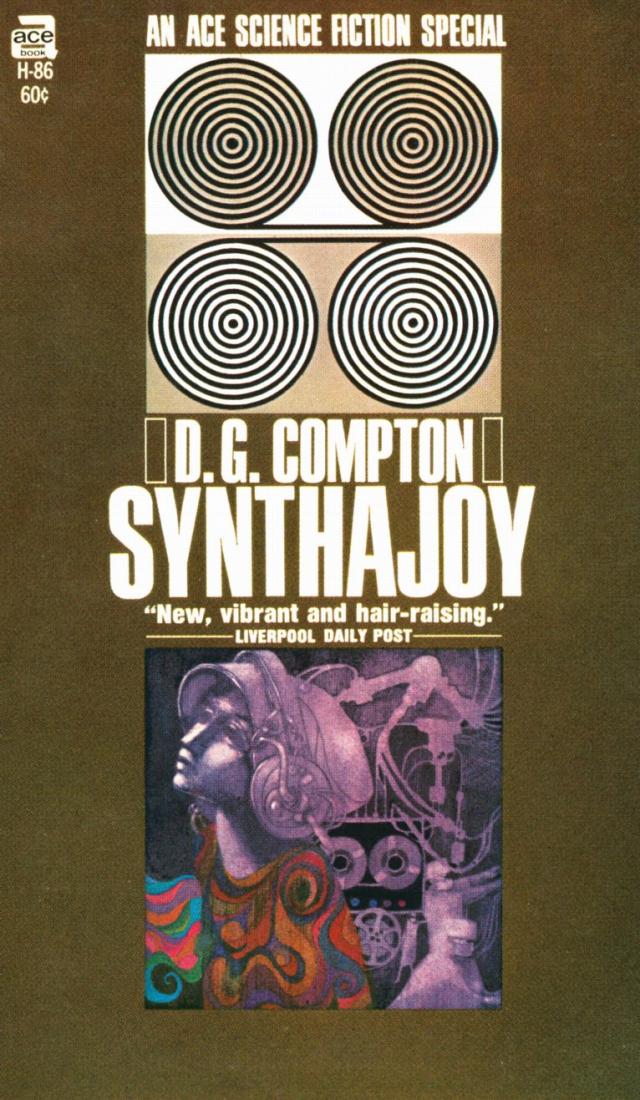
Edward Cadence was a brilliant man, and a dedicated scientist. He had invented Sensitape, a means of recording the thoughts and emotions of great musicians, religious figures, etc. so that others could experience at first-hand just what it was like to play a magnificent concerto, or to slip peacefully toward an untroubled death with the sure expectation that Heaven lies waiting. And he had added Sexitape, whereby people whose sex lives weren’t completely satisfying could experience everything that the most compatible couple in the world felt together.
For all this he was given the Nobel Prize, became enormously wealthy and famous.
But finally he set to work on the ultimate application of his experiments: SYNTHAJOY. And when the enormity of this dehumanizing process became clear, he was murdered.
Here is a novel of the day after tomorrow that will grip your imagination from start to finish and that will make you think.
D. G. COMPTON was born in London in 1930; both his parents were in the theatre, and he was brought up by his grandmother. After eighteen months’ National Service, he tried a variety of jobs—as a stage manager, salesman, dock worker, shop display manager, jobbing builder—then he gave up working in order to write full-time.
He is married, with children, and lives in Devon, England. His hobbies are music, sailing and vintage cars. Mr. Compton is the author of several radio, stage and television plays, and of three previous science fiction novels. SYNTHAJOY is his first novel to be published in the United States.
SYNTHAJOY
D.G. COMPTON
ACE BOOKS, INC.
1120 Avenue of the Americas
New York, N.Y. 10036
synthajoy
Copyright, ©, 1968 by D.G. Compton
An Ace Book, by arrangement with the author.
All Rights Reserved
Printed in U.S.A.
DAY 25
Mrs. Craig has just asked me yet again to remember that she is a nurse, and to address her as such. I wonder if it is simply small-minded for me to persist in calling her my wardress.
We returned from today’s tape therapy five minutes ago. She evidently imagines that she has to lead me everywhere, as if I were either very old or an idiot. Unless it’s simply that she’s so foolish she obeys the letter of her training even with patients who would be much better helped by the spirit. Now she’s helping me tidy my room. As I watch her I know that I’m right to call her my wardress. No woman who wasn’t a wardress would want to make the folds of a curtain as regular as corrugated iron. She’s doing it now, tugging at the hems one after another…She tears off lavatory paper in just the same way—a neat sharp tweak that separates it straight along the perforated edge. The pieces of paper Mrs. Craig offers me, folded in two, are as neat and as sharp as envelopes. We know a lot about each other’s habits, she and I: I am her charge and she is my wardress
She tidies my room really so well and so quickly that there’s nothing left for me to do at all. It’s the same with all of my life now—either from a lack of imagination or a malicious need to destroy me, she’s taken over my every department. I find myself left without will or energy. Doctor would say this is a result of my personality breakup, that it started months ago, long before I came to this place. But I know different. I know the will and the energy that I had the day before. No, on the very day that. The very day that. I know it’s the result of having Mrs. Craig for a wardress. And a wardress for Mrs. Craig. That’s not a silly thing to say—Mrs. Craigs are essential to most of us, but they don’t have to be so noticeably wardress.
She’s seen now that I’m watching her in the plastic mirror.
“Do you like your hair hanging all over your face, Mrs. Cadence?”
That’s her way of pretending that she wants me to make a decision for myself. I don’t answer.
“It’s the way Doctor puts on the headset, Mrs. Cadence. It upsets all your good work. And it really isn’t necessary, not with these new units. I’ll speak to him about it.”
Her ideas of how to flatter me into doing things are quite childish. I may be in her charge, but that doesn’t make me either paranoid or halfwitted.
“There are things about this place that have to be resisted, Mrs. C.” Don’t call me that. “I don’t agree with every aspect of your treatment. I shall speak to Doctor again about having you moved into a ward. This single room is doing you no good. No good at all.”
She goes to the door. What she doesn’t know—though she must really—is that dignity and self-respect can be entirely interior and that I intend to hang on to these whatever may be done to me. To her I must look like just another sulking psychotic.
“I think you’re wrong, Mrs. Craig.” I don’t know why I’m bothering, why I’m calling her Mrs. Craig even. “Surely the reason for my being here is so that I may come to terms with myself and what I have done? I doubt if I’d get on with that half as well in the friendly atmosphere of a ward.”
I wish I hadn’t chosen my words so carefully, hadn’t wanted so badly to show her.
“It’s not that I like being alone in here. It’s just that I believe it’s good for me. And so did the judge.”
I don’t hear her reply. Now that her hand’s on the doorknob I’m soon going to be left alone again. I shake my hair back from my face and look at myself in the mirror. I try to see from my reflection’s eyes what my reflection is thinking. Nothing shows.
“The tapes should be doing that for you, Mrs. Cadence.
For the rest of the time you’d find you were helped by a more normal social life.”
“But haven’t you read reports of the trial?” Allowing a note of hysteria. Not able to keep it out. “All about how I hate Sensitape? Can’t you see how much more valuable my salvation would be if I arrived at it on my own?”
“Some diseases are hard to cure by an act of the mind alone, Mrs. Cadence.”
“The past isn’t a disease, Mrs. Craig. To talk of curing it is ridiculous.”
I can’t read her eyes either. With subtle people one seldom can.
’The past doesn’t exist, Mrs. Cadence. Only our different ideas of it.”
Not a bad exit line. And afterward the door is neither more shut nor less. Which I say to myself by way of reassurance since it seems in fact to be more shut than any other door I’ve ever seen. And in my mind, because of the guilt which is there—what guilt, what particular guilt is this?—the door shuts unfairly, separating off past happiness, leaving on my side of it only past sorrow.
There are other concepts of time, Wardress. Sometimes it is seen as a fixed landscape through which we move, so that the past and the future all exist at once…She does everything knowingly; why has she decided to try to take the past away from me? All the past, that is, before the murder. She’s not likely to be doubting the reality of that. The eyes in the plastic mirror tell me nothing. Indeed, they feed back into my own, canceling thought. I go to the door and, because I am calm and sensible, I open it. The corridor is pleasant, carefully domestic. They got the scale right.
Oh my darling.
I remember how slow the bus was all the way along from the Tottenham Court Road. The trees hiding all but the highest roofs of the zoo and a distant giraffe, I sat on the top of the bus and watched their pale, tiny leaves, so out of place in the seasonless city. If spring belonged anywhere it was in the crocus shop windows, and in the women’s clothes. A sour thought, from present cynicism. At the time the leaves were young and delicate, the sky was cloudless, and I was three bus stops away from Tony.
“Thea. Thea, my dear…My little love—”
I’d jumped from the bus while it was still moving, nearly broken my ankle, run between the amiable people and hung myself up around his neck. Nobody minded how ridiculous it was, me at thirty-one still like a schoolgirl, nobody on the whole pavement. Baker Street was golden. We moved on another plane, and everyone who saw us.
“Were going to the park,” Tony said. “I’ve brought you a present.”
It was silly. It was a tin opener and a tin of frankfurter sausages.
The buildings were so clear that afternoon, so tall, so exquisitely detailed. I stopped Tony in front of a blank shop window, trying to see in his reflection the ordinariness other people must see. The reflection was even more marvelous than the reality. He was easier than usual. He took off his hat to it. Then we walked on. A side road gave us a glimpse of a cobbled mews and expensive houses with window boxes. There were daffodils, and some kind of blue flowers, and a cheerful car in front with a spotted perspex roof. The bricks of the house were earth red, the cobbles brown. None of it was real. As we watched a man in a green fake baize apron came out with a watering can and began to water the ground floor window boxes. He disturbed a cat from one and she moved onto the top of the car. Only we saw all this, and it was ours. We went toward the park, humbled.
We held hands.
“Theary, Theary, I have a Theary and I love my Theary.”
I didn’t ask him what his theory was. It would have involved some comic mathematical formula and would have reminded us of his work. So silk thin was our happiness.
“In fact,” he said, “my love is entirely Thearetical.”
His name was Tony Stech (not quite English, you see) and he regarded puns as the apostles must have regarded the tongues of flame.
At the crossing there wasn’t a car in sight. The road stretched as clear as a triumphal route right along to Lancaster Gate. We went over the road and into the park. I wish I could remember what we said to each other—there was nothing capable of b
Tony found us a bench by the canal, sat me down and opened the tin of sausages. He fed them to me, shiny little things that tasted of salt and herbs and not much else. But they snapped satisfactorily and between us we ate the whole tin. I can experience their feel even now, and the feel of the bench against my back, and the feel of the sharp unlit air that was different from any other day’s, and the feel of being with Tony and in him and a part of him. The frankfurter sausages of that particular day too—no other food has ever been so deeply involved in the totality of experience. The totality of experience, jargon words, worked to death by Edward in his Sensitape handouts—but everything he said and did had been a Sensitape handout, had been for seven years—but even so I know of no other. We lived inside out, our souls and our senses indissoluble. This is probably what being in love means. This is probably what made it possible for us to be happy.
Houses showed, cream-painted and regular, through the trees, fine rich houses with fine blank windows. In my mind they were unattainable—also undesirable—though through Edward’s money, Sensitape money, I could easily have encompassed any one of them. While I was with Tony neither the past, nor the real present, nor the future existed. Doctor is wrong. If my personality ever disintegrated it was then, more than a year ago. More recent months have in fact seen a coming together.
Tony poured the saline solution that had contained the sausages onto the grass, and threw the tin into a litter basket. He insisted that I keep the tin opener. He said he was giving me the key to his heart, so for the sake of his joke I tried to put it down the front of my dress. In the end it went into my handbag. He had the sense of humor of a much uglier man.
We did usual things. They were there to be done, each one a personal magic. Mostly we walked. Walked. Lovers do walk. There were birds to be fed, and the pointless race up over the bridge and down the other side which Tony won, and my silly shoes to be laughed at, and the page of newspaper that we picked up and read for omens, and buttoned children who thought we were mad because we were not sane, and the final slope of damp bald grass not to be minded as we lay on it and got our breaths back and watched the sky through the tiny leaves (why is it always spring in fairy stories?), and didn’t need to kiss or make love at all.
At four o’clock Tony took me to a caf6 for tea. Time was running out, had been from the moment I got off the bus. The place laid on a special tea for men out with other men’s wives, weak, with dry yellow scones and a dusty slab of cake. The men never noticed and the wives were too polite to. But it was quiet, and respectable, with a spinning wheel in one comer and a respectability that was catching. It helped us back into the necessary constraint. I had to be in Richmond by six, when Edward’s first private patient arrived. The constraint worked so well that I remember Tony asked me when he’d see me again. Memory safe now and not able to hurt, I remember my answer and what followed.
“At the conference tomorrow morning,” I said. “Had you forgotten?”
“No, I meant see you.” Poor Tony, he was embarrassed. “See you alone.”
“What’s the conference going to be about?” I said, not answering him.
“Hasn’t Edward told you?”
This was the important conversation. This was the one that could be remembered.
“A new process, he told me. And he gave me a list of the important people attending.”
“And he didn’t say what the process was?”
He hadn’t told me because I hadn’t wanted to be told. I’d had more than enough of new processes. Now Tony would tell me if I didn’t stop him, and then it would be time for my train out to Richmond. I gathered together my gloves and my handbag. My face could wait for later, for the cold summing-up on the train home. Already we were running out of isolation.
“Actually he did tell me. I suppose I tried to forget.”
Tony, so distant, didn’t see my lie. He put his hand across the table and onto mine, a gesture as much a part of the Spinning Wheel as its red gingham curtains or the genuine beam.
“You don’t approve,” he said.
“What’s the use, Tony? You don’t stop technical progress by not approving of it.”
There will be medical advantages, you know. With Synthajoy we’ll be able to analyze deficiences in—”
“Dont go on, Tony.” Aching. Bleak. “You show the whole thing up so.”
“Show it up?”
I couldn’t bear him pretending he didn’t understand. I took my hand away, began to put my gloves on. Fine black leather, hand-stitched. Possessions were mattering a lot by then—they were all Edward gave me.
“We’re a part of the entertainment industry now, Tony. We’d better face it.”
“That’s not true. You oversimpilfy, Thea. Edward’s clinic does very fine work.”
“And the Governor’s Wife? Does she do very fine work?”
“You do what you can. The clinic is the one decent bit of Sensitape left. Without you it wouldn’t function.”
“The clinic is a face-saver.”
I knew I wasn’t being fair, not fair in the way I was blaming Tony. To stand up to Edward would have needed an equivalent ruthlessness. And even then, it wasn’t Edward who needed standing up to, but twenty million Sensitape users. That sort of strength would have made Tony different, a fanatic, a man whom I could never, warned by Edward, have loved.
“Leave it, shall we, Tony? It’s not worth quarreling about. We’re all caught up in the same thing—you should tell me not to be so bloody self-righteous.”
“Years ago—three years ago—when you were showing me the Richmond house for the first time, I told you then what was going to happen. Do you remember?”
“I prefer to remember that afternoon for something else you told me.”
“It does worry me, Thea. It worries me sick.”
“Tony—stay in your laboratory. Edward’s shoulders are broad enough for all of us.”
I stood up. He helped me into my coat. The dishonesty of what I had just said closed the subject, closed almost any subject. Otherwise he’d have told me again about the tigers and crocodiles, and the cage it was my responsibility to build against them. I’ve always thought it a nonsense, this in the world but separate from it, but I loved Tony far too much ever to argue.
Loved him too much…This love then, does it make morality irrelevant? Does body take over, and soul, leaving conscience safely tucked away in the mind? I don’t like to think of my knowledge of right and wrong being situated entirely in my mind. It’s my mind that Doctor treats each afternoon with guilt—yet he doesn’t reach me, not the part of me capable of love. Love deeper than conscience? I know what Pastor Mannheim would have said. The trouble is, I don’t know how he would have justified it.
The corridor has a carpet—I chose a lot here in the Kingston; did I choose that carpet?—and a comfortable unstylish cupboard with a vase of flowers on it. Have the daffodils come from a hothouse or do they mean that outside it’s spring? The Superintendent seems capable of knowing the importance of truth in such a matter. I can’t tell from the few times I have met him how he would use that importance, though. The cupboard is slim against the wall so that nothing interrupts the full width of the carpet: it spoils the domestic effect, this clearway for trolleys. Still, the attempt is appreciated. Peace of mind, however evilly used, is a welcome gift. In the Kingston we give in almost without noticing. Dungeons and thumbscrews, while easier to fight, would be infinitely worse.